Building Thermal Imaging Surveys: Why the Season Decides the Result
Every summer we take calls from people wanting a thermal survey of their building, and every summer the answer is the same: wait. Not because we are busy, and not because the equipment struggles in warm weather. Because there is nothing to photograph.
A thermal camera does not see insulation. It sees temperature difference. If the inside of a building and the outside sit at broadly the same temperature, heat is not moving through the fabric in any useful quantity, and a wall with no insulation looks much like a wall with plenty. The image is not wrong. It is empty.
That one fact governs when this work can be done, how the results should be read, and what a report is worth afterwards. It is also why a survey booked at the wrong time of year is worse than no survey at all. A survey in July does not fail loudly. It produces a clean-looking set of images and a confident-sounding report that quietly found nothing, because there was nothing there to find, and the building is then assumed sound on the strength of it.
The rest of this piece sets out what the camera is actually measuring, the temperature differential the standard asks for, why the usable season in the United Kingdom is shorter than the calendar suggests, and what makes one night worth flying and the next one worthless.
Blog Content TL;DR...
When a building thermal survey works, when it does not, and what the standard asks for.
- A thermal camera reads temperature difference, not insulation. With no heat flowing through the fabric, an uninsulated wall and a well insulated one look much the same.
- EN 13187 recommends a minimum differential of around 10°C. Below that, the patterns worth finding are lost in ordinary surface variation.
- In the United Kingdom that means roughly October to March, and a mild winter day can still fall short of it.
- The survey happens well after sunset, because masonry and render release stored solar energy for hours and a sunlit elevation reads warm whatever is behind it.
- Wind, rain and heavy cloud all flatten the result. Still, dry, clear nights produce imagery a surveyor can act on.
Book the season, not the week. The nights that give the cleanest imagery are the ones that go first.
Why We Tell People to Wait Until October
A camera that reads temperature difference needs a temperature difference to read
What the camera is actually measuring
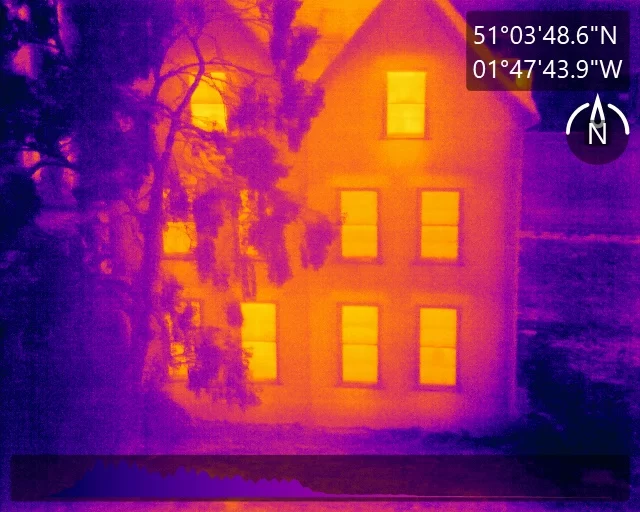
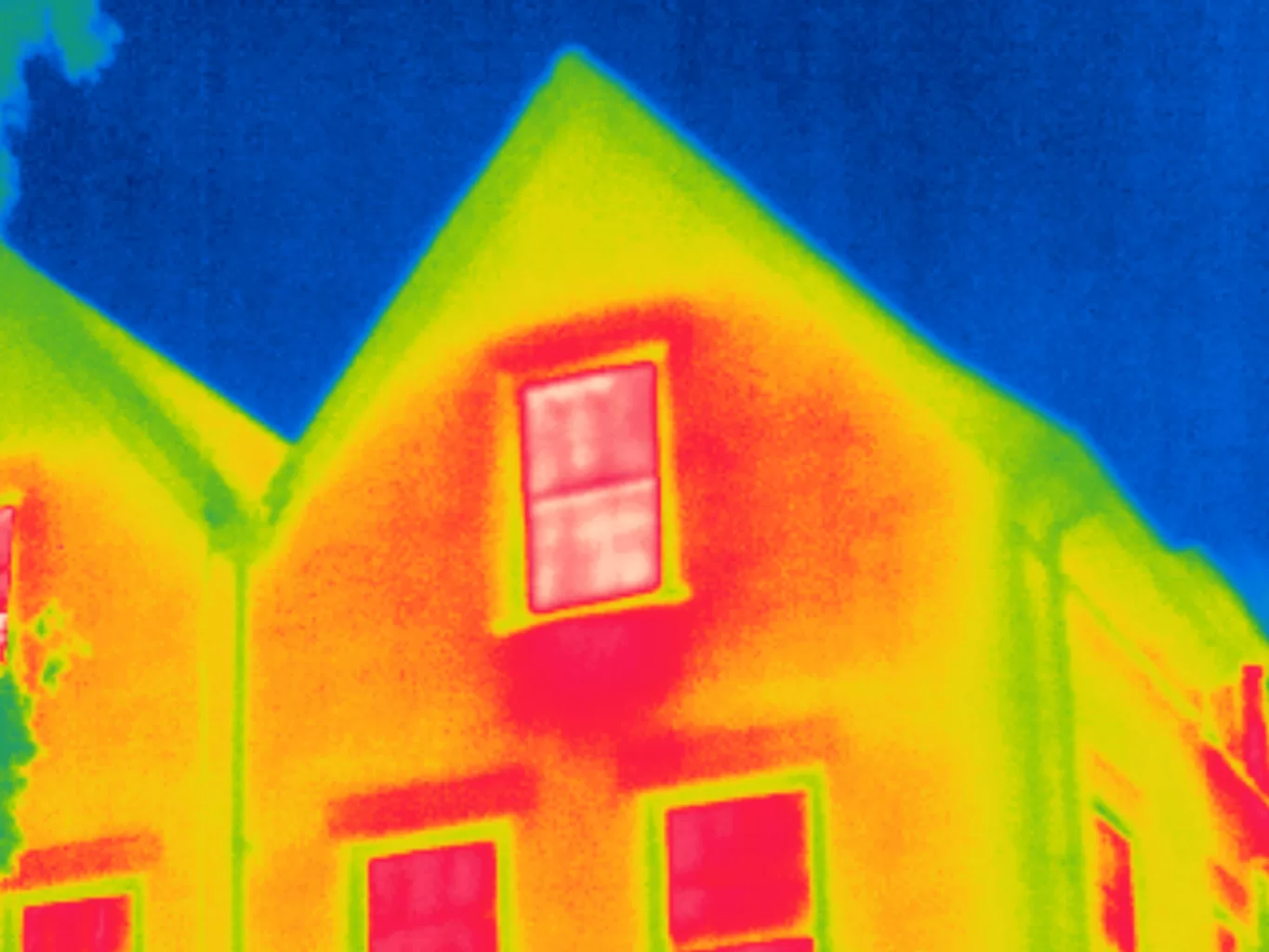
Heat has to be flowing before it can be measured. In practice that means the building is heated, the outside is cold, and the difference between the two is large enough to drive a detectable signal through the wall. What the camera records is the surface temperature of the fabric, and what makes that useful is the pattern: a cold bridge reads differently from the wall around it, a gap in insulation reads differently from the insulation either side of it, and warm air escaping around a poorly sealed opening reads differently again.
None of those patterns exist without a differential. They are not faint in summer, they are absent, because the mechanism that produces them has stopped.
The number that decides it
EN 13187 recommends a minimum temperature differential of around 10°C between inside and outside. Below it, the patterns that reveal missing insulation, thermal bridging and air leakage are too faint to separate reliably from ordinary variation in a surface, and ordinary variation is considerable: different materials, different exposures, moisture, staining, old repairs.
Above it, the same defects become obvious, resolving into clear readable shapes rather than into noise a report has to argue about. The larger the differential, the cleaner that separation gets, which is why a hard frost makes a better survey night than a mild one. Where the differential sits close to the minimum, the limitation belongs in the report rather than buried, because it changes how confidently the findings can be read.
when to do a building thermal survey, EN 13187 temperature differential, thermal imaging survey season UKwhen to do a building thermal survey, EN 13187 temperature differential, thermal imaging survey season UK
What the Camera Is Actually Measuring
Why the season is shorter than the calendar
In the United Kingdom the usable window runs broadly from October to March. That is a consequence rather than a rule: the survey needs a cold enough night, and outside the heating season those nights do not arrive. On a mild winter day at 12°C outside and 20°C inside, the differential is already below the recommended minimum before wind, cloud or sunshine are considered at all.
So the working season is shorter than six months of calendar suggests, and the number of genuinely good nights inside it is smaller again. Cold, still and clear have to arrive together, and in a British winter they frequently do not.
What that means for booking
It makes this a job to plan rather than to react to, because the month you notice the damp patch is very often not a month in which anything useful can be photographed. Waiting for the right conditions is considerably cheaper than paying for the wrong ones.
It also means the good nights get taken early. A hard, still, clear night in January is exactly what every building survey wants, and there are not many of them. Work booked in advance gets the pick of the conditions; work booked in response to a problem gets whatever is left, and sometimes that is nothing at all until the following autumn. That is worth knowing in September rather than discovering in February, which is the main reason this piece exists at the end of August rather than in the middle of winter.
When to Survey, and What Makes a Night Usable
Why the survey happens after dark
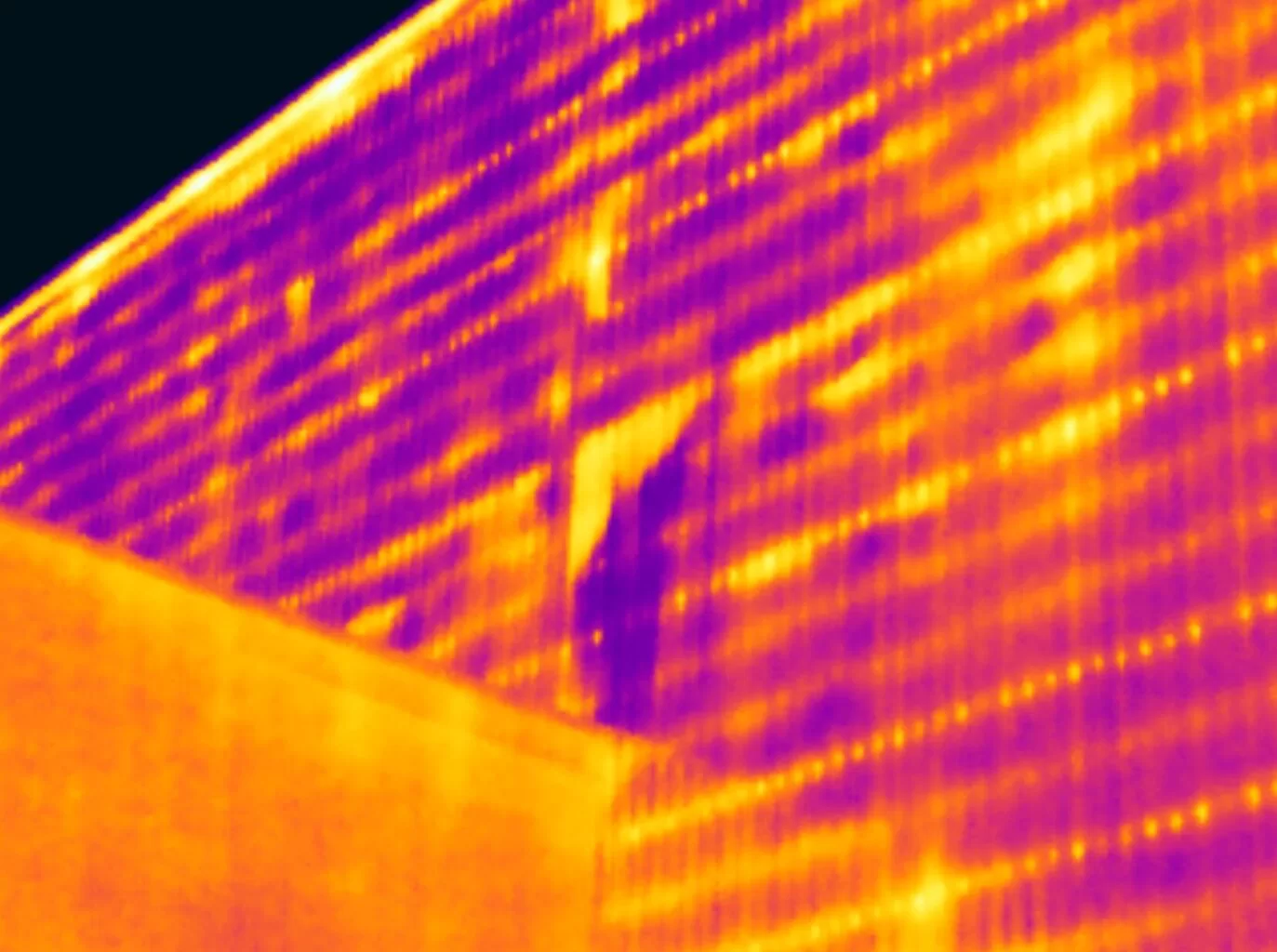
Sunshine ruins a building thermogram, and it goes on ruining it long after the sun has gone. Masonry, tile and render absorb solar energy through the day and release it for hours afterwards, so an elevation that faced the sun reads warm regardless of what sits behind it. A south wall photographed at dusk can look like a heat loss disaster and be perfectly well insulated, and a genuine defect on that same wall can be swamped entirely.
The answer is to survey once the fabric has shed that stored energy, which means well after sunset rather than at the end of the working day. On a recent high-rise block surveyed in March, imagery was captured roughly an hour and twenty-five minutes after sunset, and the difference between the solar-loaded south elevation and the radiatively cooled north elevation was still plainly visible. That contrast says something useful about the sky conditions. It is also a warning about what an earlier survey would have shown.
Wind, rain and cloud
Wind strips heat from an external surface and flattens the very differences the survey exists to find. A still night is worth waiting for, and a windy one is worth cancelling.
Rain and surface moisture do the same by evaporative cooling. A wet wall photographs as uniformly cold whatever its condition, and a wall drying unevenly photographs as a defect that is not there.
Heavy cloud reduces radiative cooling to the sky and softens contrast across the whole elevation. Clear skies sharpen it.
What gets recorded, and why it matters later
Air temperature inside and out, the differential, wind, sky state and the time relative to sunset are all recorded as part of the survey. That is what lets anyone reading the report months later judge how much weight the findings carry, and see where the survey was working at the edge of what the method supports rather than comfortably inside it. A report that states a differential of 10 to 13°C and says openly that this sits at the lower end of the recommendation can be relied on. One that stays quiet about conditions has to be taken on trust.
Differential. EN 13187 recommends a minimum of about 10°C between internal and external air temperature. A differential of 10 to 13°C sits at the lower end of that recommendation and the limitation should be stated in the report rather than glossed over. Larger differentials give cleaner separation between sound and defective fabric.
Timing. Survey after the fabric has released its stored solar gain, which is well after sunset rather than at dusk. Where a building has a strongly solar-loaded elevation, the residual contrast between that face and a shaded one is a direct check on whether enough time has passed.
Sky and wind. Clear skies increase radiative cooling and sharpen contrast. Still air preserves the surface temperature differences the method depends on. Both are recorded at the time of survey.
Standard. This is qualitative detection of thermal irregularities under EN 13187, supported by ISO 6781-3. It identifies where the fabric is behaving differently, not how much energy is being lost. A quantified figure needs a different exercise.
Governing Standards
- EN 13187:1999 specifies the thermographic method for qualitative detection of thermal irregularities in building envelopes, and sets the recommended minimum temperature differential the survey depends on.
- ISO 6781-3 covers the detection of heat, air and moisture irregularities in buildings by infrared methods, and informs how the imagery is interpreted.
- This is qualitative detection, not measurement of energy loss. A thermographic survey identifies where the fabric is behaving differently. It does not produce a quantified heat loss figure, and findings are reported as observations warranting further investigation by a suitably qualified contractor.
- Survey, analysis and reporting are conducted by Steve Fisher, ITC Level III Certified Master Thermographer (Infrared Training Centre; Certification #205722059), practising in accordance with the frameworks of ISO 18436-7:2014, ASNT SNT-TC-1A and ANSI/ASNT CP-105, and BINDT CMGEN Appendix B as UK training governance.
Plan the Survey for the Right Night
If you are thinking about a heat loss survey, the season starting now is the one to use. Tell us the building, roughly what has prompted it, and whether anyone has looked before, and we will come back with a fixed price and the conditions we would want on the night.
Booking early matters more on this work than on most. The usable window is short, it depends on weather nobody controls, and the nights that produce the best imagery are the ones that get taken first.
related posts

Air leakage is only visible to a thermal camera when something is pushing air through the building fabric. Stack effect, wind and mechanical ventilation each create that pressure difference, each acts differently on different elevations, and each can disappear during a survey. This piece explains what drives air through a building envelope, why leakage appears as a spreading plume rather than a hard edged patch, and where a thermal survey stops and a pressurisation test begins.
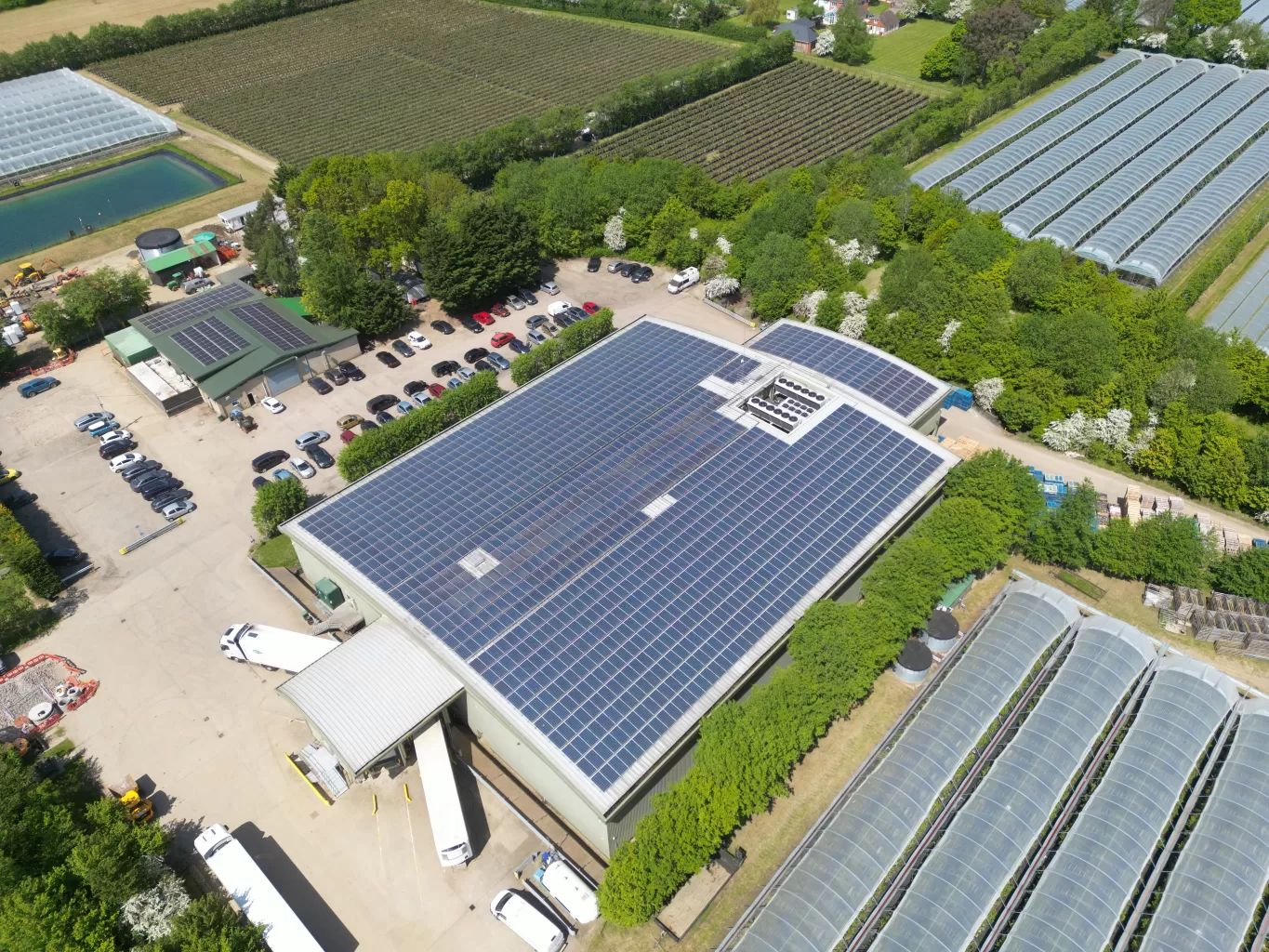
Winterwood Farms in Maidstone can rely on IEC's thermal expert solar panel inspection services to ensure optimal performance during the winter months. Our team of professionals will thoroughly assess the panels, identifying any issues that may affect efficiency. With our comprehensive inspection, Winterwood Farms can maximise energy production and minimise potential downtime.

A site owner's question is usually whether a drone is allowed. The regulations answer a different one: how far the aircraft must stay from people who are not part of the operation. That distance is not fixed. It moves with the authorisation the operator holds, the mass and class of the aircraft flown, and how the people on site are briefed. This is what actually decides whether a working site can be flown, and the small part the client plays in it.