
Post-Installation Commissioning Inspections for Solar PV
Hand It Over With the Evidence Attached
A new array is the one moment in its life when everything is known to be right, and almost nobody records it. An independent commissioning inspection captures that condition while it is still true, giving your client a baseline to measure against for the next twenty-five years and giving you a dated, third-party record that the installation left your hands in good order.
Hand It Over With the Evidence Attached
Handover is the point at which an installation stops being yours and becomes somebody else’s problem, and the quality of that transition decides a good deal of what happens afterwards. Most disputes about a solar array, months or years later, come down to a question nobody can answer: was it like that when it was installed?
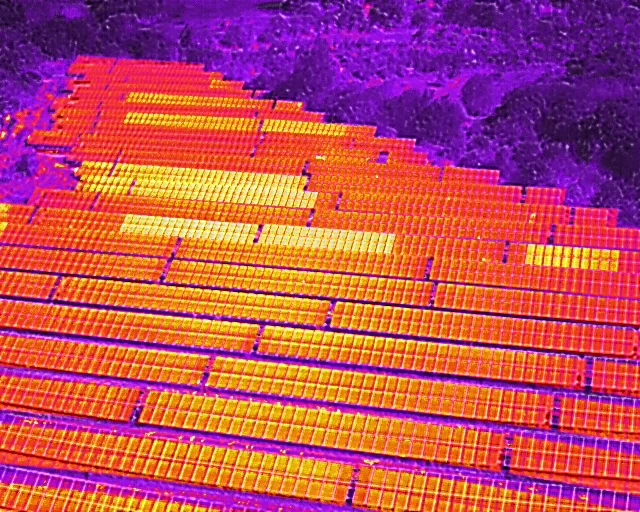
A commissioning inspection answers it in advance. The array is surveyed thermally, module by module, at the point where it should be in perfect condition, and the results are recorded and dated. If anything is wrong you find out while it is still straightforwardly somebody’s warranty rather than an argument, and if nothing is wrong you have that in writing from a party with no interest in the outcome.
Drone Media Imaging carries this out for installers and EPC contractors in line with IEC 62446-3:2017, with string-level electrical verification to IEC 62446-1 where it is wanted alongside. The analysis is by an ITC Level III Certified Master Thermographer, and the report is written to be handed straight to your client.
Why the Baseline Is Worth More Than the Findings
A survey with nothing to compare against is only half a survey
A commissioning inspection usually finds very little, and that is not an argument against doing it. It is the argument for doing it. The value is not primarily in what turns up on the day, it is in having a dated record of what a healthy array looked like on this particular site, with these particular modules, in this particular arrangement.
Thermographic analysis works by comparison. An anomaly is identified because it differs from what is normal, and “normal” is easy to establish within a single image and much harder to establish across years. When a survey four years from now finds a module running warm, the question that decides whether it matters is whether it was doing that at the start. Without a baseline, the honest answer is that nobody knows.
The same applies to patterns rather than individual faults. Gradual degradation across a whole table, a string that has always slightly underperformed its neighbours, a corner of the site that runs warmer because of how it is laid out: none of these can be distinguished from a developing fault without knowing where they started.
So the deliverable is not really a list of problems, though it contains one. It is a reference document that makes every subsequent survey more useful than it would otherwise be, and its usefulness increases the longer the array is in service.
At a glance
What a post-installation commissioning inspection gives an installer or EPC contractor at handover.
- A dated baseline for the client. The condition of every module at the one moment it should be perfect, recorded so future surveys have something to compare against.
- Problems found while they are still under warranty, and while they are still the manufacturer’s or the installer’s rather than a dispute.
- Independent of you, which is the point. A verification carried out by the party that did the installing proves less than one carried out by somebody with no stake in the answer.
- Thermal survey to IEC TS 62446-3:2017, module by module, with severity classified and every finding located.
- Optional string testing to IEC 62446-1, which is the electrical half of commissioning verification and catches the faults that produce no heat.
- Analysis by an ITC Level III Certified Master Thermographer, named in the report.
- Written to be handed on. Your client, their insurer and their future maintenance contractor can all read it without translation.
The best time to prove an array is sound is the day it is finished.
Related Solar Survey Services
What It Does for You, Not Just for the Client
A clean handover is worth having in writing
Most of the argument for commissioning inspection is made on the client’s behalf. There is a second argument that is entirely yours, and it is the reason most installers who do this keep doing it.
An installation you signed off is a liability for as long as anyone can plausibly claim something was wrong from the beginning. A dated independent survey closes that off. If a module fails in year three, the question of whether it was installed damaged has an answer, and the answer is not a matter of anyone’s word against anyone else’s. That protects a good installer far more than it exposes one, because good installations survive inspection and the record proves it.
It also finds the things that are genuinely easier to fix now. Transit damage that has not yet shown itself in generation figures, a connector that was not fully seated, a module that arrived with a cell already compromised: all of these are somebody’s warranty on the day of handover and all of them become an expensive conversation later. Finding them while the scaffolding is still up, or the site team is still on site, is worth considerably more than finding them in a maintenance survey two years on.
And it is independent, which is the part that gives it weight. A verification carried out by the party that did the installing proves less than one carried out by somebody with nothing at stake. That is not a comment on anyone’s honesty, it is simply how evidence works, and it is why we do not carry out remedial work of any kind.
IEC 62446-3 Solar Inspection Returns a Certified All-Clear
A commercial rooftop installation inspected to IEC 62446-3:2017 that returned something worth having in writing: a complete all-clear, with no thermal anomaly at any classification level across the whole array. It is the clearest illustration of why a survey that finds nothing is still worth commissioning, because the value is not only in what turns up, it is in the dated, certified record that nothing did.
Fitting It Into a Handover
The awkward part of commissioning inspection is not the survey, it is the timing. Thermal imaging of a photovoltaic array is only valid while the modules are generating strongly and their temperatures are stable, which means the work has to be done on a suitable day rather than on the day the programme says handover happens.
That is worth knowing early rather than discovering at the end of a job. We assess the window against a calibrated forecast model, so a date can be planned against likely conditions rather than booked hopefully, and a realistic view can be given of how much slack a particular week carries. On most sites the survey itself takes an hour or two, inside a window of around four hours, so it is a small imposition once the day is right.
The commissioning tests already required of you are electrical, and this does not replace them. Thermal imaging answers a question those tests do not: it looks at every module individually rather than at the circuits they sit in, and it sees a compromised cell or a poor connection that a string-level result can average away. Where the two are wanted together, string testing to IEC 62446-1 can be carried out in the same visit and reported alongside.
The report is written to leave your hands and keep working. Your client receives a document their insurer will accept, their maintenance contractor can act on, and their next surveyor can compare against, with your involvement recorded as the party who commissioned it rather than the party who marked its own homework.
- IEC TS 62446-3:2017 is the technical specification for outdoor infrared thermography of photovoltaic modules and plants, and it governs the conditions, method, competence and reporting of the thermal survey.
- IEC 62446-1:2016+A1:2018 covers electrical testing, documentation and commissioning verification for grid-connected PV systems, and governs our optional string-level testing.
- MIS 3002 is the microgeneration installation standard for solar photovoltaic systems in the UK, and is commonly the framework an installer is already working within.
- ISO 18436-7:2014 sets the international framework for thermographic condition monitoring personnel, and our analysis practice is aligned to it, alongside ASNT SNT-TC-1A and ANSI/ASNT CP-105.
- Survey conducted by Steve Fisher, ITC Level III Certified Master Thermographer (Infrared Training Centre; Certification #205722059), holding iRed Academy Thermal Imaging Category 2 and Drone Thermography Category 1.
- Flown under CAA Operational Authorisation, with GVC and A2 CofC, and fully insured for commercial operations across the UK, Ireland and Europe.
Book It Into the Programme
Tell us where the site is, roughly its size, and when you expect to be handing over. Talk to us before the programme is fixed rather than after, because the survey has to happen on a suitable day and knowing that early is worth more than knowing it late. We will scope it and come back with a fixed price. Site size and location determine cost on this work, which is why we quote rather than publish a rate card. Quotations and consultations are free, and if you commission these regularly it is worth having the conversation once rather than site by site.