Chimney and High Level Inspections
The Parts of a Building Nobody Has Looked At
Close photographic inspection of chimney stacks, gutters, parapets, dormers, finials, weathervanes and any high-level detail that is awkward to reach and easy to ignore, across Sussex, Surrey, Kent and Hampshire. A small aircraft gets in close where a tower or a platform cannot go, on tight urban sites and around listed buildings, and you get the images with the observations marked on them.
The Parts of a Building Nobody Has Looked At
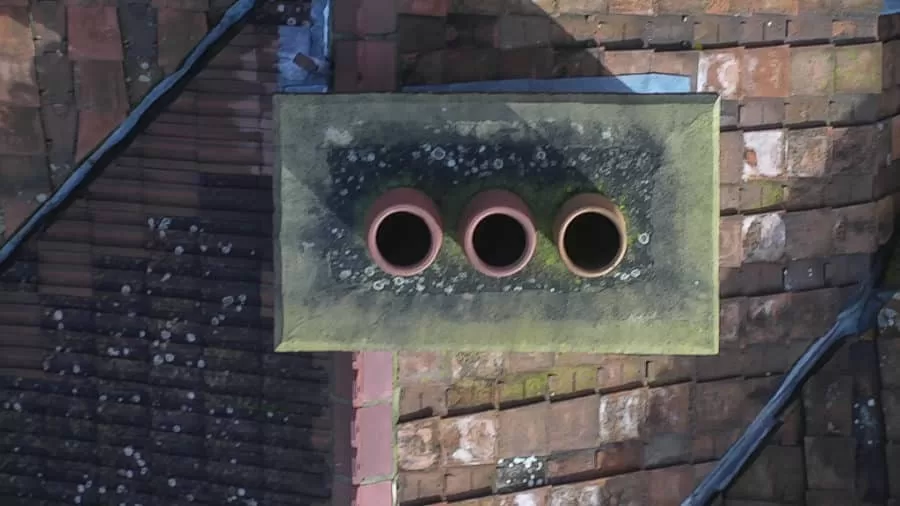
A chimney stack is the most exposed part of a building and the least examined. It takes the weather from every side, it is built of the materials most vulnerable to it, and getting a person up to look at it properly means scaffold, a tower or a rope. So it does not get looked at, and the first anybody hears of a problem is usually damp on a chimney breast or a piece of pot in the garden.
Gutters, parapets, dormers and the detail along a roofline are in the same position. Nobody is arguing they do not matter. They just cost more to reach than anyone wants to spend on a look. A small aircraft changes the arithmetic entirely, and on a tight urban site or around a listed building it will get closer to the detail than a tower ever could.
This is work suited to the older housing of the South East, and it is where a good deal of it happens: the Victorian terraces of Brighton and Hove, the period stock of Lewes, Tunbridge Wells, Chichester, Arundel, Canterbury, Winchester, Farnham and Rye, and the villages across West Sussex, Surrey and Kent where a stack is both the most vulnerable part of the building and the hardest to get a ladder to.
What a Stack Tells You Once You Can See It
Flaunching, pointing, flashings and the things that let water in
Damp on a chimney breast almost always has a cause that is visible from above, and it is usually one of a short list of things.
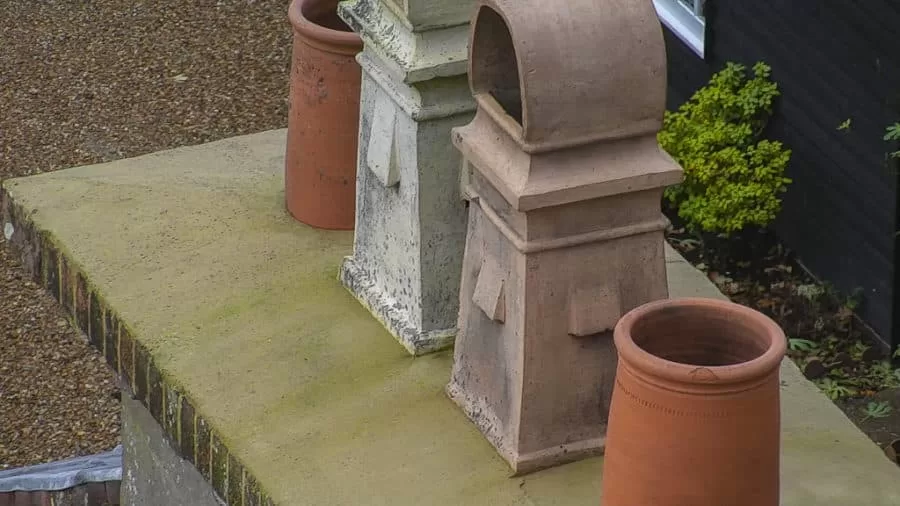
The flaunching, the mortar bed the pots sit in, cracks and lifts as it ages and lets water straight down into the stack. It is the single most common defect and it is completely invisible from the ground.
The pointing and the brickwork. A stack takes wind-driven rain on every face and dries unevenly, so it erodes faster than the wall below it. Open joints, spalled faces where frost has done the damage, and a stack that has started to lean are all obvious in a photograph taken level with them and impossible to judge from sixty feet below.
The flashings and soakers where the stack passes through the roof. Lead lifts, splits along a fold, gets displaced by a slipped tile, or was never properly dressed in the first place. This is where a great many chimney leaks actually originate, and it is a detail that has to be photographed close to be worth anything.
The pots themselves, cracked, loose in the flaunching or missing, plus whatever has grown or nested in them. On a terrace, seeing your neighbour’s stack in the same frame is frequently useful, because a shared parapet or valley is often where the argument ends up.
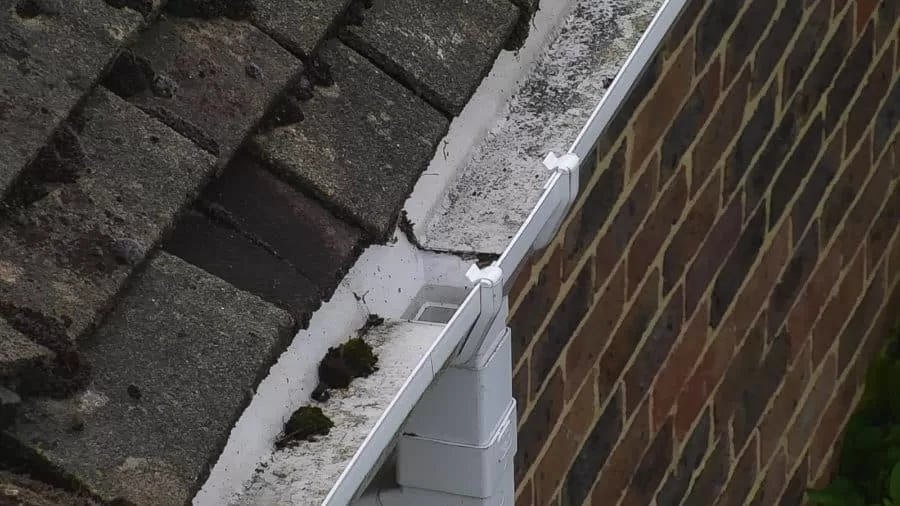
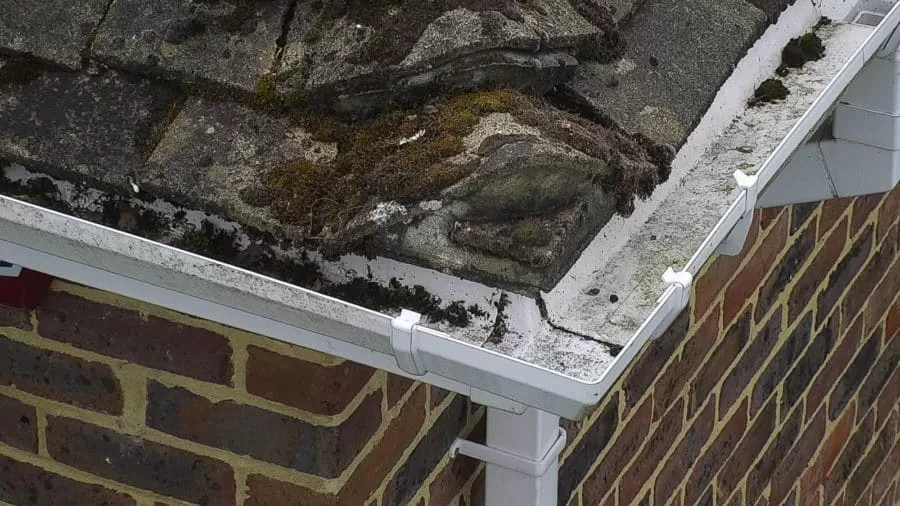
Gutters get the same treatment and are usually a five-minute addition once we are there: blockages, standing water, sagging runs, joints letting go, and brackets pulling out of a fascia that has itself started to rot.
At a glance
What high-level inspection covers, and why a small aircraft suits it better than anything on the ground.
- Across Sussex, Surrey, Kent and Hampshire, on the terraces, period property and conservation areas the South East has a great deal of.
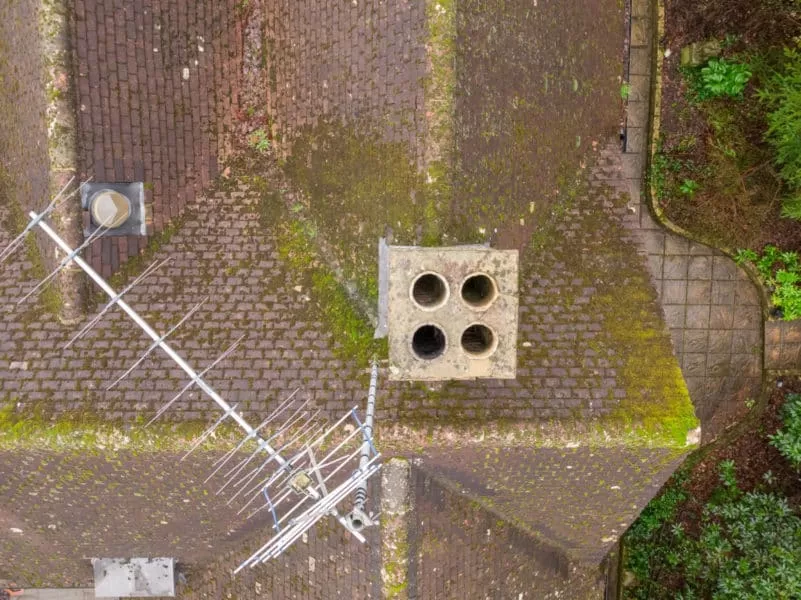
- Chimney stacks: pots, flaunching, the state of the brickwork and pointing, corbelling, lead flashings and soakers, and any lean or movement visible from above.
- Gutters and rainwater goods: whether they are blocked, sagging, holding standing water, pulling away from the fascia, or discharging down a wall instead of into a downpipe.
- Parapets, copings, dormers and rooflines, plus finials, weathervanes, ornamental stonework and anything on a listed building nobody wants a ladder anywhere near.
- Close work, on tight sites. A small aircraft operates in courtyards, alleys and gaps between buildings where a tower or a platform will not fit and could not be sited.
- No scaffold, no tower, no rope access, and nothing to book, licence or take down afterwards.
- Observations marked on the images, so a roofer or a steeplejack can quote from photographs instead of pricing a look first.
The cheapest way to find out whether a stack needs work is not to put somebody next to it.
Usually Worth Doing on the Same Visit
Why a Small Aircraft Suits This Work
Terraces, courtyards, town centres and listed buildings
High-level detail is usually in the most awkward place on the building, and awkward places are exactly where large equipment stops being an option.
A terraced house has nowhere to put a tower. The stack is in the middle of the roof, the street is at the front, and there is a small garden and a neighbour’s fence at the back. A courtyard, an alley between two buildings or a town centre frontage on a live pavement is the same problem. A small aircraft launches from a very modest footprint and works in the gap.
Nothing touches the building. On a listed building, a heritage frontage or anything with fragile stonework or ornamental detail, not putting a ladder, a tower foot or a scaffold tie anywhere near it is a considerable advantage in its own right, and it removes the consents conversation that comes with them.
It is quick enough to be worth doing on suspicion. That is the real change. A scaffold has to be justified before it goes up, so a stack gets inspected once somebody is already fairly sure there is a problem. When looking is cheap and takes an hour, you can look because the damp patch appeared last winter and nobody knows why, which is a much better time to find out.
And the aircraft is not the point. It removes the argument about how the job gets done, which leaves the only thing that actually varies: whether the photographs are any good. That is where thirty years of commercial photography earns its place, because a stack shot into a bright sky is a silhouette, and a lead flashing photographed flat looks perfect right up until it leaks.
When People Ask for This, and What It Settles
Four situations account for most of this work, and in three of them the photographs are what stops the argument.
Damp with no obvious source. Somebody has a stain on a chimney breast or a wall and two contractors have offered two different explanations. Photographs of the flaunching, the pointing and the flashings usually settle which one is right, and occasionally show that neither is.
Before committing to scaffold. Scaffold for a stack is a significant cost and it goes up before anybody knows the extent of the work. Photographing it first means the scaffold is erected once, for a defined job, and the quote is priced against something everybody can see. Where the stack turns out to be sound, the scaffold does not go up at all.
Party wall and neighbour disputes. Shared stacks, shared valleys and shared parapets generate a particular kind of disagreement, and it is almost always conducted without either party having seen the thing being argued about. Dated photographs move it onto a different footing.
Heritage and listed buildings, where the fabric is the reason for the care and any physical access is itself a risk to it. Recording ornamental detail, finials, stonework and leadwork without touching the building is frequently the only inspection that will be permitted.
What it does not do. This is a visual inspection from the outside. It does not look down a flue, does not assess whether a chimney is safe to use, does not sweep or test anything, and is not a structural opinion on whether a stack needs taking down and rebuilding. Those are jobs for a sweep, a steeplejack or a structural engineer, and the photographs are what they will work from. We do no repair work of any kind, so there is nothing on your building that is worth more to us found than not found.
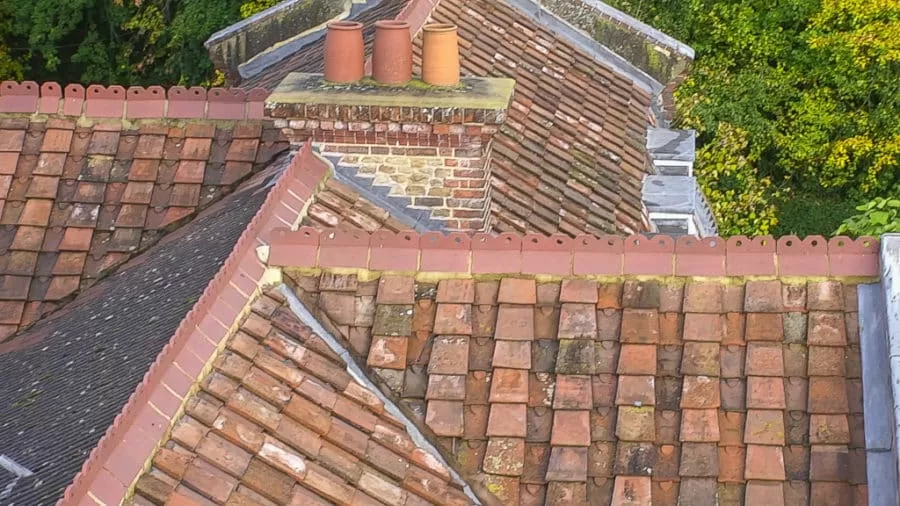
The South East has a great deal of exactly the building this service was made for. Victorian and Edwardian terraces with shared stacks, Georgian frontages in conservation areas, flint and tile-hung cottages, oast houses, and town centres where there is nowhere to stand a tower even if you were willing to pay for one.
West Sussex and East Sussex are the doorstep. Brighton and Hove, Lewes, Worthing, Chichester, Arundel, Horsham, Crawley, East Grinstead, Haywards Heath, Eastbourne, Hastings, Bexhill, Seaford and Rye, where terraces, seafront exposure and salt air between them account for a lot of failed flaunching and lifted lead.
Surrey covers Guildford, Farnham, Godalming, Dorking, Reigate and Redhill, Epsom, Leatherhead and Woking. Kent takes in Tunbridge Wells, Tonbridge, Sevenoaks, Canterbury, Maidstone, Ashford, Faversham, Whitstable and the Medway towns. Hampshire reaches Winchester, Petersfield, Alton, Romsey, Southampton, Portsmouth, Fareham, Havant and Basingstoke.
Listed buildings and conservation areas are routine rather than exceptional here, and they are the clearest case for photographing rather than climbing. Where the fabric is the reason for the care, not putting a ladder foot, a tower base or a scaffold tie against it is an advantage in itself, and it usually removes a consents conversation as well.
Being close by matters on this work more than on most. A stack inspection is a short job, so a long journey to reach it stops making sense quickly. Within these counties it is a straightforward booking. Beyond them, ask, and we will give you a straight answer.
- This is a visual inspection service. Drone Media Imaging photographs what is visible and describes what the photographs show. No building survey, structural assessment, condition grading or professional opinion on the condition of a chimney or structure is offered or implied, and no surveying qualification is held or claimed.
- No assessment is made of a flue, of whether a chimney is safe to use, or of whether a stack requires rebuilding. Those are matters for a suitably qualified sweep, steeplejack or structural engineer.
- Flight operations are conducted under a Civil Aviation Authority Operational Authorisation, with a General VLOS Certificate (GVC) and an A2 Certificate of Competency, and are fully insured for commercial operation.
- Drone Media Imaging carries out no repair, roofing, masonry or maintenance work of any kind, and has no commercial interest in what an inspection does or does not find.
Tell Us Which Stack, and What Made You Look
Damp on a chimney breast, a quote for scaffold you want checked first, a neighbour dispute over a shared stack, or a listed building where nobody wants a ladder against the stonework. Send us the address and what has prompted it, and we will come back with a fixed price. If a contractor has already quoted for the work, say so, because photographing it before the scaffold goes up is usually the cheaper order to do things in.
A stack in Brighton, Hove, Lewes, Tunbridge Wells, Chichester, Guildford, Canterbury or Winchester is home ground, as is anywhere else across Sussex, Surrey, Kent and Hampshire. Terraces and town centres are the normal case rather than the difficult one, so the tight site is rarely the problem it sounds like.