

Air Leakage and Air Pressure in Buildings
Air does not leak out of a building because there is a hole in it. It leaks because something is pushing or pulling it, and a hole happens to be in the way. That distinction sounds pedantic until a survey is booked on a still, mild evening and finds nothing at joints that are demonstrably leaky in January.
Air leakage is a pressure story before it is a temperature story. A thermal camera cannot see air and it cannot see pressure. What it sees is the warm surface left behind when heated air travels through a gap in the fabric and washes across the material on the other side. No pressure difference means no travelling air, which means no thermal evidence, whatever the real state of the building.
This is why air leakage work is timed rather than simply scheduled, and why the environmental conditions are recorded per elevation and per flight rather than noted once at the gate. It is also why the shape of what appears in the image matters as much as its temperature. What follows sets out what drives air through a building envelope, what that looks like in a thermogram, and where a thermal survey stops and a pressurisation test begins.
Blog Content TL;DR...
Why air leakage is a pressure problem before it is a temperature problem, and what that means for when a survey is worth flying.
- Air needs a driver. Stack effect, wind and mechanical ventilation create the pressure difference. Without one, there is nothing for the camera to see.
- Elevations differ. One face can be pushing air out whilst the opposite face pulls cold air in, so conditions are recorded per elevation and per flight.
- Shape is the evidence. Leakage spreads and fades as a plume. Conduction follows the construction and has edges.
- Wind is both cause and spoiler. Too much air movement strips the plume off the surface before it can be resolved.
- Location, not quantity. Thermography finds where air crosses the envelope. A pressurisation test measures how much.
Book the survey for the conditions, not for the diary.
What Actually Moves Air Through a Building
Three drivers, and not one of them holds still
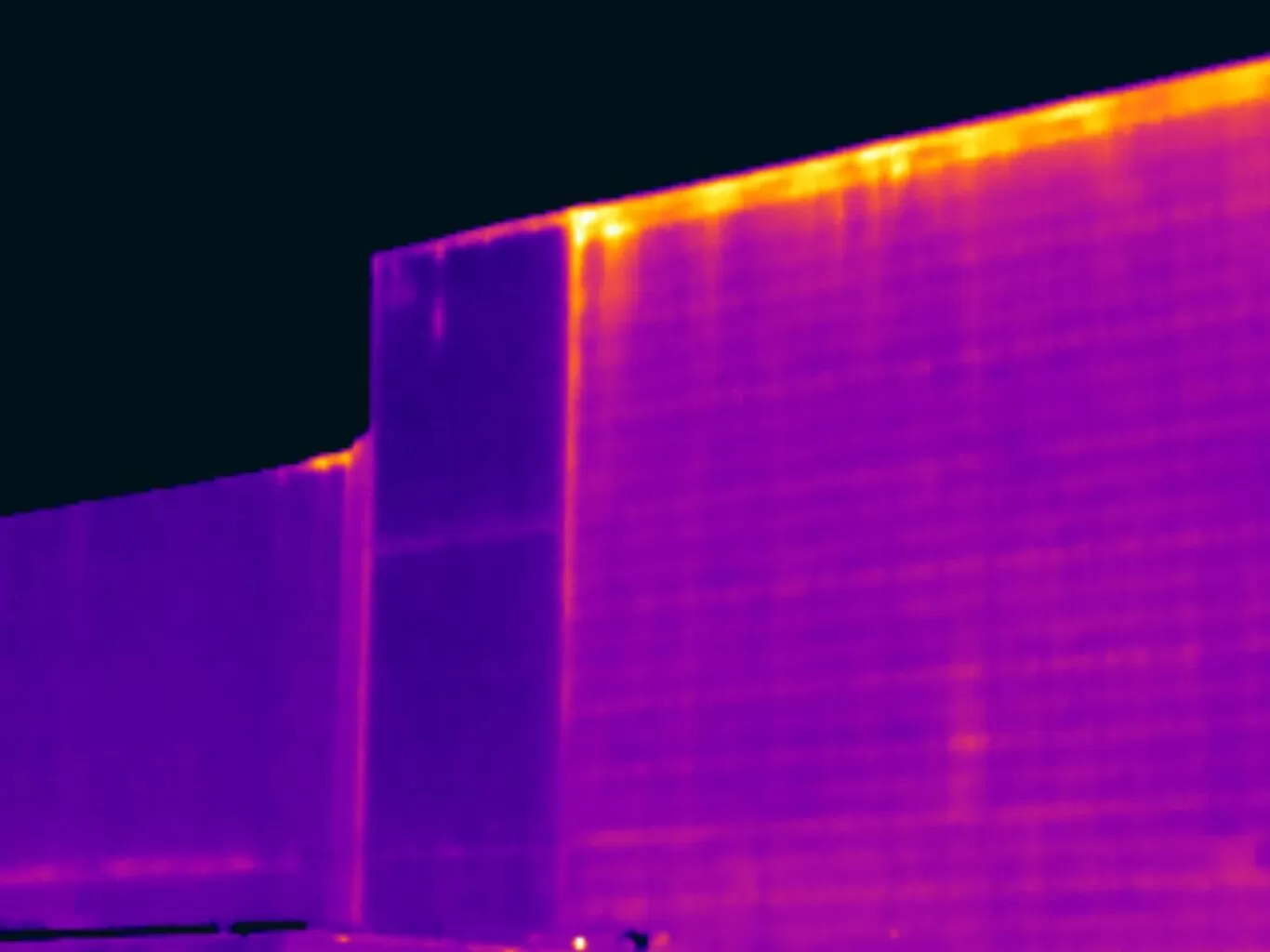
Stack effect
Warm air inside a heated building is less dense than the cold air outside it, so it rises. That rise draws air in low down and pushes it out high up, and somewhere between the two sits a level where the pressure inside and outside is equal. Below that level the building is pulling air in, above it the building is pushing air out. The colder it is outside, and the taller the building, the stronger the effect becomes, which is why a tall block in midwinter is the easiest case and a low building on a mild evening the hardest.
Wind
Wind presses on the elevation it strikes and drags air away from the faces it passes and the one behind. One side of the same building can be pushing air out through its junctions whilst the opposite side is pulling cold air in through identical ones. This is why a leakage finding on one elevation says nothing reliable about the elevation on the far side, and why wind speed and direction are recorded before every flight rather than once at the start of the night.
Mechanical ventilation
Extract fans, air handling plant and unbalanced supply and extract systems impose their own regime on top of the other two, and unlike the other two they can switch on and off during a survey. A building running under mild negative pressure will draw outside air through every gap in the fabric it has. The same building an hour later, with the plant idle, may show very little at the same joints.
None of the three is a fault. They are the conditions that make a leak visible, and knowing which one is acting is the difference between a finding and a guess.
finding air leaks with thermal imaging, why air leakage shows as a plume, pressure difference across a building envelopefinding air leaks with thermal imaging, why air leakage shows as a plume, pressure difference across a building envelope
Reading the Evidence, and When It Is Readable
A plume, not an edge
Heat conducted through a solid surface produces a pattern that follows the construction, and it has edges. A slab edge reads as a line, a missing insulation board as a rectangle, a lintel as a bar. Air escaping through a joint behaves completely differently, because the warm air itself is doing the travelling. It spreads across the surface downstream of the opening, fades as it mixes with the outside air, and takes a shape governed by the flow rather than by the building. That difference in shape is the primary evidence that air movement, rather than conduction, is what is being seen. It is also why a leakage observation is stronger when the same joint is imaged more than once, since a plume that shifts with the conditions is behaving like moving air, whilst a patch that stays put is behaving like fabric.
Wind gives, and wind takes away
The same wind that creates the pressure difference also destroys the evidence of it. A moving air stream across an elevation strips escaping warm air off the surface before it can spread far enough to be resolved, and it cools the fabric unevenly, which flattens the contrast the survey depends on. There is a narrow band of conditions in which the pressure difference is strong enough to drive air through the envelope and the air movement outside is calm enough to leave the plume in place. Outside that band the survey is stood down rather than flown and caveated, which is the standing discipline across drone thermography work generally.
Timing, then, is not an administrative detail. It decides whether a leak is present in the data at all, and no amount of analysis afterwards recovers a plume that was never captured.
What the Survey Settles, and What It Does Not
Location, not quantity
A thermal survey shows where air is crossing the envelope, which is genuinely hard to establish any other way on a large or tall building. It does not say how much air, in total, is crossing it. That figure comes from a pressurisation test, which puts the whole building under a known pressure difference and measures the flow needed to hold it. The two answer different questions and they pair well, because the pressure test quantifies without locating and the thermal survey locates without quantifying. A building can pass a pressurisation test on its overall figure and still carry a serious concentration of leakage at one junction, and it is the concentration, not the total, that a repair is aimed at. Ordering one when the question needed the other is the most common way this work gets wasted.
What lands in the report
Each observation is placed on its elevation, described in terms of what the pattern shows, and graded so the findings can be worked through in a sensible order rather than read as an undifferentiated list. The conditions under which it was captured are recorded alongside it, because a leakage observation without its wind and pressure context cannot be defended or repeated later. Where the evidence supports one cause it is stated, and where two remain possible the report says so rather than choosing the more impressive.
Findings are areas warranting further investigation by a suitably qualified contractor. Air leakage is rarely the only thing worth knowing about an envelope, and it is usually surveyed alongside insulation and thermal bridging as part of a building heat loss survey.
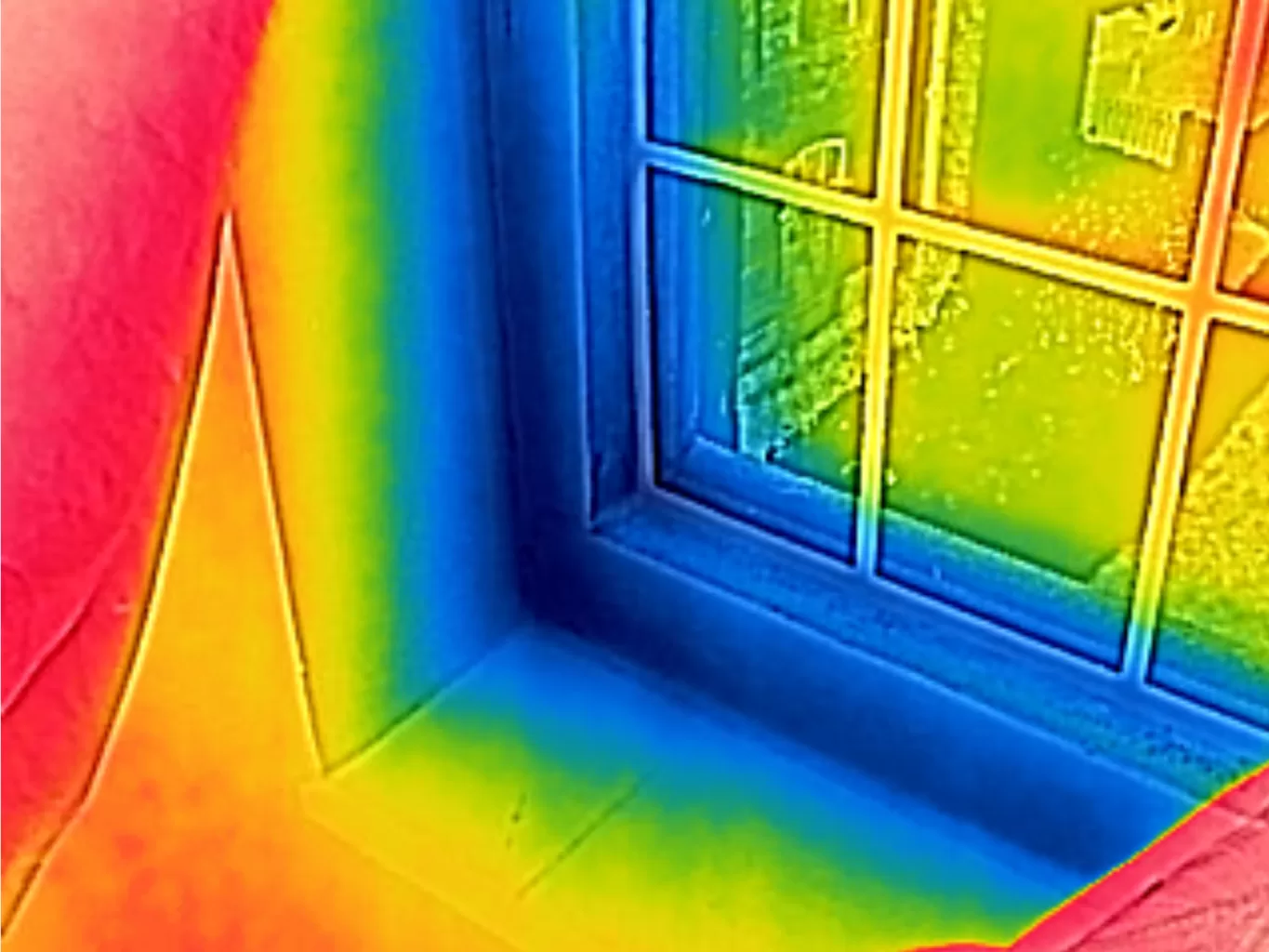
Building envelope thermography is qualitative work, aligned in methodology with EN 13187:1999, which covers the detection of thermal irregularities in building envelopes. It identifies and locates anomalies. It does not produce a rate of heat transfer, and no thermal camera produces a U-value.
Object parameters are set before capture rather than corrected afterwards. Emissivity is set for the fabric in view, commonly around 0.90 for ordinary painted and rendered building surfaces. Reflected apparent temperature is established on site, either by imaging a diffuse reflector placed in the target plane or by taking a sky reading, then entered with the measured air temperature, the relative humidity and the distance to the surface.
Air temperature, relative humidity, wind speed, wind direction and cloud cover are logged at the start of each flight and against the compass orientation of the elevation being flown. Viewing geometry is held as close to perpendicular as the site allows, because a steep viewing angle changes what a surface appears to emit.
Governing Standards and Certification
- Survey, analysis and reporting conducted by Steve Fisher, ITC Level III Certified Master Thermographer (Infrared Training Centre; Certification #205722059).
- Practising in accordance with the frameworks of ISO 18436-7:2014, ASNT SNT-TC-1A and ANSI/ASNT CP-105, and BINDT CMGEN Appendix B as UK training governance.
- Methodology aligned with EN 13187:1999 for building envelopes, and with IEC 62446-3:2017 where photovoltaic assets fall within scope.
- Reflected apparent temperature determined by the recognised methods of ISO 18434-1:2008.
- Drone operations flown under the operator’s Civil Aviation Authority authorisation, with a site specific risk assessment before every flight.
Talk to Us About an Air Leakage Survey
Drone Media Imaging surveys building envelopes across Sussex, Hampshire, Kent and Surrey, travelling throughout the UK, Ireland and Europe. Tell us about the building and the question you need answered, and we will say plainly whether a thermal survey is the right tool for it.
related posts
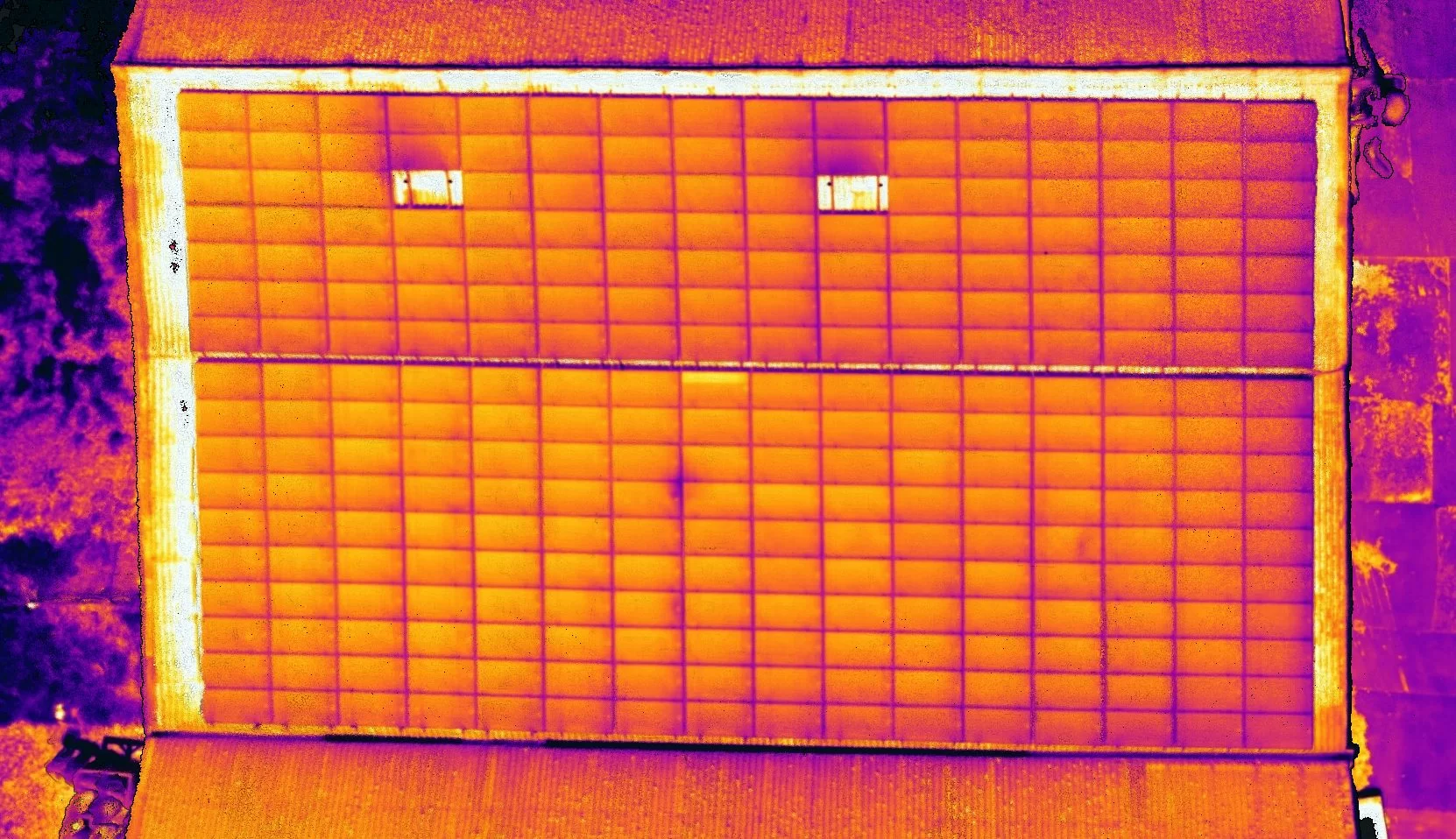
An aerial thermal survey records a temperature difference, and that difference has to exist when the image is taken. Conditions are therefore not a preference but a precondition, and different assets want opposite weather: a photovoltaic array needs bright, stable sun, a building envelope needs a cold night after dark. This piece sets out what the standards ask for, why each figure exists, and what booking against a window rather than a date means in practice.
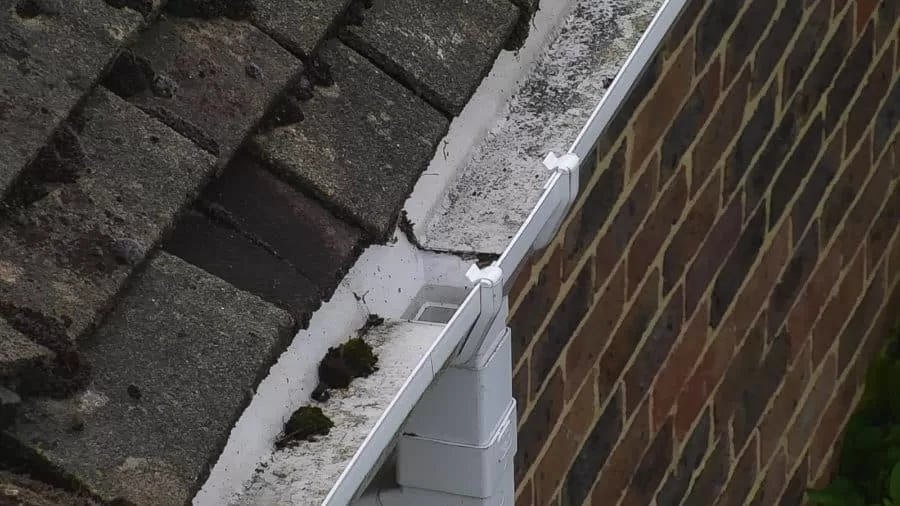
A roof moves rainwater along a designed path, from slope to valley to gutter to outlet. Autumn is when that path is loaded for the first time in months, and when anything silted, sagging or split begins to show. Almost none of it is visible from ground level. This is what an aerial inspection records about roof drainage, why standing water is such a useful signal, and how observations are marked on the imagery so a contractor can quote from them.

Conducting an IEC inspection at Trethosa, Cornwall's solar farm for Natural Generation Ltd.Drone Media Imaging examined the solar panels in line with IEC 62446-3:2017 to ensure compliance with safety standards, ensuring optimal performance and longevity of the solar farm.