
The distance question, answered from the site owner's side
Most enquiries arrive carrying the same underlying worry. There is a building, or a solar array, or a roof that needs looking at, and around it there are neighbours, a car park, a delivery yard and people who work there every day. The question the caller asks is whether a drone is allowed. The question they actually mean is whether the work can be done without disrupting the site or creating a problem they will have to manage afterwards.
The answer, almost always, is yes. What decides it is not the site itself but the distance an aircraft has to keep from people who are not part of the operation, and that distance is not a single fixed number. It changes with the authorisation the operator holds, with the mass and class of the aircraft flown, and with how the people on site are treated on the day.
None of that is the client’s problem to solve. It is settled in planning, long before anyone arrives. What is useful for a site owner to understand is roughly how the decision gets made, because it explains why a competent operator asks so many questions at the enquiry stage, and why the answer to a difficult-looking site is usually a different aircraft rather than a refusal.
Blog Content TL;DR...
What actually decides whether a working site can be flown, and the part the client plays.
- The limit is a separation distance from people who are not part of the operation. It is not a rule about your address.
- An Operational Authorisation lets an operator work close to built-up areas that the standard open category rules would put 150 metres away.
- Aircraft mass and class change the distance. A lighter class-marked aircraft flown slowly can work far closer than a heavy one.
- A person counts as involved only if they have consented, been briefed, understood it and are free to decline. A tannoy announcement does not achieve that.
- What the operator needs from you is landowner permission, access, a named contact and somebody who can brief the staff working nearby.
A difficult site usually changes the aircraft and the method, not the answer.
The Question Behind The Question
Why a site is never simply allowed or forbidden

A distance, not a permission
The rules governing drone flight in the United Kingdom are written around people rather than places. There is no register of sites that may or may not be flown, and no permission that attaches to a particular address. What the regulations set is a minimum horizontal distance between the aircraft and anyone who is not taking part in the operation, and it is that distance which has to be engineered on the day. A site becomes flyable the moment an operator can hold the applicable distance, or can lawfully reduce it.
Why the old figures still circulate
A great deal of what is still repeated about drone distances comes from the regime replaced in 2020, when commercial flying ran on a permission issued against the Air Navigation Order and one set of figures applied to everybody who held one. That is no longer how it works. Operations are now classified by risk rather than by payment, and the distance that applies depends on the framework the flight is planned under and the aircraft chosen to fly it. Two operators standing on the same site, working to the same brief, can lawfully operate at very different distances from the same group of people.
This matters commercially rather than academically. The framework and the aircraft are selected at planning, from what the job actually needs, and that single decision is what determines whether a survey can be flown from inside the car park or has to be flown from the far side of a field.
how close can a drone fly to people, drone separation distances on a working site, can my site be flown by a dronehow close can a drone fly to people, drone separation distances on a working site, can my site be flown by a drone
How The Distance Is Actually Set
The framework decides the number
Work that has to happen close to occupied buildings is normally planned one of two ways. Under a CAA Operational Authorisation, the written permission an operator holds for higher-risk work, the aircraft is kept 50 metres from uninvolved people in flight and 30 metres during take-off and landing, and it may work within 150 metres of residential, commercial, industrial and recreational areas. Under the open category’s near-people subcategory, flown with a suitably class-marked aircraft, the separation falls to 30 metres, and to 5 metres in low-speed mode. The two are never mixed inside a single flight, so the choice is made before the aircraft leaves its case.
Involved and uninvolved are not the same as present
The distances apply only to people who are not part of the operation. Somebody can properly be treated as involved, at which point the separation stops counting against them, but the test is a real one rather than a formality. They must have consented, received and understood a briefing on what to do if the aircraft behaves unexpectedly, been free to decline without penalty, and broadly understood the risk. A crowd cannot be converted by a public address announcement or a line of small print on a ticket. This is the one part of the picture a client can genuinely influence, because a handful of briefed staff can change the shape of a site entirely.
Mass and class change what is possible
The aircraft is the other variable, and since January 2026 it has been sorted by a class marking system that grades airframes by weight and capability. A sub-250 gram aircraft may fly over uninvolved people in the lightest subcategory, though never over an assembly. A class-marked aircraft in the middle bracket unlocks the reduced near-people separations. A heavier airframe carrying survey-grade sensors does neither and holds the full distance. The sensible order is to match the aircraft to the site, not to book one and then find out what it cannot reach.
What This Looks Like On A Real Site
Neighbours, yards and public access
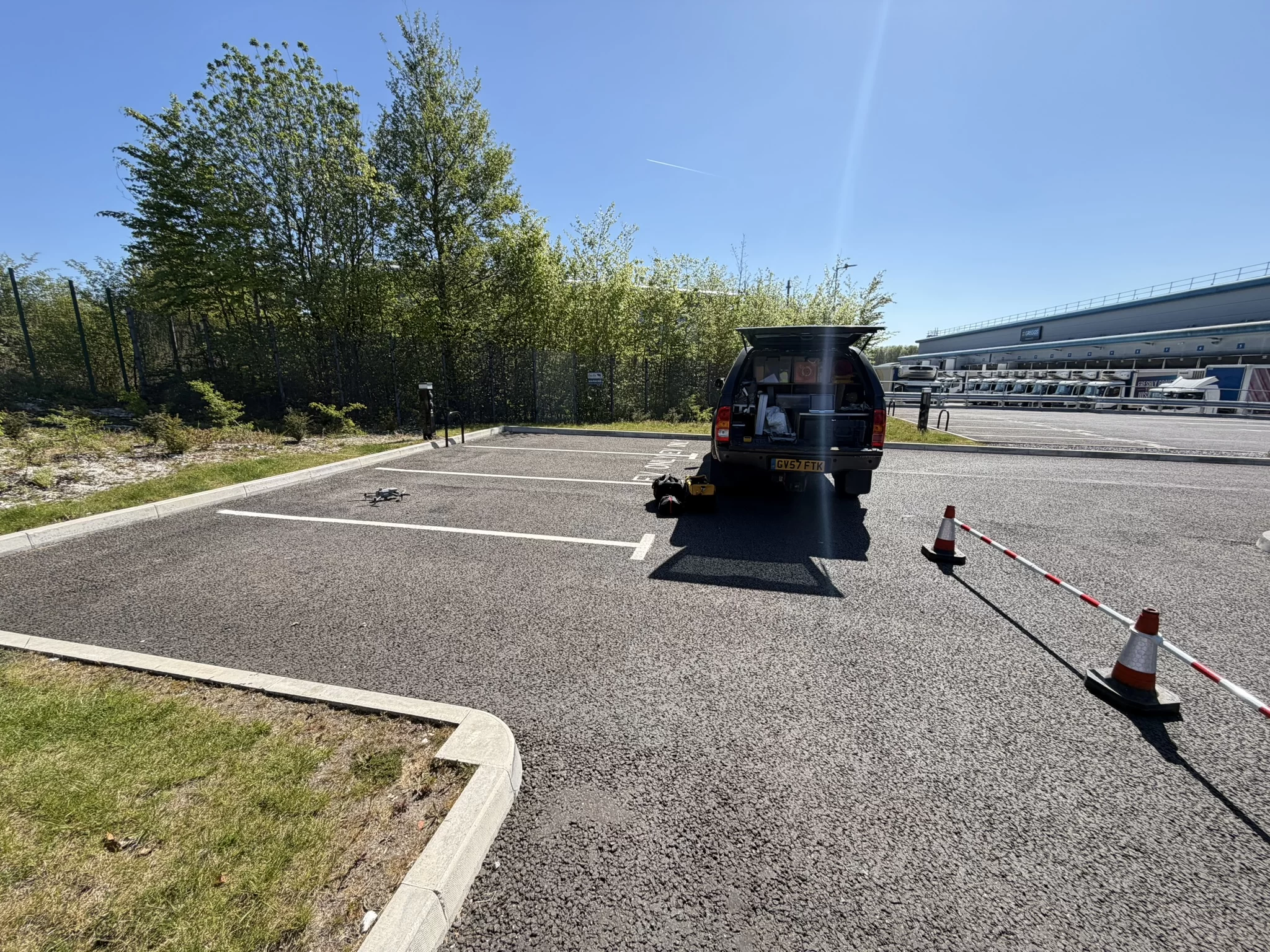
Most commercial sites are not empty. There is a car park that fills at nine, a path along one boundary, a neighbouring unit with its own staff, and a working team who need to carry on with their day. None of that stops the work. It changes the method. A fully secure site with controlled access may need nothing at all beyond the normal planning. Where people could reasonably wander in, the response is scaled to the likelihood, from signage alone, through cones and signage, to a linked physical barrier around the take-off and landing point with a crew member standing on it. The aim is to make encroachment improbable, not to shut the site down, and the scale of it is judged against what is actually likely rather than the worst case anybody can imagine.
What the operator needs from you
Very little, and all of it ordinary. Permission to take off and land from the landowner or leaseholder, recorded formally where the client is not the landowner. Access, a named site contact, and a phone number that will be answered on the day. An honest description of who will be on site and when, because a survey moved by two hours is frequently the whole solution. And, where it helps, somebody with the authority to brief the staff who will be working nearby. A confirmation is taken the day before and again on arrival, so nobody travels to a site that has changed since the last conversation.
The work that makes all this straightforward happens well before the visit, in the survey and the risk assessment. By the time the operator is standing in your car park, the question of whether the site could be flown was settled weeks earlier.
Under the Operational Authorisation, an aircraft below 25 kg may be flown within 150 metres of residential, commercial, industrial and recreational areas, in visual line of sight, to a maximum of 500 metres from the remote pilot and a maximum height of 120 metres above the closest point of the surface. A co-located competent observer may assist the remote pilot in maintaining that line of sight. Separation from uninvolved people is 50 metres in flight and 30 metres at take-off and landing. Assemblies are never overflown, never approached closer than 50 metres horizontally, and never closer than the aircraft’s own height. An obstacle taller than 105 metres may be overflown by up to 15 metres, within 50 metres of it, at the request of the person responsible for that obstacle. In the open category’s near-people subcategory, a suitably class-marked aircraft holds 30 metres, reducing to 5 metres in low-speed mode. The arrangement recognising European class marks as their UK equivalents runs to the end of 2027.
Governing Standards And Guidance
- Assimilated Regulation (EU) 2019/947, the framework setting the Open, Specific and Certified operating categories and their conditions
- CAP 722, the Civil Aviation Authority’s guidance on uncrewed aircraft operations in UK airspace
- CAP 722H, the requirements applying to operations flown under a Pre-Defined Risk Assessment
- The Air Navigation Order 2016, as amended
- The Drone and Model Aircraft Code, CAP 2320
- IEC 62446-3:2017, where thermographic survey of a solar photovoltaic system forms part of the scope
Tell Us About Your Site
If your site has neighbours, a working yard or public access close by, describe it as it actually is and we will tell you plainly how it would be flown. Drone Media Imaging works across Sussex, Hampshire, Kent and Surrey, travelling throughout the UK, Ireland and Europe.
related posts

The air a survey drone works in is shared. Air ambulances, police helicopters, light aircraft, infrastructure inspection flights and military low flying training all have legitimate business below 120m, and none of them knows a drone is there unless somebody says so. This piece explains how a commercial operator builds the low level picture before a flight, what the United Kingdom Low Flying System is, how notification works and what it does not buy, and the small decisions on site that keep a survey and a passing aircraft apart.
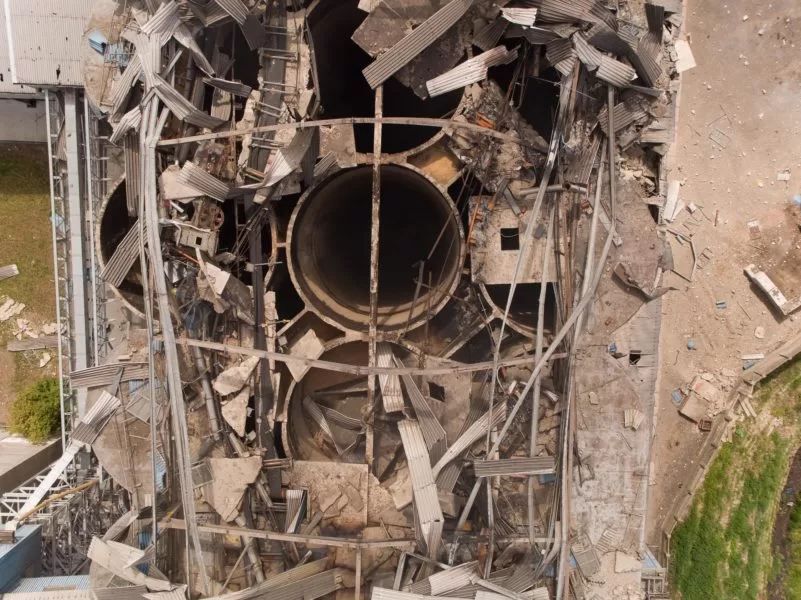
An inspection happens on one morning, but its photographs are usually needed months later by somebody who was not there. What makes them usable then is not the drama of the aerial view. It is whether each observation is marked where it sits, whether close detail is paired with a frame that places it, whether coverage is systematic enough that absence means something, and whether the set can be navigated at all.
Booking a drone operator means checking paperwork, and the names have changed since most checklists were written. This piece sets out the three families of document a client should ask for, registration, authorisation and insurance, what each proves, and the pairs most often confused: an Operator ID against a Flyer ID, an Operational Authorisation against the retired PfCO, a GVC against an A2 CofC. It closes with the paperwork that belongs to your job rather than the operator.