Qualifications and Accreditations
What We Hold, What We Work To, and What the Standards Actually Mean
A thermographic survey is only as good as the person interpreting it, and the qualification behind that interpretation is the one thing a buyer cannot easily check. This page sets out exactly what Drone Media Imaging holds, which standards the survey and analysis work is carried out to, and what the various thermography qualifications actually mean, including the ones we do not hold. Every certificate is stated as issued.
What We Hold, What We Work To, and What the Standards Actually Mean
Thermography has no single licensing body, and that is the root of the problem for anyone buying a survey. Certificates are issued by training organisations, by employers and by independent certification bodies. All of them use the words Level 1, Level 2 and Level 3, and none of them means quite the same thing. A drone operator who has done a two-day camera course and a thermographer holding a Level 3 certification can both describe themselves as qualified, and from the outside they can look identical.
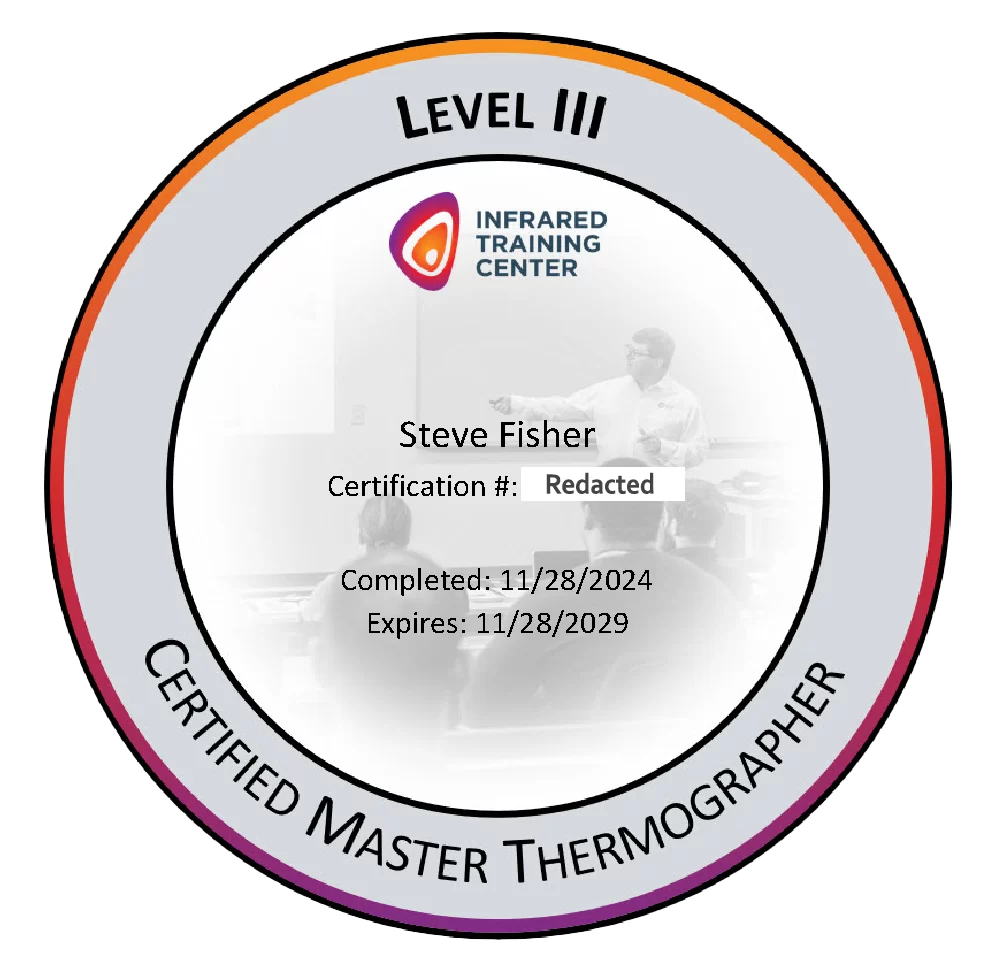
Drone Media Imaging is run by Steve Fisher, an ITC Level III Certified Master Thermographer, which is the highest of the three thermographic levels. Set out below is the full register: the certificates actually held, the standards the survey and analysis work is carried out to, and a plain explanation of the wider qualification landscape, so that you can read any provider’s credentials, not only ours.


The Certificates Actually Held
Stated exactly as issued, nothing inflated
The principal thermographic qualification is Level III Certified Master Thermographer, issued by the Infrared Training Centre, the training arm of Teledyne FLIR. Certification #205722059, issued 28 November 2024 and valid to 28 November 2029. It is the qualification under which every thermal survey is analysed and every report is written, and it is the reason third-party operators send their own thermal data here for interpretation.
Two earlier thermography certificates sit beneath it, both from iRed Academy, a BINDT-approved training organisation: Thermal Imaging Category 2, awarded October 2020, and Drone Thermography Category 1, awarded April 2018. They matter because they show the progression, and because Category 1 is the competence level under which supervised data collection is carried out on projects where somebody else flies.
Electrical qualifications support the string-level testing that runs alongside solar thermal work: the Level 3 Award in Requirements for Electrical Installations, BS 7671:2018, the Level 2 Certificate in Fundamental Inspection, Testing and Initial Verification, and the Level 3 Certificate in Building Regulations for Electrical Installations in Dwellings. Very few drone operators hold any electrical qualification at all, which is why thermal and electrical testing are almost never offered together.
Flight operations are conducted under a Civil Aviation Authority Operational Authorisation, held against the PDRA-01 standard scenario, together with a General VLOS Certificate (GVC) and an A2 Certificate of Competency. Alongside these sit the working site certificates that commercial clients ask for: electrical safety, asbestos awareness Category A, fire safety, working at height, manual handling, method statements and risk assessment.
At a glance
What Drone Media Imaging holds, what the work is carried out to, and how to read a thermography qualification.
- Thermographic analysis and reporting are carried out by an ITC Level III Certified Master Thermographer, Infrared Training Centre, Certification #205722059, valid to 28 November 2029.
- Level III is the highest of the three thermographic levels. Level 1 collects the data, Level 2 interprets it, Level 3 sets the method and carries responsibility for the conclusions.
- Survey methodology follows IEC 62446-3:2017 for solar PV and EN 13187:1999 for building envelopes.
- Competence is held in accordance with the frameworks of ISO 18436-7:2014, ASNT SNT-TC-1A, ANSI/ASNT CP-105 and BINDT CMGEN Appendix B.
- Electrical competence to BS 7671:2018 Level 3 supports IEC 62446-1 string-level testing alongside the thermal survey.
- Flight operations are conducted under a CAA Operational Authorisation held to PDRA-01, with a General VLOS Certificate, and the pilot and the thermographer are the same person.
- ISO 9712 is a third-party certification scheme we do not hold and do not claim. It is explained below, so you can tell the difference.
Every certificate here is stated exactly as issued, and every standard is named as either methodology or alignment, never as a qualification we hold.
Where That Qualification Gets Used


The Standards the Work Is Carried Out To
Methodology and competence are two different things
Standards fall into two groups that are constantly muddled, including by people who should know better. Methodology standards tell you how to carry out the survey. Competence frameworks describe what the person carrying it out should know. A survey can follow a methodology standard; it cannot follow a competence framework, because that governs people rather than method.
The methodology standards this work is carried out to are IEC 62446-3:2017 for the thermographic inspection of solar photovoltaic systems, which sets the survey conditions, the anomaly categories and the reporting requirements, and EN 13187:1999 for the qualitative detection of thermal irregularities in building envelopes. Solar electrical testing is carried out to IEC 62446-1, and electrical installation work is governed by BS 7671:2018.
The competence frameworks are ISO 18436-7:2014, which covers condition monitoring and diagnostics by thermography, together with ASNT SNT-TC-1A and ANSI/ASNT CP-105, and BINDT CMGEN Appendix B, which governs the delivery of thermographic training in the United Kingdom. Practice is in accordance with these frameworks. They are not certificates and are never described as such here.
That distinction is not pedantry. Naming a competence framework as though it were a qualification is one of the commonest ways a credentials claim quietly becomes untrue, and it is worth checking on any provider’s page, including this one.
A Certified All-Clear, Flown in Spain and Analysed in the UK
A commercial rooftop array in Lanzarote was inspected to IEC 62446-3:2017. Thermal data was collected on site by a specialist local operator working under a supervised Level 1 protocol, then submitted to Drone Media Imaging for Level 3 analysis and certified reporting. The outcome was a documented all-clear across the whole installation, which is exactly what the Level 3 qualification exists to be able to say.
Other Standards, and What They Actually Mean
This section covers standards and schemes we do not hold, because knowing what they are is the only way to judge what anybody’s credentials are worth. Nobody else in the field seems willing to set it out, which is precisely why it is here.
There are three different architectures for certifying a thermographer, and they are not interchangeable. A third-party scheme has you examined and certified by an independent certification body that has no commercial interest in you passing. An employer-based scheme has your employer certify you against a written practice. A training-body scheme has the organisation that trained you examine and certify you against its own framework. All three produce a certificate that says Level 1, Level 2 or Level 3, and a buyer looking at a website cannot tell them apart.
ISO 9712 is the third-party route, titled Non-Destructive Testing, Qualification and Certification of NDT Personnel. It is not a method standard and says nothing about how to conduct a survey. Critically, an ISO 9712 certificate can only be issued by an accredited certification body operating to ISO/IEC 17024, which in the United Kingdom means the British Institute of Non-Destructive Testing through its PCN scheme. A training provider cannot issue one, however good the training is. Drone Media Imaging does not hold ISO 9712 certification and does not claim it. Anyone who tells you their surveys “follow ISO 9712” has misunderstood what it is.
ASNT SNT-TC-1A is the employer-based route, a recommended practice published by the American Society for Nondestructive Testing, and ANSI/ASNT CP-105 sets out the training syllabus behind it. Both are alignment frameworks here rather than certificates.
So what does the standard governing solar inspection actually ask for? IEC 62446-3 Annex B asks for proof of qualification and certification in electro thermography. It offers ISO 9712 as one route by which that can be confirmed and does not mandate it, and the minimum it sets is expressed as level 1 or equivalent. An ITC Level III certificate answers what the standard asks for. That is the honest position, and it is a stronger one than a claim that would not survive a check.
The three levels are not three sizes of the same thing. They describe different jobs, and what changes between them is who is allowed to decide what an image means.
Level 1 operates the equipment and collects the data, working to a procedure somebody else has written. A Level 1 thermographer captures the imagery correctly but does not determine what the findings mean or issue conclusions.
Level 2 interprets. They set up and calibrate the equipment, apply the correct emissivity and reflected temperature values, evaluate the results against the applicable standard and classify what they find.
Level 3 takes responsibility for the whole thing. They establish the method and the acceptance criteria, interpret against the standard, decide the techniques to be used, and carry professional responsibility for the conclusions the report reaches. Level 3 also examines and oversees the levels beneath.
The practical consequence for a buyer is straightforward. A thermal image on its own proves very little. What makes a survey defensible is the level of the person who decided what it meant, and that is the question worth asking of any provider.
- Thermographic inspection, analysis and reporting are conducted by Steve Fisher, ITC Level III Certified Master Thermographer (Infrared Training Centre; Certification #205722059), practising in accordance with the frameworks of ISO 18436-7:2014, ASNT SNT-TC-1A and ANSI/ASNT CP-105, and BINDT CMGEN Appendix B (UK training governance).
- Inspection methodology is aligned with IEC 62446-3:2017 (solar PV) and EN 13187:1999 (building envelopes) as applicable.
- Electrical testing is carried out to IEC 62446-1 for solar string-level verification, under BS 7671:2018 Level 3 electrical competence.
- Flight operations are conducted under a Civil Aviation Authority Operational Authorisation held against the PDRA-01 standard scenario, with a General VLOS Certificate (GVC) and an A2 Certificate of Competency.
Ask Us What Level Your Survey Was Analysed At
If you are commissioning a thermal survey, or you already have a report and you are not sure what stands behind it, tell us what you need and we will tell you plainly what is involved and what it will cost. Every survey we quote for is analysed and reported by an ITC Level III Certified Master Thermographer, whether we fly it ourselves or work from data your own operator has captured.