Drone Roof Inspections
See Your Roof Without Anybody Going Up There
Photographic inspection of pitched and flat roofs across Sussex, Surrey, Kent and Hampshire, covering slopes, ridges, valleys, flashings, verges and rooflights from the air. No scaffold, no tower, nobody walking on a covering that may not take the weight. You get the images, with anything worth your attention marked on them, in a form you can forward straight to a roofer, a managing agent or an insurer.
See Your Roof Without Anybody Going Up There
Most roofs are not looked at. They are inferred from a stain on a ceiling, a report written years ago, or a contractor’s word after twenty minutes on a ladder at one corner of the building. The reason is simple enough: getting a person safely onto a roof costs more than most people want to spend on finding out whether there is a problem at all.
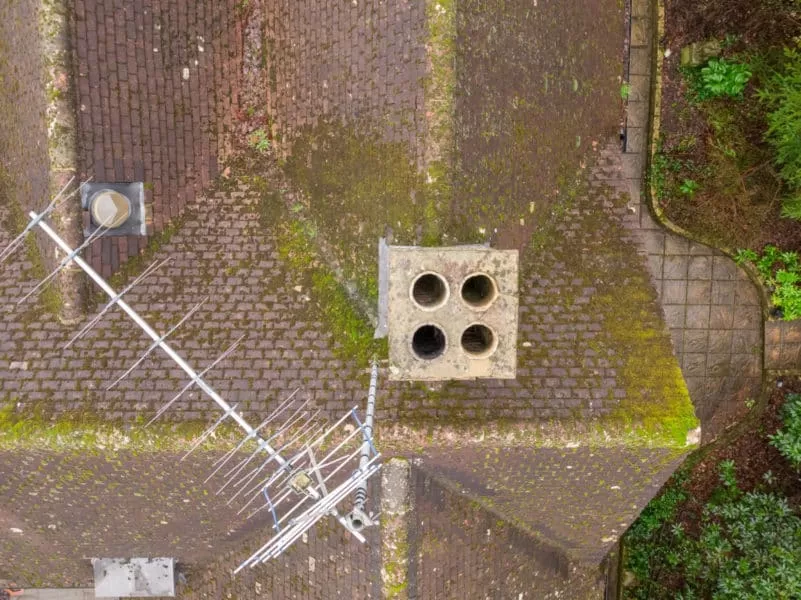
Photographing it from the air removes that, and everyone in this business will tell you so. The part worth asking about is what comes back. A roof inspection is a set of photographs, and photographs vary enormously depending on who took them. Ours are made by a commercial photographer, framed and exposed so that a slipped tile, a lifted flashing or a split in a membrane reads clearly to somebody who has never been on the building, with each observation marked on the image and located on the roof.
We work from Crawley in West Sussex, so roofs in Horsham, Brighton, Worthing, East Grinstead, Guildford, Tunbridge Wells and the towns around them are a short run rather than an expedition. That matters on a job this size, because the travel is a real part of what a single roof inspection costs and there is no sense in paying for a long drive to look at one building.

What Gets Photographed, and Why It Is Worth Seeing
The details that fail first, and are seen last
Roofs rarely fail in the middle of a slope. They fail at the edges and the joins, which are exactly the parts nobody can see from the ground and nobody wants to walk to.
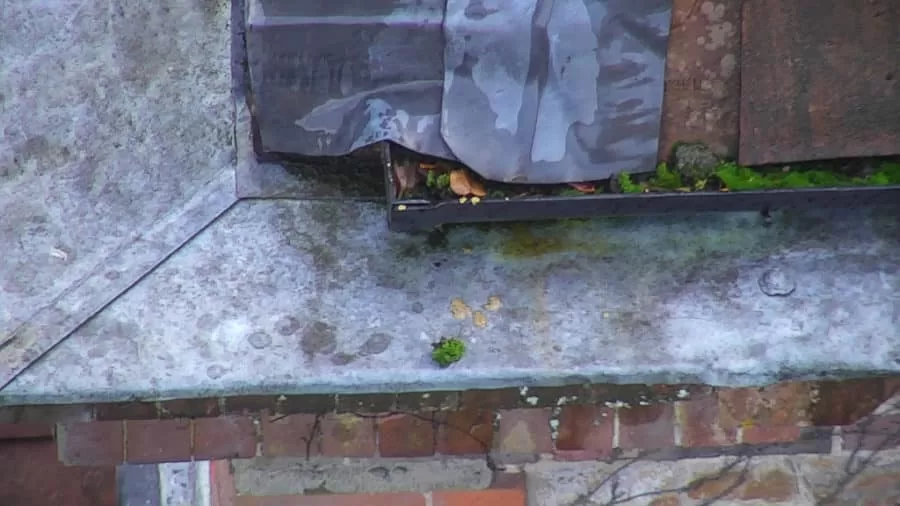
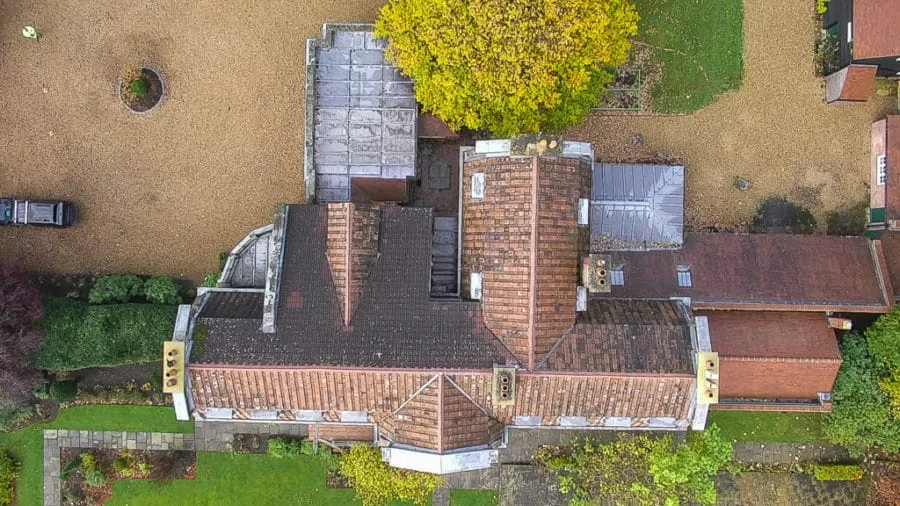
On a pitched roof that means the ridge and hip mortar, slipped or cracked slates and tiles, the flashings where the roof meets a wall, a stack or a valley, the verges, and the condition of the gutters and their fixings. It also means the things that only show from above: moss and lichen holding water against the covering, a previous repair done in the wrong material, a slate that has slipped only far enough to open a gap.
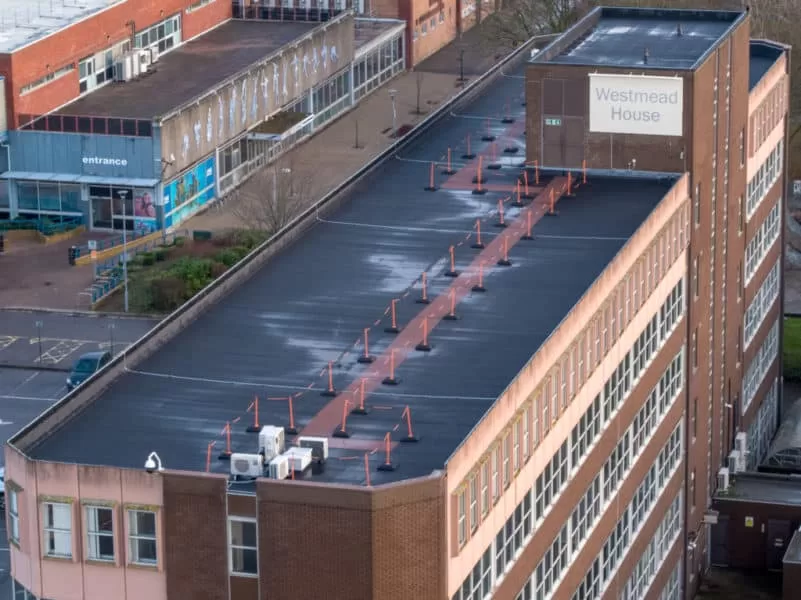
On a flat roof it means the upstands and terminations, splits or blistering in the membrane, standing water and where it is pooling, failed seams, the condition around every penetration, rooflight and plant base, and the outlets that are supposed to be taking the water away and often are not.
Every one of those is a small thing photographed close. That is what separates a useful set of images from an aerial view of a building: not the height it was taken from, but how close the camera got to the detail and whether the light was working with it or against it.
Where a roof is large or complex the coverage is systematic, slope by slope, so nothing is missed and every image can be placed on the building afterwards. Where the job is one suspected problem, the effort goes into photographing that one thing properly from several angles rather than producing a hundred frames of everything else.
At a glance
What a drone roof inspection covers, what you receive, and what it will not tell you.
- Worked across Sussex, Surrey, Kent and Hampshire from a base in Crawley, West Sussex, which keeps the travel in proportion on what is usually a single-building job.
- Pitched and flat roofs, including slopes, ridges, hips, valleys, flashings, verges, abutments, rooflights, parapets and rainwater goods.
- Nobody goes onto the covering. No scaffold, no tower, no ladder against a gutter, and no risk of a foot through a fragile rooflight or a cracked slate.
- The deliverable is your scope: stills, video, or both. A full record of every slope, or one detail photographed properly, depending on what you are trying to settle.
- Observations marked on the images and located on the roof, so a roofer can quote from them and an insurer can accept them without a covering explanation.
- Useful for insurance and storm damage evidence, pre-purchase and pre-lease checks, dilapidations, planned maintenance, and settling an argument about whether a roof needs repair or replacement.
- It is a visual inspection, not a building survey. It records what can be seen from above and does not see beneath the covering.
Anyone can photograph a roof. The question is whether the photograph shows you the problem.
Usually Worth Doing on the Same Visit
What Does a Drone Roof Inspection Cost?
What actually drives the price, and why a list price would mislead you
It is the first question most people ask, and the honest answer is that it depends on four things. We would rather set those out than publish a headline figure that turns out not to apply to your building.
The size and shape of the roof. A single domestic roof is a short visit. A commercial building with multiple levels, plant, rooflights and internal valleys takes considerably longer, both in the air and afterwards, because there is more to cover and far more detail to work through.
What you need back. A set of images answering one specific question is not the same job as a systematic record of every slope with observations marked on it. Neither is better; they answer different questions and they cost different amounts.
Where the building is. Travel is a real cost, and it is the reason this service is built around Sussex, Surrey, Kent and Hampshire rather than sold nationally. A roof in Brighton, Horsham, Guildford, Tunbridge Wells or Southampton is a straightforward morning from Crawley, and what you pay reflects that. Location also adds planning in its own right, near an airfield, in a town centre, beside a school or a railway, or where access has to be arranged with a third party. Gatwick airspace is familiar ground rather than an obstacle, which is one of the practical advantages of being based next to it.
Whether anything else is worth doing while we are there. Elevations, chimneys, gutters or a thermal pass over the same roof all cost far less added to an existing visit than booked separately, because the travel and the setting up are already paid for.
What we will not do is quote you a number before understanding the building. A price advertised as “from” a figure is only ever the simplest possible job, and everyone knows it. Send us the address and what has prompted the enquiry, and you will get a fixed price for your roof, not a starting point that moves.
Who Buys This, and What They Do With It
The same photographs get used for very different purposes, and knowing which one you are is usually enough to settle what the job needs to cover.
Insurance and storm damage. After a storm an insurer wants to see the damage, and the claim moves faster with dated photographs than with a description. The same images also demonstrate what was already there beforehand, which matters when the question is wear against a single event. This is the most common reason a domestic roof gets photographed.
Buying, leasing or handing back. A roof is the most expensive part of a building to get wrong and the least accessible to check. Photographs before exchange, or at the start and end of a lease, put the condition beyond argument. On dilapidations they are frequently the difference between a negotiation and a dispute.
Managing a building or a portfolio. Where you are responsible for roofs you cannot see, an annual set of images is a cheap way to know which ones need money and which do not. Repeat the exercise the following year and the comparison shows what is deteriorating, which is a stronger basis for a maintenance budget than a contractor’s opinion.
Deciding between repair and replacement. Roofing quotes vary enormously, and the reason is often that each contractor has looked at a different part of the roof. Photographs of the whole thing let everyone price the same job, and let you see whether the recommendation to replace is supported by what is actually up there.
And a word on what this does not settle. It records the surface. It does not see under a covering, into a cavity or through a ceiling, and it is not a building survey, a structural assessment or a professional opinion on the condition of the building. Where water is getting in and the entry point is not visible from above, the images narrow it down rather than confirming it, and the opening up is done by a roofer. We do not carry out repairs, so nothing found is worth more to us than nothing found.

Roof inspection is local work by its nature. It is usually one building, often at short notice, and frequently because somebody has noticed something and wants to know how worried to be. A firm three counties away can do it, but by the time the journey is priced in, the answer costs more than it is worth.
West Sussex is the doorstep: Crawley, Horsham, East Grinstead, Haywards Heath, Burgess Hill, Worthing, Chichester, Bognor Regis, Littlehampton and Shoreham. East Sussex is the same morning: Brighton and Hove, Lewes, Eastbourne, Hastings, Bexhill, Seaford, Uckfield and Crowborough, where the terraced and semi-detached stock throws up most of the slipped-slate and valley-gutter work.
Surrey covers Guildford, Woking, Redhill and Reigate, Epsom, Leatherhead, Dorking, Farnham, Godalming and Camberley. Kent takes in Tunbridge Wells, Tonbridge, Sevenoaks, Maidstone, Ashford, Canterbury, Dartford, Gravesend and the Medway towns. Hampshire reaches Southampton, Portsmouth, Basingstoke, Winchester, Fareham, Havant, Aldershot, Farnborough, Andover and Petersfield, where a good deal of the flat-roof and commercial work sits.
Domestic pitched roofs, commercial flat roofs, industrial units, blocks of flats, schools, churches and listed buildings all get the same treatment, because the difficulty is never the building type. It is whether the photographs show the problem clearly enough for somebody else to act on them.
Outside that area, ask anyway. We will give you an honest answer about whether the journey is worth paying for, and on a single roof it very often is not.
- This is a visual inspection service. Drone Media Imaging photographs what is visible and describes what the photographs show. No building survey, structural assessment, condition grading or professional opinion on the condition of a roof or structure is offered or implied, and no surveying qualification is held or claimed.
- Findings are reported as observations warranting further investigation by a suitably qualified contractor or surveyor.
- Flight operations are conducted under a Civil Aviation Authority Operational Authorisation, with a General VLOS Certificate (GVC) and an A2 Certificate of Competency, and are fully insured for commercial operation.
- Drone Media Imaging carries out no roofing, repair or maintenance work of any kind, and has no commercial interest in what an inspection does or does not find.
Send Us the Address and What Has Prompted It
A leak nobody can trace, storm damage an insurer wants evidence of, a purchase you want eyes on, a lease ending, or simply a roof you are responsible for and have never seen. Tell us the address and the reason, and we will come back with a fixed price and what we would cover. You do not need to specify the job. If a roofer has already told you it needs replacing and you want that checked independently, say so, because that changes what is worth photographing.
Sussex, Surrey, Kent and Hampshire are home ground, so a roof in Crawley, Brighton, Worthing, Horsham, Guildford, Maidstone, Tunbridge Wells, Basingstoke or Southampton is a straightforward booking rather than a special trip. Give us the postcode and we will tell you plainly whether it is worth doing.