
Solar Panel Inspection for Facilities Managers: Commercial Rooftop Surveys
It Looks Fine From the Ground. It Would.
Drone Media Imaging surveys commercial rooftop solar for facilities and property managers who have inherited an array nobody has looked at. We fly it, analyse it at ITC Level III and give you a report in plain terms: what is wrong, how serious it is, where it is, and what to deal with first. An hour or two on site, no scaffolding, no roof access, no disruption to the building.
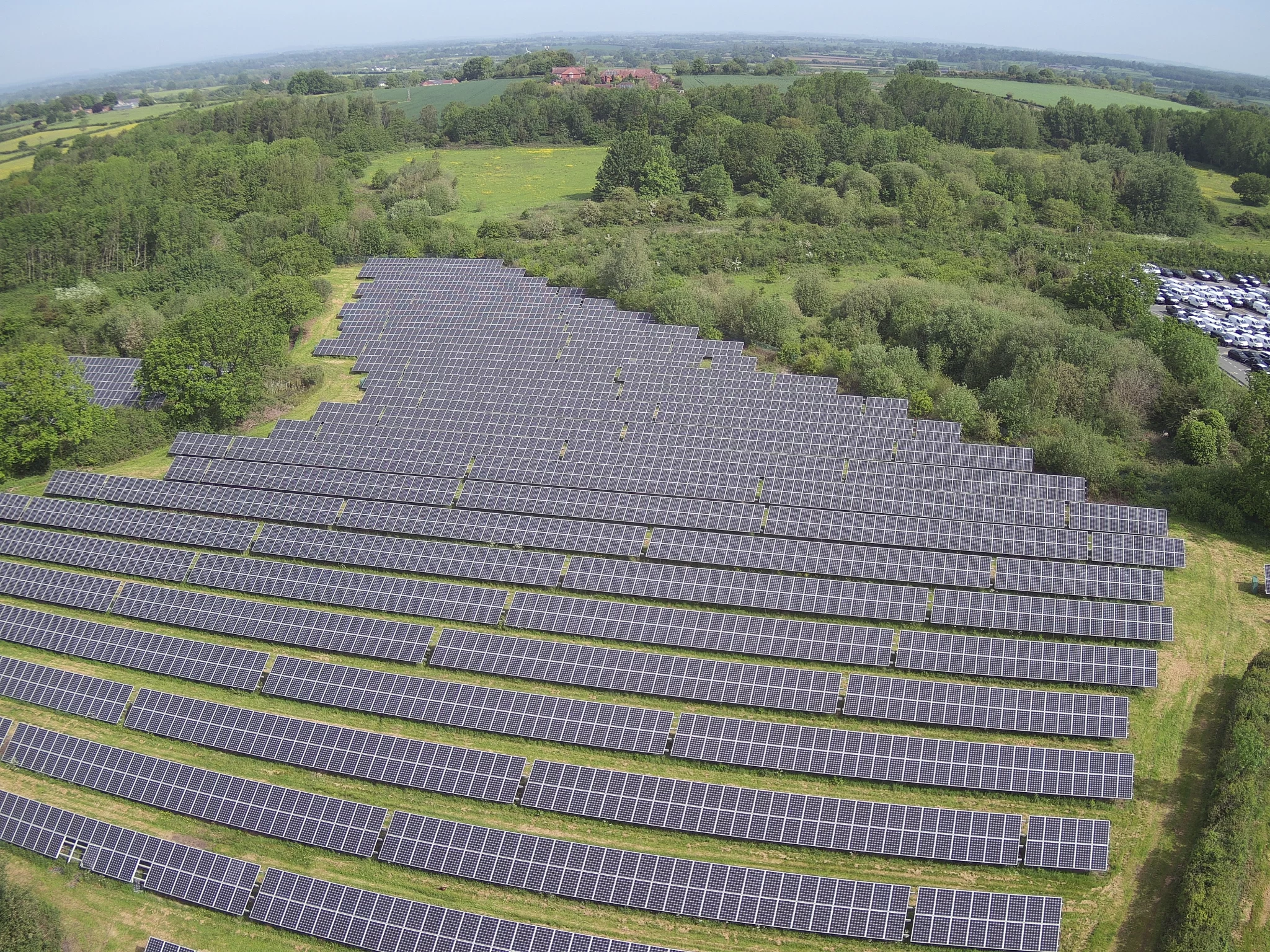
It Looks Fine From the Ground. It Would.
Solar panels are an odd thing to have on a building. They sit on a roof you rarely visit, they have no moving parts, nothing beeps when they go wrong, and they were almost certainly installed by somebody who is no longer involved. Most of the time they simply work, which is exactly why nobody looks at them.
Then something prompts a question. A generation figure looks lower than last year without an obvious reason. Roof works are being planned and somebody asks about the array before the scaffolders arrive. Or you have taken on a building and nobody can tell you when the panels were last looked at, or by whom.
If you have not commissioned this kind of survey before, you are in the majority, and it is more straightforward than it sounds. We fly the array with a thermal camera, work out what the images mean, and give you a report that says what is wrong, how serious it is, where on the roof to find it and what to deal with first.
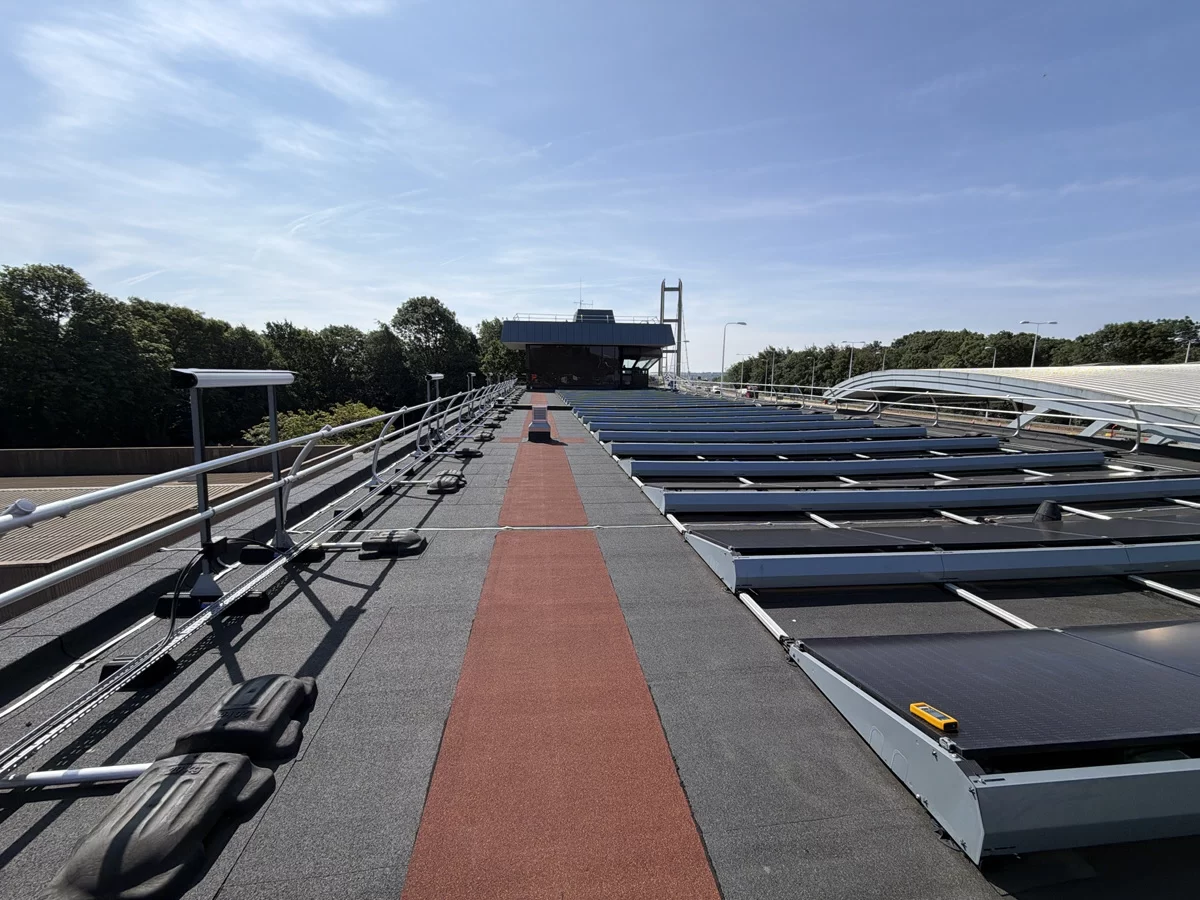
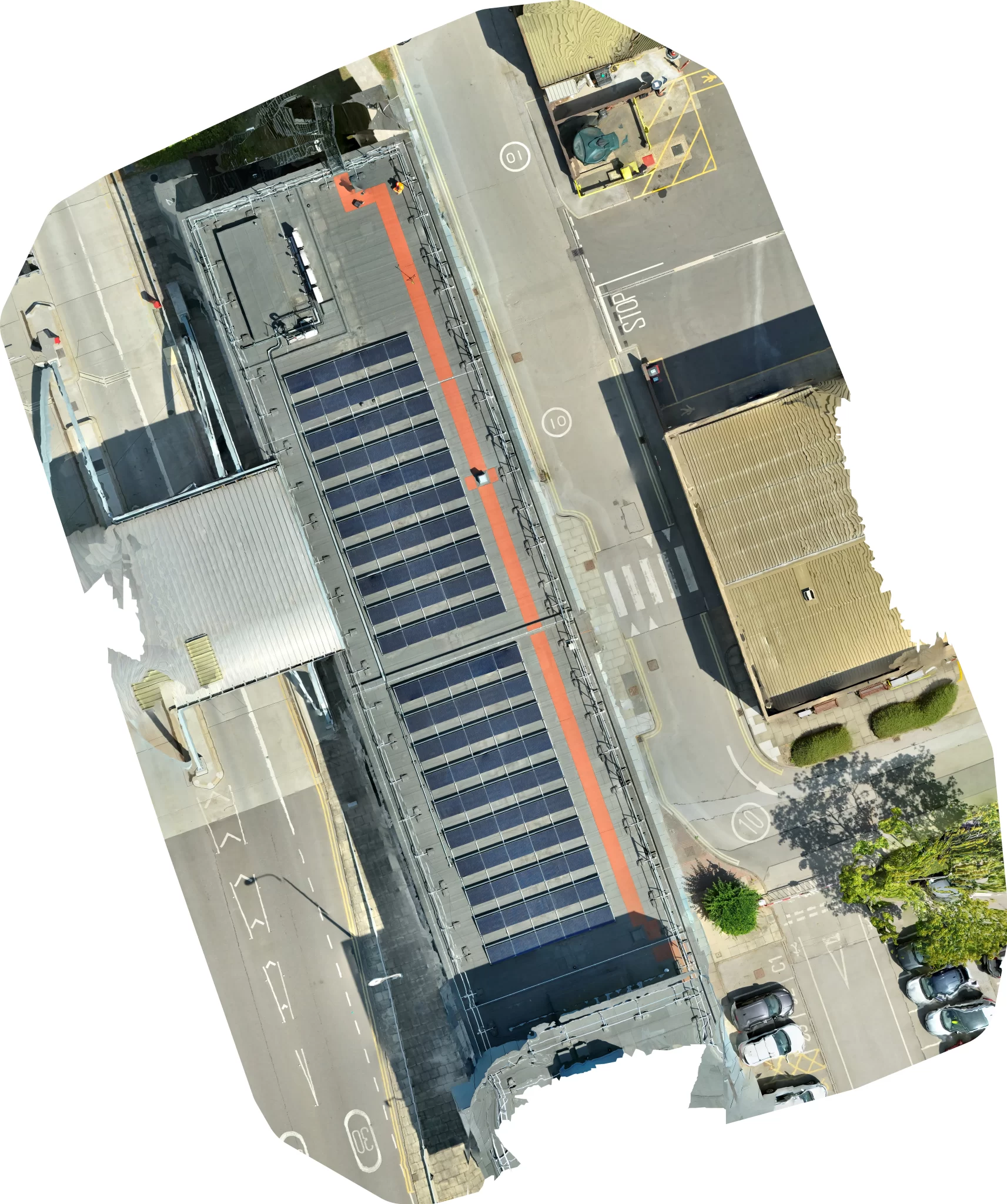
What Actually Happens on the Day
Less disruptive than a window clean
Before we come, we need very little from you: the address, roughly how big the array is, where we can take off and land, and anything unusual about the site such as restricted airspace, a school next door or shift patterns we should avoid. We handle the flight permissions and the risk assessment.
The date and the time of day matter more than most people expect. Thermal imaging of solar panels only works while the panels are generating properly and conditions are stable, which on a good day gives a usable window of around four hours. We check the forecast against a calibrated model before confirming, which is why we may suggest a date rather than simply take one. It is also why a survey occasionally moves at short notice, and we would rather do that than fly a job that produces a report worth nothing.
Inside that window, most commercial roofs take an hour or two. The aircraft flies a planned pattern over the array, photographing every panel in thermal and in ordinary high-resolution colour, and it does so from above rather than from anywhere near people or vehicles. Nothing needs to be switched off, nobody needs to leave the building, and no part of the roof needs to be walked on.
Then it goes quiet for a bit, because the useful half is the analysis. Every panel is examined, compared against healthy panels in the same image, and anything abnormal is identified, rated and located. That takes considerably longer than the flying and it is the part you are actually paying for.
At a glance
What a commercial rooftop solar survey involves, for anyone commissioning one for the first time.
- Nobody goes on the roof. The array is flown with a thermal camera, so there is no scaffolding, no access equipment and no disruption to the building or its occupants.
- An hour or two on site for most commercial roofs, inside a survey window of around four hours when conditions allow the work to be done properly.
- Faults show up as heat. A failing connection, a cracked module or a dead section runs warmer or cooler than its neighbours, and that difference is what the camera sees.
- Someone qualified reads the results. Analysis is by an ITC Level III Certified Master Thermographer, not by the pilot, and the certification is named in the report.
- The report is written to be used. Each finding is rated for severity, located precisely on the roof, and put in order of what matters most.
- We do not do the repairs. Findings go to whichever contractor you already use, so there is nothing being sold to you on the back of the survey.
- Carried out in line with IEC 62446-3:2017, the international standard for this work, which is the name your insurer or surveyor will recognise.
You do not need to understand thermography. You need a report you can act on and hand to someone else.
Related Solar Survey Services
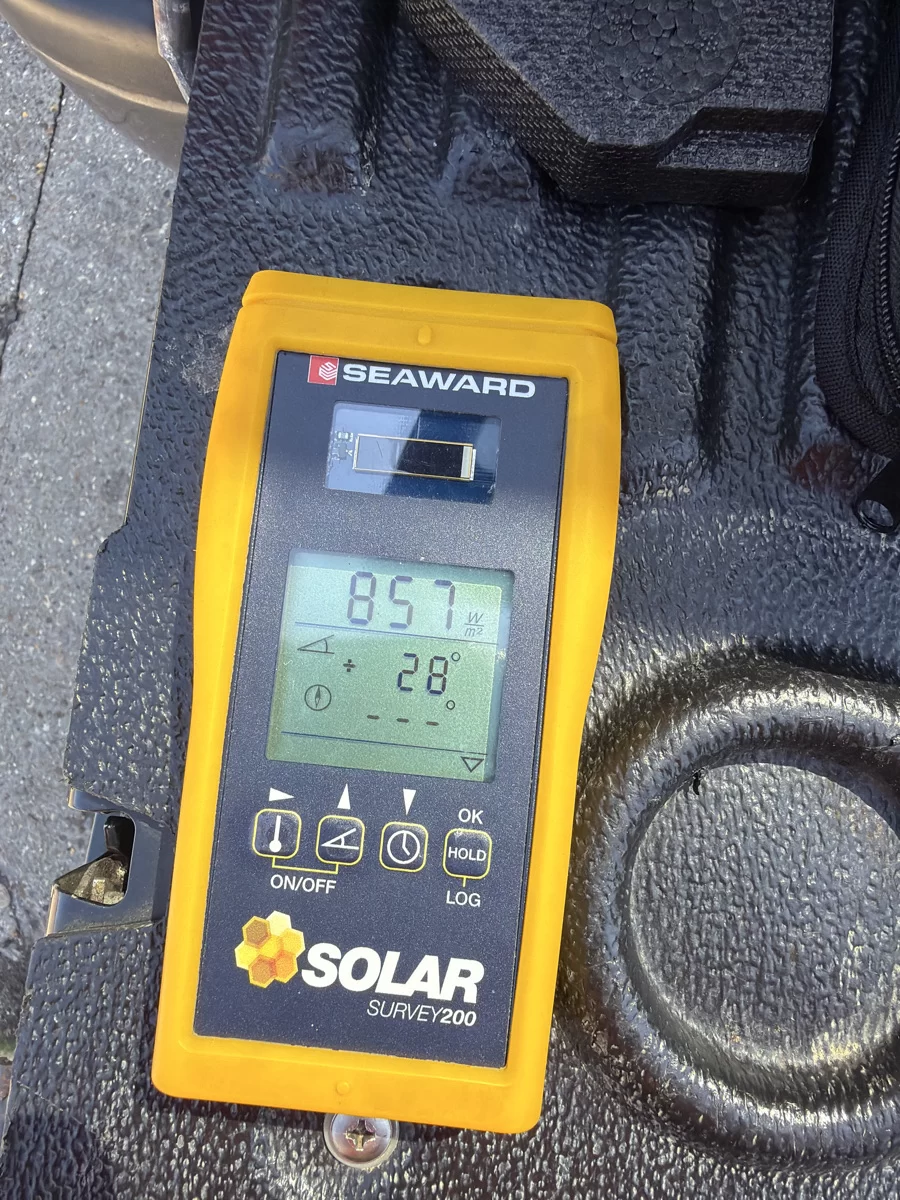
What You Get Back, and Who It Is Written For
A document you can forward, not one you have to decode
A thermal report can very easily be a folder of orange pictures and a lot of numbers, which puts the work of understanding it back onto you. Ours is written on the assumption that you will need to forward it to at least two other people and should not have to explain it to either.
Every finding gets three things. A severity rating, so you can tell a monitor-it from a deal-with-it. A location, precise enough that a contractor can walk to the right panel rather than search the roof. And a plain statement of consequence, meaning whether it is costing you generation, shortening the life of equipment, or presenting a safety concern. Those are different problems with different urgencies and they should not be lumped together.
The findings are set out in priority order, so if you read only the first page you still know what matters. Thermal images sit alongside ordinary photographs of the same panel, which makes it obvious you are looking at a real defect rather than a reflection or a bird.
What the report will not do is quote you for repairs. We survey, analyse and report, and we do not carry out remedial work, so anything needing attention is written up as an area warranting further investigation by a suitably qualified contractor. You pass it to whoever you already use. It also means the report is genuinely independent, which is what your insurer or your board will care about if the question ever gets asked properly.
Fitting It Into Planned Maintenance
Solar tends to fall between the cracks of a maintenance schedule. It is not quite building fabric, not quite plant, and the people who installed it are usually long gone. So it sits outside the planned cycle until something forces it back in.
The simplest way to deal with that is to give it a line of its own. If the array has never been surveyed, a first survey establishes a condition baseline, which is the document that makes every later one meaningful: without it, nobody can say whether something is new or has been there for eight years.
After that, a cycle. IEC 62446-3 recommends thermographic inspection every four years and leaves the interval to the owner, the insurer or national codes. MIS 3002 points to a full maintenance visit every two years. RC62, the joint code of practice published by the UK insurance industry, recommends thermographic examination as part of the risk regime for photovoltaic installations. Most managed portfolios settle somewhere inside that range, and it is worth agreeing the interval once rather than revisiting it each year.
Two other moments are worth putting in the diary rather than leaving to chance. After anything that could have damaged the roof, meaning storms, roof works, or contractors working at height near the array. And when a building changes hands or a lease changes, in either direction, because a survey is the cheapest way to document condition at handover and it protects whoever is inheriting the responsibility.
None of this needs to be complicated. One survey, an agreed interval, and a note in the file of when the next one is due.
Solar PV Thermographic Inspection of a Commercial Rooftop Array
A 46.8 kWp commercial rooftop array of around 180 modules, flown near solar noon under clear skies. One string was found not exporting current, rated Medium severity with a yield consequence, alongside a developing bypass diode fault and two minor anomalies flagged only for monitoring. The owner got a condition baseline and a clear order of priority.
- IEC TS 62446-3:2017 is the international technical specification for infrared thermography of photovoltaic installations. It sets the conditions the survey has to be flown in, the method, and what the report should contain.
- RC62, the joint code of practice issued by the UK insurance industry, recommends thermographic examination as part of the risk regime for photovoltaic installations.
- MIS 3002, the Microgeneration Certification Scheme standard for solar photovoltaic installations, points to a full maintenance visit every two years.
- ISO 18436-7:2014 sets the international framework for thermographic condition monitoring personnel, and our analysis practice is aligned to it, alongside ASNT SNT-TC-1A and ANSI/ASNT CP-105.
- Survey conducted by Steve Fisher, ITC Level III Certified Master Thermographer (Infrared Training Centre; Certification #205722059), holding iRed Academy Thermal Imaging Category 2 and Drone Thermography Category 1.
- Flown under CAA Operational Authorisation, with GVC and A2 CofC, and fully insured for commercial operations across the UK, Ireland and Europe.
Get the Array on Your Roof Looked At
Tell us the address and roughly how many panels are up there. If you do not know, a rough guess or a photograph from the ground is enough to start with, and we can work the rest out. Tell us what prompted the enquiry too, because an insurer’s question and a drop in generation lead to slightly different surveys. We will come back with a fixed price and what the report will contain. Quotations and consultations are free. We work across Sussex, Hampshire, Kent and Surrey, and travel throughout the UK, Ireland and Europe.