

Bird Fouling and Lichen on a Photovoltaic Array
A thermal image of a solar array after autumn rarely comes back clean. Leaf litter, bird fouling and the slow spread of lichen build up on module glass through the colder months, and each of them makes the cells beneath run warmer than their neighbours. On a thermogram, a small warm patch caused by a bird dropping can look very like a cell that has cracked, and a band of lichen creeping in from a module frame can resemble an electrical pattern that genuinely needs an installer.
That resemblance costs money in both directions. An owner who reads every warm patch as a defect may pay to have modules investigated or replaced when the glass only needed attention. An owner who reads every warm patch as dirt may have the array cleaned, see the same pattern a year later and never learn that one of those patches was a real fault all along.
The difference is not in the camera. It is in the interpretation, and it is settled before anything goes into the report. This article sets out how bird droppings and lichen present on a thermal survey, why each can be mistaken for a module defect, and how a certified survey separates an external cause from a fault inside the panel, so that every finding goes to the right person.
Blog Content TL;DR...
Not every warm patch on a solar panel is a fault. Here is the short version.
- Bird droppings and lichen both shade individual cells, and a shaded cell runs warmer than its neighbours, so both show on a thermal image.
- Droppings land at random as small isolated marks. Lichen grows in colonies that spread over time and often gather towards module edges.
- A dropping can resemble a single cell anomaly, and edge-weighted lichen can resemble electrical patterns that also favour the module edges.
- A certified survey reads each warm area against the matching visual image, its distribution and its symmetry before classifying it.
- The report says which findings are surface matters for whoever maintains the array and which are module findings for a suitably qualified contractor.
Drone Media Imaging conducts Survey, Analysis and Reporting. We report surface growth; we do not clean panels or carry out remedial work.
Two Deposits, Two Different Behaviours
Bird fouling and lichen both warm the cells beneath, but they arrive and spread differently

Bird droppings and lichen are often grouped together as soiling, and on a thermal image they share a cause. Each is opaque, each stops light reaching part of a cell, and a cell generating less than the cells it is wired in series with is forced to dissipate energy as heat rather than deliver it as current. The result is a warm area on the module face, and on a survey flown in the right conditions it is plainly visible.
Bird droppings: random, isolated, often transient
Droppings land wherever birds happen to pass over. They appear as small, irregular marks scattered across the array with no relationship to one another, and on the thermal image they show as small isolated warm areas, usually confined to part of a single cell. On one of our surveys, deposits of this kind read between 3 and 6°C above the surrounding working module. Rain removes some of them, while others bake on and persist through a dry spell.
Lichen: colonies that grow
Lichen behaves differently because it is alive. It establishes in patches, grows season on season and holds moisture, and it tends to gather towards the lower edges and frames of a module, where water and organic debris collect. Its thermal signature is usually broader and softer than a dropping, spread across a cluster of cells rather than concentrated in one. It does not wash away, which matters for what the report should say about it.
Two deposits, then, with two different behaviours. Telling them apart from each other is useful. Telling either of them apart from a genuine module defect is the part that protects the owner’s money.
Lichen on Solar Panels, Bird Droppings or a Cell Fault, Reading Surface Growth on a Thermal SurveyLichen on Solar Panels, Bird Droppings or a Cell Fault, Reading Surface Growth on a Thermal Survey
Why Surface Growth Can Look Like a Fault
A thermal image records surface temperature. It does not record cause, and two of the patterns that surface growth produces sit uncomfortably close to patterns produced by genuine defects.
The isolated mark and the single cell
A dropping over part of one cell produces a small, sharply bounded warm area. So does a cracked cell, a cell with a manufacturing defect, or a cell with raised internal resistance. On the thermal frame alone the two can be close to indistinguishable, and a report that classified every one of them as a cell anomaly would send a contractor up a ladder to inspect glass that only needed rain.
The edge pattern
Lichen gathering along module frames produces warmth weighted towards the edges of the panel. Some electrical conditions also show cells nearer the frame running warmer, potential induced degradation being the best known, where leakage towards earth affects the cells closest to the frame first. Mistake one for the other and either a degrading array is written off as dirty, or a dirty array is reported as degrading.
How the two are separated
The separation rests on evidence beyond the thermal frame. Every thermogram is read against a high resolution visual image of the same modules, so a warm area can be checked against what is physically on the glass. Distribution comes next: a deposit follows birds, gravity and water, while a defect follows the electrical layout of the module and the string. Symmetry is the third test. On a rooftop array we surveyed in Scotland, the predominant finding was cell-level heating in a repeating, mirrored pattern, and that symmetry pointed to an electrical origin, because a surface deposit presents patchily and does not mirror. The electrical fault shapes themselves are covered in our guide to reading the shape of a solar fault.
What the Report Tells You to Do Next
The value of separating surface growth from module defects is that each finding then goes to the right person, and nobody spends money in the wrong place.
Three outcomes, three destinations
A transient deposit such as scattered bird fouling is recorded and located, with a note that it may clear and should be read again at the next survey. Persistent biological growth such as lichen is reported as a maintenance matter for whoever looks after the array, because it does not stabilise. On the Scottish rooftop array, distributed biological growth across the west-facing roof plane was reported as an independent matter, separate from the electrical findings and not the cause of any of them, with a note to address it before it extended further. A warm area that nothing on the glass explains is classified as a module finding and passed to a suitably qualified contractor for investigation.
Where a deposit and a possible defect coincide, the report says so rather than guessing, and recommends confirmation at close quarters before any decision is taken about the module. Drone Media Imaging does not advise on cleaning methods or products, and carries out no cleaning or remedial work. The survey’s job is to tell you which is which.
Why it matters after autumn
Leaf fall and bird fouling build through autumn and early winter, so by the time the spring survey season opens many arrays carry a winter’s worth of deposits. That is not a reason to delay a survey. It is a reason to insist that the survey distinguishes them. An IEC 62446-3 thermographic inspection analysed at Level 3 gives you a findings list you can act on, and our solar inspections for O&M contractors apply the same separation across a portfolio of sites.
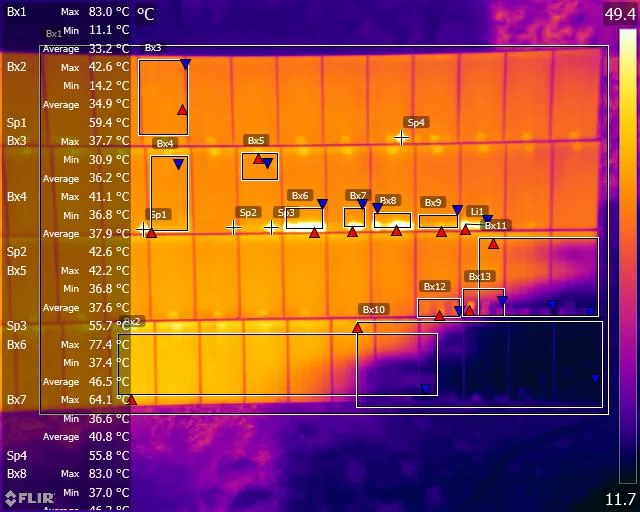
The temperature of a module on a working roof depends on irradiance, air temperature, wind and the angle of the sun, and all of those change through a survey. An absolute reading on its own therefore says very little about whether a cell is behaving abnormally. For that reason, every anomaly in a Drone Media Imaging solar survey is assessed as a temperature difference against a healthy reference module of the same orientation, measured within the same thermogram.
Comparing a warm area with its neighbour in the same frame removes irradiance, ambient temperature and passing cloud from the comparison in one step. It also helps separate a deposit from a defect, because a deposit is judged against the clean glass beside it and the matching visual image, while a defect is judged against cells that share its electrical conditions. The difference is then classified for severity and consequence, and the report states the conditions it was recorded under, following the methodology of IEC TS 62446-3:2017.
Governing Standards
- IEC TS 62446-3:2017, outdoor infrared thermography of photovoltaic modules and plants in operation, the methodology this survey work follows.
- Thermographic analysis by Steve Fisher, ITC Level III Certified Master Thermographer (Infrared Training Centre; Certification #205722059), practising in accordance with the frameworks of ISO 18436-7:2014, ASNT SNT-TC-1A and ANSI/ASNT CP-105, and BINDT CMGEN Appendix B as UK training governance.
Know Which Warm Patches Matter
Drone Media Imaging carries out drone thermographic surveys of solar PV arrays to the methodology of IEC TS 62446-3:2017, analysed and certified by an ITC Level III Certified Master Thermographer. Every warm area is checked against the matching visual image, classified and located, so surface growth is reported as surface growth and module findings go to the right contractor. Core coverage across Sussex, Hampshire, Kent and Surrey, travelling throughout the UK, Ireland and Europe.
related posts

A retrofit is usually justified before it starts and assumed after it finishes. A matched pair of thermal surveys, one before the work and one after, can show whether the building envelope behaves differently, but only if the two are genuinely comparable. This post covers why the baseline has to come first, what has to match between the two surveys, and what the pair can and cannot honestly claim.

A roof gets inspected in the places a person could stand, and that single fact explains most of what gets found late. Ladders reach the eaves, scaffolds cover one elevation, and fragile coverings restrict a roof walk exactly where the roof is oldest. Photographing from the air removes the constraint rather than the expertise: every slope is covered square on, and the interpretation stays with your roofer or surveyor.
Explore the crucial role of drone thermal imaging in boosting fire safety measures at solid waste landfill sites.