Solar PV Thermographic Inspection of a 241 kWp Rooftop Array in Scotland
Why a Food Production Site Commissioned a Rooftop Solar Thermal Survey
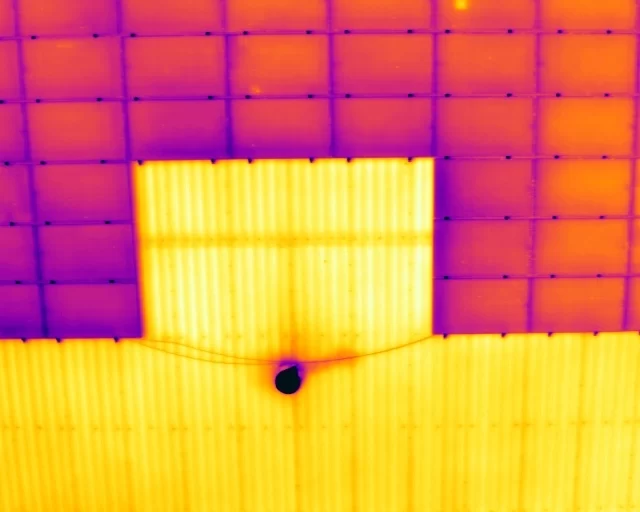
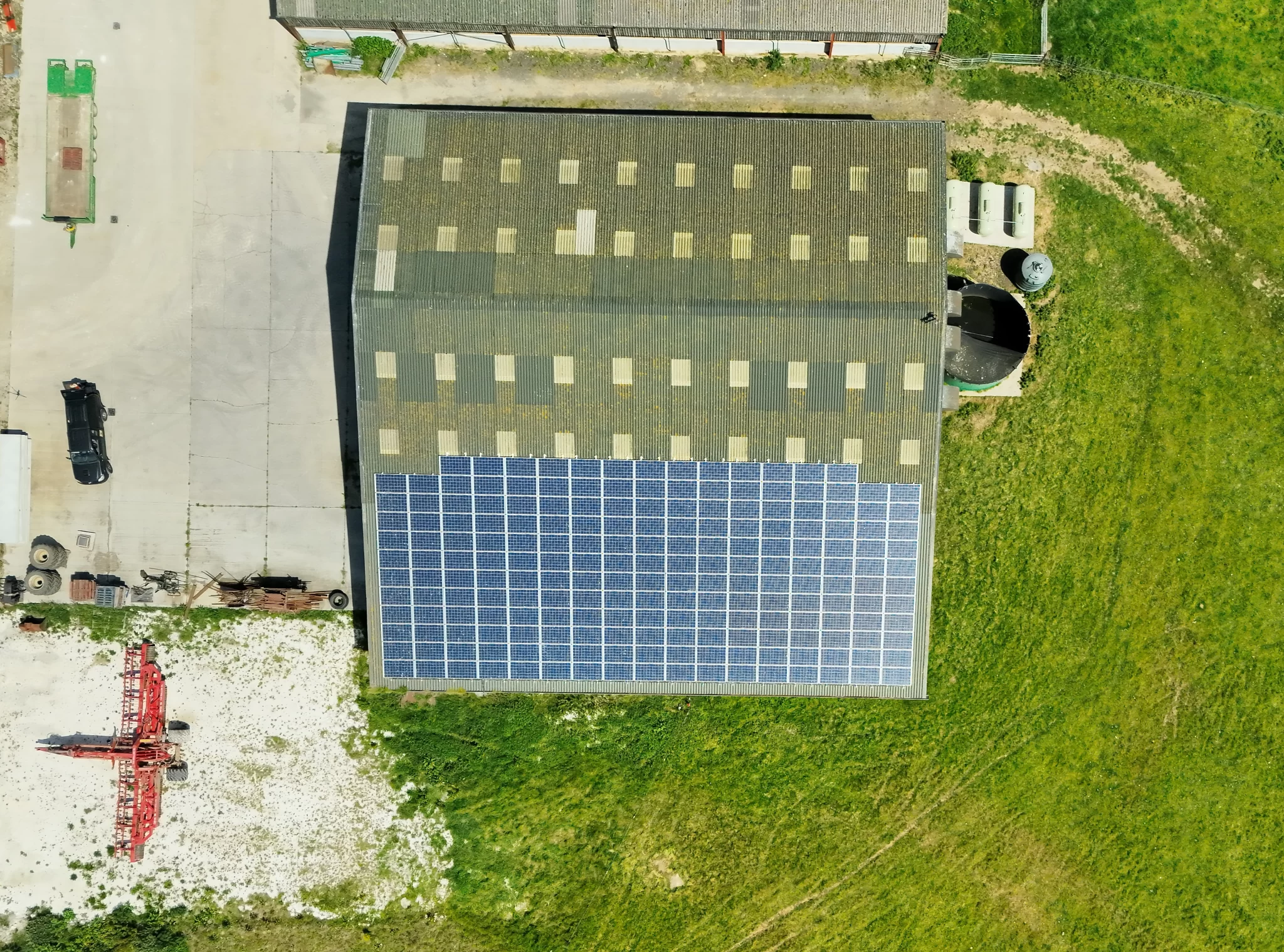
A solar PV thermographic inspection was carried out by Drone Media Imaging on a 241 kWp rooftop array at a food production site in Scotland, covering 1,026 modules across a south-facing and a west-facing roof plane. The survey was flown by drone under IEC 62446-3:2017, with the array on and under load and environmental conditions logged throughout, and thirty-four thermograms were then analysed in detail by our Level 3 Master Thermographer. Every measurement was taken as a differential above a healthy reference module within the same image, which separates genuine electrical faults from reflections and passing cloud. The array was found to be in normal operating condition for a system in established service. The predominant finding was low-grade cell-level heating, with a smaller number of bypassed sub-strings carrying a present yield consequence, and no string-scale condition anywhere. Fifteen vacant module positions and distributed biological growth were reported separately. The operator now holds a located, classified baseline for future comparison.
Project Overview
Subject
Solar PV thermographic inspection, rooftop solar array survey, Scotland, food manufacturing, IEC 62446-3:2017
Skills Used
IEC 62446-3 Solar Thermographic Inspection, Delta-T Assessment, Level 3 Report Writing
Portfolio Tags
Solar PV Inspection, Aerial Thermography, Rooftop Solar Array, Scotland, IEC 62446-3, Food Manufacturing, Drone Media Imaging, What Is A Solar Thermographic Survey
How Often Should A Commercial Solar Array Be Thermally Inspected, Solar PV Thermographic Inspection Scotland, What Does A Drone Thermal Survey Of Solar Panels ShowHow Often Should A Commercial Solar Array Be Thermally Inspected, Solar PV Thermographic Inspection Scotland, What Does A Drone Thermal Survey Of Solar Panels Show
Solar PV Thermographic Inspection of a 241 kWp Rooftop Array in Scotland
~ Two roof planes, 1,026 modules, one defensible picture of a working array ~
Knowing what a roof is actually doing, module by module
Why a Food Production Site Commissioned a Rooftop Solar Thermal Survey
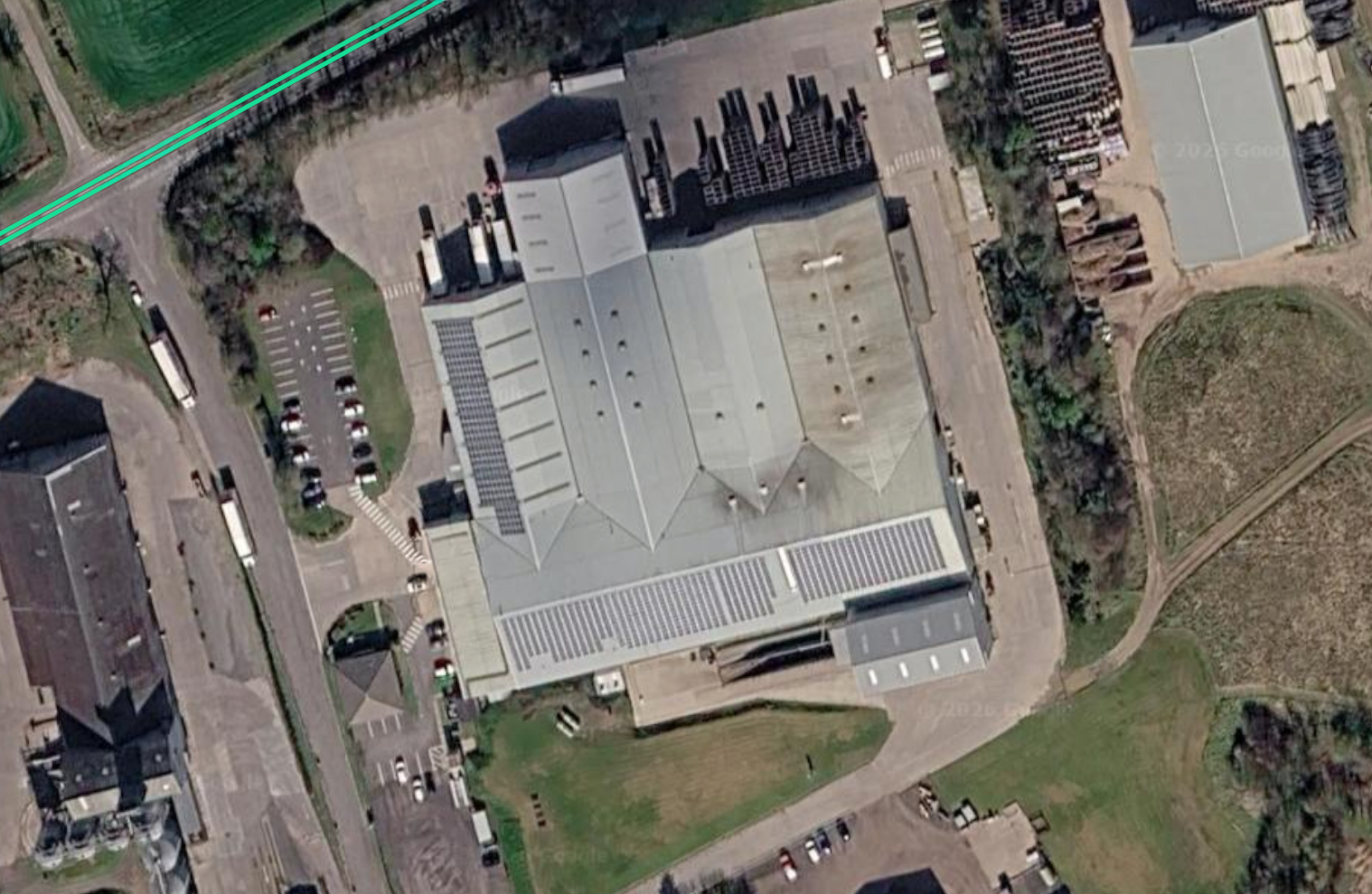
A food production site in Scotland operates a rooftop solar array across two large roof planes, one facing south and one facing west, carrying 1,026 modules and approximately 241 kWp of generating capacity. For a business of this kind the array is working plant rather than a showpiece: it offsets a continuous industrial load, and any generation it quietly stops producing goes straight to the bottom line. The site has been generating for some years and had reached the point where its owners needed to know the condition of the array itself, not simply what the inverters were reporting.
Inverter data tells an operator how much a system produced. It does not tell them which module is running hot, which sub-string has been bypassed, or whether a fault is stable or advancing. Those distinctions matter, because a cell that has been driven into reverse bias is dissipating energy as heat instead of generating it, and left alone that heating is itself a degradation mechanism. A solar PV thermographic inspection is the only practical way to see the array at module and cell scale across a roof of this size without touching a single panel.
Drone Media Imaging was commissioned to survey both roof planes and produce a certified report to IEC 62446-3:2017. The brief was to establish the true condition of the array, classify anything found by both thermal severity and its commercial consequence, and locate every finding precisely enough that a contractor could go to it. The whole survey, analysis and reporting package was delivered by Drone Media Imaging, with all interpretation and certification carried out by our Level 3 Master Thermographer.
Governing Standards
- IEC 62446-3:2017 The international standard for thermographic inspection of photovoltaic modules and plants, which sets the environmental conditions, the inspection classifications and the reporting requirements this survey was carried out under.
- ISO 18436-7 The alignment framework for the training and assessment of thermographic condition monitoring personnel, against which our Level 3 Master Thermographer’s certification is structured.
How was the thermographic survey carried out?
How Is a Solar PV Thermographic Inspection Carried Out to IEC 62446-3?
IEC 62446-3:2017 sets conditions before it sets method, because a thermographic survey flown in the wrong conditions produces confident nonsense. The array must be generating under sufficient irradiance, wind must be low enough that convective cooling does not wash out the very differences being looked for, and the modules must be at thermal steady state. Both roof planes were flown in the afternoon with in-plane irradiance comfortably above the 600 W/m² minimum throughout, wind well inside limits, and the array on and under load. Conditions were logged continuously with an industry-grade weather meter and an IEC-compliant irradiance meter.
Capture was by drone at a target ground sample distance of 3 cm, close enough to resolve behaviour at individual cell level across more than a thousand modules. The two planes were surveyed in separate windows because their orientation and solar geometry differ, and were treated as separate datasets throughout. Radiometric parameters were set per plane from the measured conditions rather than left at instrument defaults, which is what makes the resulting temperatures defensible.
Analysis was carried out afterwards, not in the field. Each thermogram was assessed against an EL1 baseline, a reference measurement taken from a healthy module of the same orientation within that same image. Comparing against a neighbour rather than an absolute figure removes irradiance, ambient temperature and passing cloud from the equation in one step, and it is what separates a genuine fault from a reflection.
- Included: aerial thermographic capture of both roof planes, RGB reference imagery, Level 3 analysis of every anomaly, severity and consequence classification, positional mapping, and a certified report.
- Not included: electrical testing, intrusive investigation, or any remedial work. Findings identify areas warranting further investigation by a suitably qualified contractor.
What did the solar thermographic inspection find?
The array was found to be in normal operating condition for a system in established service. That is the headline, and it is worth stating plainly, because a report that opens on its worst measurement misrepresents a roof that is, in substance, working as it should. Of the thirty-four thermograms analysed, six carried Advisory observations, twenty-three classified Low, four Medium and one High. No finding anywhere on the array carried a safety consequence, and no measurement came close to a temperature at which fire or arc-fault risk becomes credible.
The predominant finding was symmetrical cell-level heating, where a small number of cells within a module run warmer than their neighbours in a repeating, mirrored pattern. That symmetry is the diagnostic anchor. A repeating mirrored signature points to a cell-level electrical origin, whereas a surface effect such as dirt or a deposit presents patchily and does not mirror. At this scale the module’s bypass diode continues to carry the string current, so these features cost no output today and are reported for their trajectory rather than any present loss.
A smaller number of findings sat at sub-string scale, where a bypass diode was found conducting and the section it protects was producing nothing at the time of survey. Those carry a present yield consequence and are the findings with immediate commercial effect. One module presented a uniform elevation across its whole face, indicating it was limiting the current of its string. Crucially, no string-scale condition was found on either plane, which is the most consequential fault class a system of this design can develop.
What the client received, and what happens next
The deliverable was a certified report under IEC 62446-3:2017, personally signed by our Level 3 Master Thermographer. Every finding carries two classifications: a severity band expressing thermal magnitude, and a Drone Media Imaging Consequence Classification expressing what it means commercially, whether that is Yield for output being lost now, or Degradation Trajectory for a mechanism likely to progress. Two axes, because a small differential on a bypassed sub-string can cost more output today than a dramatic one on a single cell.
Every finding was located to a specific row and column on an array map built from the survey imagery, so a contractor attending site can walk to the module rather than hunt for it. The report also recorded two matters outside the thermal findings: fifteen vacant module mounting positions, representing capacity absent from the roof, and distributed biological growth across the west-facing plane, reported as an independent maintenance matter rather than a cause of any classified finding.
- Review the sub-string and module-scale findings with a suitably qualified electrical contractor, as these are the ones affecting output now.
- Establish with whoever maintains the array why fifteen module positions are vacant and whether replacement is intended.
- Address the biological growth before it extends further, since growth of this kind spreads season on season rather than stabilising.
- Re-survey at the next scheduled interval and compare differentials against this baseline to see what has moved.
That last point is where the real value sits. A single thermographic survey describes a moment. This one now gives the operator a classified, located reference against which the next inspection can be read, so progression is caught while it is still minor and inexpensive.
Know what your solar array is really doing
Drone Media Imaging carries out solar PV thermographic inspections to IEC 62446-3:2017, with every finding classified for both thermal severity and commercial consequence, and located module by module. Survey, analysis and certified reporting are delivered in-house by our Level 3 Master Thermographer. We cover Sussex, Hampshire, Kent and Surrey, and travel throughout the UK, Ireland and Europe.