
See the Whole Roof, Not the Part Somebody Could Reach
A roof gets inspected in the places a person could stand. That sounds obvious written down, and it is the single thing most likely to explain why a defect was found late. Ladders reach the eaves. A tower or a scaffold covers the elevation it was put up against. A roof walk covers the runs that will take the weight. Everything else gets inferred, and inference is how a problem stays hidden for a year.
The result is not carelessness, it is geometry. Access equipment is expensive to move and slow to reposition, so it goes up where the concern already is. The inspection then confirms what somebody already suspected, and the parts of the roof nobody suspected are never photographed at all. Valleys, back gutters behind stacks, the far slope of a hip, the middle of a large flat roof, the inner face of a parapet: all of them are ordinary roof components, and all of them are awkward to reach.
Photographing a roof from the air does not make anyone a better judge of roofing. What it changes is which parts of the roof end up in front of a judgement at all. Drone Media Imaging photographs the whole covering, close enough for the detail to read, and marks what is worth somebody’s attention. The interpretation stays with the roofer or the surveyor, which is exactly where it belongs.
Blog Content TL;DR...
Why roofs get inspected in patches, and what changes when they do not.
- Access equipment decides coverage, so the part of the roof that gets looked at is the part somebody could reach.
- Moving access costs real money, so it goes up where the concern already is and tends to confirm the suspicion that paid for it.
- Fragile coverings restrict a roof walk most severely on the oldest roofs, which are the ones most worth inspecting.
- From the air every plane can be photographed square on, so valleys, back gutters and far slopes become ordinary shots.
- Complete coverage lets every contractor price the same roof, and tests whether a recommendation to replace is supported.
It is a visual inspection, not a building survey, and the interpretation stays with your contractor.
Access Decides What Gets Looked At
Why the awkward parts of a roof are the parts that stay unseen
Every traditional route onto a roof has a shape, and that shape decides the inspection. A ladder gives you the gutter line and a metre or so above it, from wherever the ladder can safely stand. A scaffold gives you one elevation properly and the rest not at all. A mobile platform needs hardstanding, reach and room to set up, none of which a town centre terrace or a yard full of parked vehicles reliably offers. Each route answers a different question, and none of them answers the question of what the whole roof looks like.
The defect you find is the defect near the access
Because moving access equipment costs real money, it goes up once, where the concern already is. That is a sensible commercial decision with an unhelpful consequence: the inspection tends to confirm the suspicion that paid for it. A slipped tile reported from a bedroom window gets looked at, and the failing flashing on the other side of the ridge, which nobody has noticed yet, is not in the photographs, because nobody was ever standing where it could be seen.
Some of it cannot be walked on at all
Fragile rooflights, ageing cement sheeting, thin metal decking and weathered slate all restrict where a person may put their weight, and the restriction is tightest exactly where the roof is oldest. On those buildings the accessible area and the area worth inspecting are close to opposites. The roof does not get a partial inspection because anyone cut corners. It gets one because the covering will not carry the inspector.
why parts of a roof never get inspected, what a ladder inspection cannot show you, getting eyes on a whole roofwhy parts of a roof never get inspected, what a ladder inspection cannot show you, getting eyes on a whole roof
What Changes When the Camera Leaves the Ground
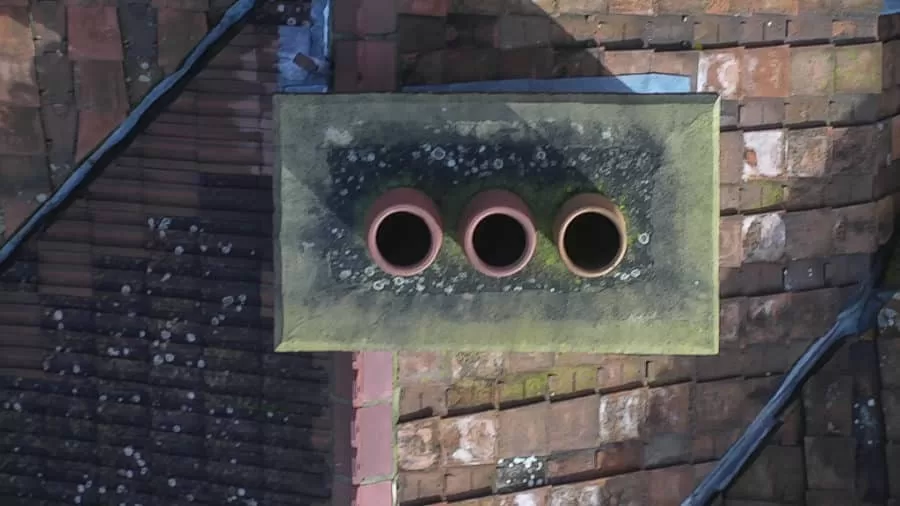
An aircraft removes the constraint that was doing the damage. The camera is no longer limited to where a person can stand, so the awkward parts of the roof stop being awkward. The back gutter behind a chimney stack, the junction where two pitches meet, the far slope that faces away from the road: these become ordinary shots rather than the reason a scaffold has to be hired.
Every plane can be viewed square on
This matters more than height does. A photograph taken at a shallow angle across a slope compresses everything and hides the lift in a tile or the gap under a flashing. The same detail photographed square on, from directly out in front of it, reads immediately. Flying lets each plane of a roof be approached on its own terms, so a building with several pitches, dormers and valleys is covered as a set of properly framed surfaces rather than one oblique view of the whole thing.
Coverage becomes systematic rather than opportunistic
Where a roof is large, it is worked slope by slope so the record is complete and every image can afterwards be placed on the building. Where the question is one suspected problem, the effort goes the other way, into photographing that one thing properly from several angles. Both are legitimate scopes, and the client sets which one applies rather than the access equipment settling it by default.
Nobody has to be on the covering
The practical effect is that a fragile roof and a sound roof receive the same inspection. There is no longer a trade-off between how much of the roof gets seen and what it is safe to walk on, because the two have stopped being connected.
What Complete Coverage Is Actually Worth
Covering the whole roof changes the conversation that follows, and that is the real return rather than the photographs themselves. When every slope has been recorded, a roofing quote can be priced against the same evidence by every contractor asked, instead of each one pricing whatever they could see from their own ladder. That alone tends to explain why three quotes for the same roof arrive so far apart.
It also changes what a recommendation to replace has to stand up against. If a full set of images shows deterioration across every slope, the recommendation is supported and the owner can spend with some confidence. If the images show one failing area and sound covering elsewhere, that is a different conversation, and it is one the owner could not have had before, because they had never seen the rest of the roof.
A dated and complete record is worth something later as well. Repeat it and the comparison shows what is actually deteriorating rather than what somebody remembers, which is a firmer basis for a maintenance budget than an opinion. After a storm, a set of images from before it is the difference between arguing about wear and demonstrating a change.
What it does not do is settle the question on its own. Photographs record surfaces. They do not see beneath a covering, into a cavity or through a ceiling, and Drone Media Imaging offers no building survey, no structural assessment and no condition grading. Observations are reported as areas warranting further investigation by a suitably qualified contractor. Roofing contractors and chartered surveying practices commission this imagery themselves, precisely so that their own judgement has something complete to work from.
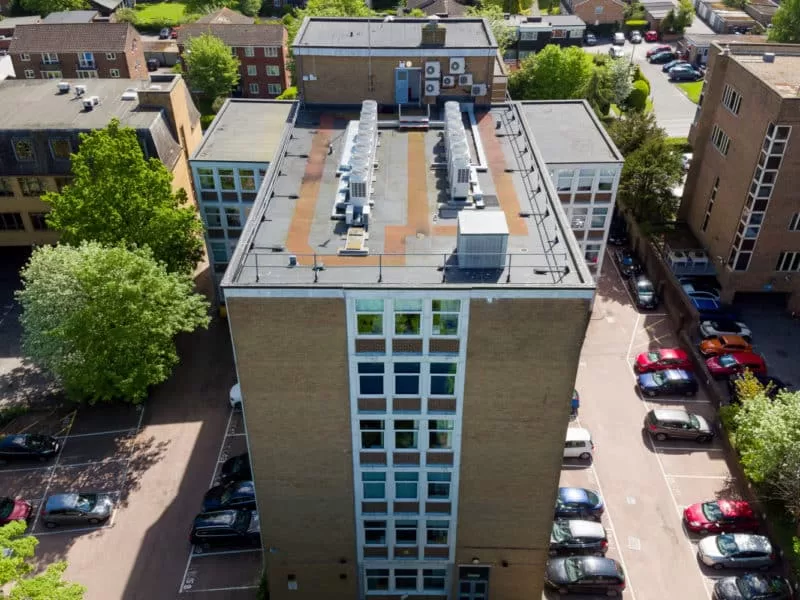
Roof inspection coverage is decided less by effort than by which components can be reached. Roofs fail at edges and junctions rather than in the middle of a slope, and edges and junctions are exactly what access equipment struggles with.
Reachable from a ladder: the gutter line, the fascia, the lowest course of tiles or slates, and the outer face of the eaves.
Reachable with a scaffold, tower or platform: ridge and hip mortar, verges, abutment flashings, the upper courses of a slope, and anything on an elevation the equipment was not erected against.
Reachable only by walking the roof: valley gutters, back gutters behind stacks, the area around rooflights and plant, and membrane seams and outlets on a flat roof.
Frequently not safely reachable at all: fragile rooflights and the covering around them, corroded metal decking, weathered slate, steep pitches, and the inner faces of parapets on tall buildings.
From the air, the last three groups cost no more to photograph than the first.
How This Work Is Framed
- This is a visual inspection service. Drone Media Imaging photographs what is visible and describes what the photographs show. No building survey, structural assessment, condition grading or professional opinion on the condition of a roof or structure is offered or implied, and no surveying qualification is held or claimed.
- Findings are reported as observations warranting further investigation by a suitably qualified contractor or surveyor.
- Drone Media Imaging carries out no roofing, repair or maintenance work of any kind, and has no commercial interest in what an inspection does or does not find.
- Flight operations are conducted under a Civil Aviation Authority Operational Authorisation and are fully insured for commercial operation.
Tell Us Which Roof, and What You Have Not Been Able to See
A leak nobody can trace, a quote you would like tested against the whole roof, or a building you are responsible for and have never been on top of. Tell us the address and what prompted the enquiry, and we will come back with what we would cover and a fixed price for it.
Sussex, Hampshire, Kent and Surrey are home ground, and we travel throughout the UK, Ireland and Europe where the job warrants it.
related posts
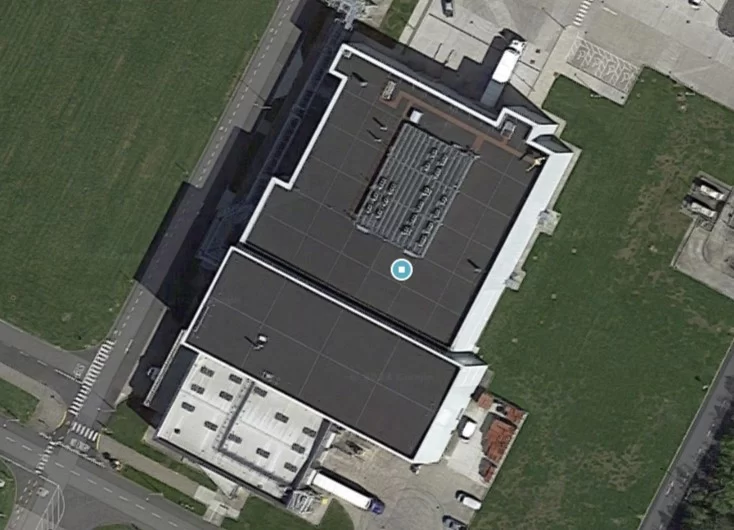
A drone roof inspection puts high-resolution, annotated imagery of every gutter, valley, ridge and fixing in your hands without scaffolding, access equipment or anyone leaving the ground. Autumn is the last sensible window to commission one before winter weather tests the roof for you. This post explains what the inspection delivers, how the imagery is captured and annotated, and why a dated photographic baseline of your roof earns its keep all winter, across Sussex, Surrey, Kent and beyond.
The instinct on an inspection is to move in close. On most sites that is the least useful thing the pilot can do, because proximity puts the platform among the hazards and changes the surface being measured. Standoff inverts the trade, letting the optics close the gap instead. This piece sets out what standoff buys on a working site, what actually governs the working distance, and where the limits sit, including why a thermal measurement is never a zoomed view.
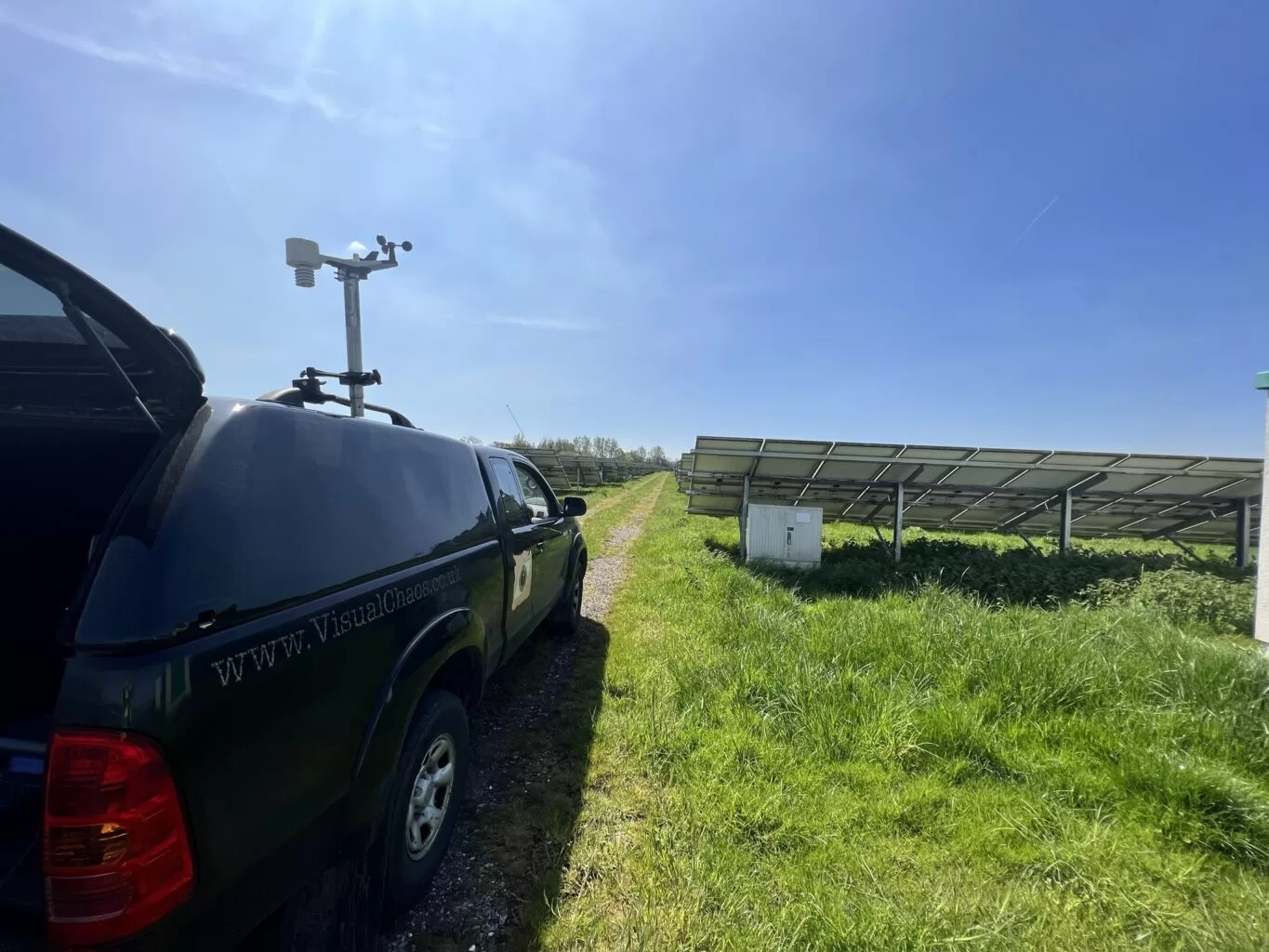
Qualified thermographers play a crucial role in ensuring reliable solar panel inspections. With certification, they possess the necessary expertise to accurately identify and diagnose potential issues, maximizing the efficiency and longevity of solar systems. Their knowledge and skills are invaluable in maintaining the integrity and performance of these renewable energy sources.