
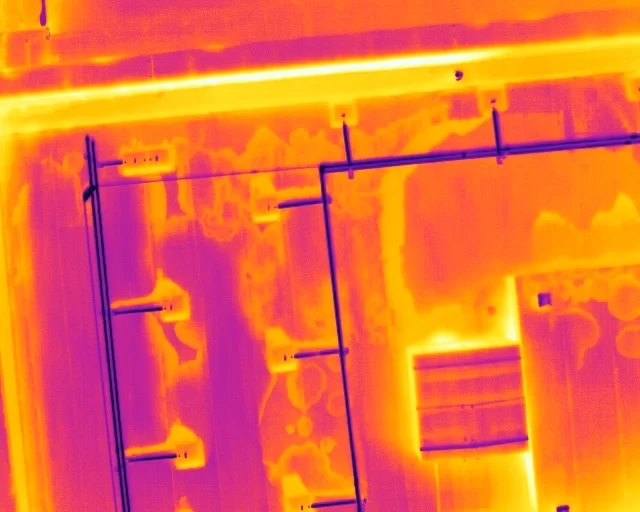
Wet insulation, and the heat it refuses to give up
A flat roof rarely tells you where it is leaking. Water finds a defect in the membrane, soaks into the insulation below, and then travels sideways through the build-up until something stops it. By the time a stain appears on a ceiling, the water has usually moved some distance from the point where it got in, and the saturated area may be larger again than either. That is the awkward truth behind every roof leak that has been chased, patched and chased again.
Thermal imaging works on this problem because wet insulation behaves differently from dry insulation, not because a camera can see water. Water has a high heat capacity, so a saturated area stores more energy during the day and gives it up more slowly once the sun goes off the roof. In the hours after sunset the dry roof cools away and the wet areas lag behind, and that difference in cooling rate is what a survey records.
This article covers the build-up itself, why moisture becomes trapped in it, how it tracks away from its entry point, and why that lateral movement is the strongest argument there is for surveying the whole roof plane rather than the area beneath the stain. It also sets out plainly what a thermal survey can conclude and what it cannot. Timing is dealt with only in passing here, because the survey window is a subject in its own right.
Blog Content TL;DR...
What a thermal survey of a flat roof is actually detecting, and why it looks at the whole roof.
- A flat roof is a layered build-up: waterproof membrane, insulation, structural deck. Only the membrane is designed to keep water out.
- Water entering a membrane defect soaks into the insulation and is held there, because the layers above and below it are both relatively impermeable.
- Wet insulation stores far more heat than dry insulation, so it cools more slowly once the sun comes off the roof. That difference in cooling rate is the signature.
- Water tracks sideways through the build-up, so the entry point, the saturated area and the internal stain are usually three different places.
- That lateral tracking is why the whole roof plane is surveyed rather than the area above the stain.
A thermal survey identifies areas warranting further investigation by a suitably qualified contractor. It is not a building survey, a structural assessment or a condition grading.
The Roof Build-Up, and Where the Water Actually Goes
Membrane, insulation and deck, and why the layer that fails is not the layer that gets wet
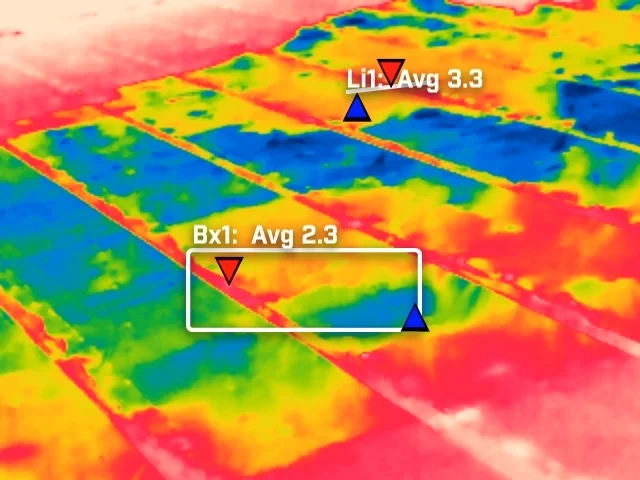
Three layers, and only one of them is waterproof
A flat or low-slope roof is a layered system rather than a single surface. A waterproof membrane sits on top, insulation sits beneath it, and a structural deck carries both. The membrane is the only layer designed to keep water out, and it is the layer exposed to ultraviolet light, foot traffic, thermal movement and every penetration the building needs for plant, flues and outlets. Insulation, by contrast, is designed to trap air, and the moment it traps water instead it stops doing the job it was specified for.
Water gets in at a point and spreads over an area
Entry is usually small and specific: a split at a lap joint, a failed detail around an outlet or upstand, a puncture, or a movement crack. What happens next is governed by the build-up rather than by the defect. Water passing the membrane reaches the top face of the insulation and then follows the path of least resistance, running along board joints, between the insulation and the vapour control layer, and down the falls built into the roof. It is held there because the membrane above and the deck below are both relatively impermeable, so the water that got in has nowhere obvious to leave from.
Trapped, not passing through
This is why the word entrapment is the right one. A pitched roof sheds water and dries; a flat roof with a saturated insulation layer holds it, often for years, because there is no ventilation path and no drying gradient to remove it. The insulation loses thermal performance as the voids fill, the deck beneath it stays damp, and the wet area tends to grow each time it rains. None of that is visible from the surface, and a membrane can look entirely sound above insulation that is thoroughly wet.
why wet roof insulation holds heat longer than dry, how water tracks sideways through a roof build-up, what a roof thermal survey can confirmwhy wet roof insulation holds heat longer than dry, how water tracks sideways through a roof build-up, what a roof thermal survey can confirm
Why the Difference Shows Up Thermally
Heat capacity, not temperature
Water stores a great deal of energy for each degree of temperature change, far more than the air-filled cells of dry insulation. A roof area whose insulation is saturated therefore carries a much larger thermal store than the dry roof around it, even though both sit at broadly the same surface temperature in the middle of a sunny afternoon. The distinction that matters is not how warm the roof is, it is how quickly it changes. Two areas can read the same at one moment and diverge sharply an hour later.
Charge by day, discharge by night
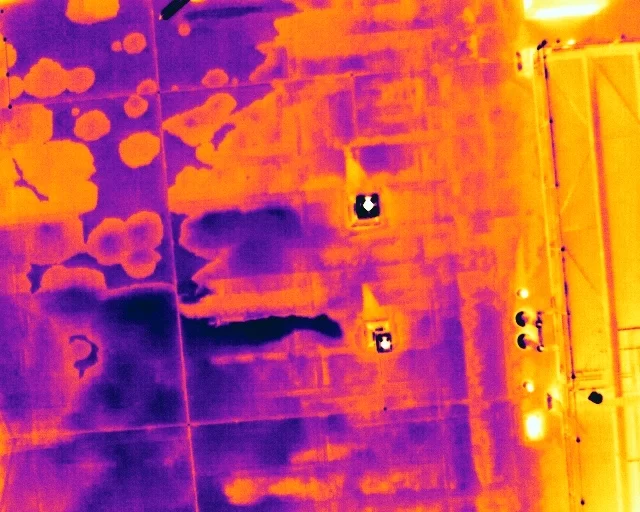
A clear sunny day loads the whole roof plane with solar energy. Once the sun comes off it, the roof begins to radiate that energy back to a cold sky, and the dry areas, holding little of it, cool quickly. The saturated areas release their much larger store far more slowly and remain measurably warmer than their surroundings while the rest of the roof falls away beneath them. The survey is therefore built around a cooling roof rather than a warm one, and the pattern it records is a map of differing cooling rates across a single plane. Cloud, wind and rain all suppress that pattern by evening out the way the surface loses heat.
What else looks warm
A warm patch is not automatically wet insulation, and a competent survey treats it as a candidate rather than a finding. Rooftop plant, flues, vents, warm rooms below the deck, ballast, standing water and recent repairs all hold or generate heat in ways that can mimic the signature. Reflective foil facings, green roofs and inverted or ballasted build-ups can suppress it altogether. This is why the thermal frames are read alongside daylight photography and a record of the conditions, and why the roof is walked or overflown in visible light as well as thermally.
Why the Whole Roof Plane Is Surveyed
The leak, the wet area and the stain are three different places
Because water tracks laterally once it is inside the build-up, the point of entry, the extent of the saturated insulation and the position of the internal stain rarely coincide. The stain appears wherever the water finally found a way through the deck, which may be at a fixing, a joint or a service penetration some distance from where it entered. Scoping a survey to the area above the stain therefore samples the one place least likely to explain the problem. It is a reasonable instinct and it is the wrong geometry.
Whole-plane coverage, and why the air suits it
Surveying the entire roof plane in one pass turns the geometry the right way round. Instead of testing a hypothesis about where the leak is, the survey maps the extent of the anomaly and lets the pattern point back towards the entry. Flown coverage makes this practical on large, awkward or inaccessible roofs where a walked survey would be slow, and it removes the need to work at height on a surface whose condition is the thing in question. Overlapping passes in two directions mean every part of the roof appears in more than one frame, so a warm area can be checked from more than one viewing angle.
What the survey concludes, and what it does not
A thermal survey of a roof is a qualitative method. It identifies areas whose thermal behaviour is consistent with trapped moisture, and it identifies areas warranting further investigation by a suitably qualified contractor. It does not confirm the presence of water on its own, which is settled by corroboration on the roof, and it is not a building survey, a structural assessment or a condition grading of the roof covering. Recording is aligned with EN 13187:1999 where relevant, and the findings are professional opinion at the time of the work.
The method depends on a thermal contrast that the weather has to create. A clear day with several hours of direct sun on the roof charges the plane; a clear, calm evening lets it discharge unevenly. Cloud re-radiates to the surface and flattens the pattern, wind drives convective cooling that evens the surface out, and recent rainfall wets the membrane and masks what lies beneath it. Standing water behaves as a thermal store in its own right and is recorded as a feature, not read as moisture.
Surface emissivity on common roof coverings, mineral felt, bitumen, single-ply and mastic asphalt, sits high enough to image reliably, in the region of 0.90 to 0.95. Foil-faced and bright metal surfaces have low emissivity and high reflectivity, and are recorded as a limitation rather than surveyed through. Reflected apparent temperature is set against the sky condition at the time, and the conditions record is kept alongside the imagery so the analysis can be re-read later.
Governing Standards and Competence
- Survey conducted by Steve Fisher, ITC Level III Certified Master Thermographer (Infrared Training Centre; Certification #205722059).
- Practising in accordance with the frameworks of ISO 18436-7:2014, ASNT SNT-TC-1A and ANSI/ASNT CP-105, and BINDT CMGEN Appendix B as UK training governance.
- Methodology aligned with EN 13187:1999 for thermographic examination of building envelopes, as applicable to the roof plane.
- Findings are professional opinion at the time of the work, and identify areas warranting further investigation by a suitably qualified contractor.
- No building survey, structural assessment or condition grading is offered or implied.
Talk to Us About Your Roof
Drone Media Imaging carries out roof thermography across Sussex, Hampshire, Kent and Surrey, travelling throughout the UK, Ireland and Europe. If you have a flat roof that is leaking and the source has not been found, tell us what you already know about it. We will tell you plainly whether a thermal survey is the right tool for the problem, and what conditions it would need to give you a usable answer.
related posts

Quantitative and qualitative thermography are two essential methods in thermal imaging analysis. Quantitative thermography measures exact temperature values, while qualitative thermography focuses on pattern recognition. Both play a crucial role in building inspections, electrical fault detection, and industrial diagnostics. Understanding their differences helps professionals choose the right approach for accurate thermal assessments. Drone Media Imaging provides expert thermographic services, ensuring precise, reliable results. Contact us today for professional thermal imaging analysis.
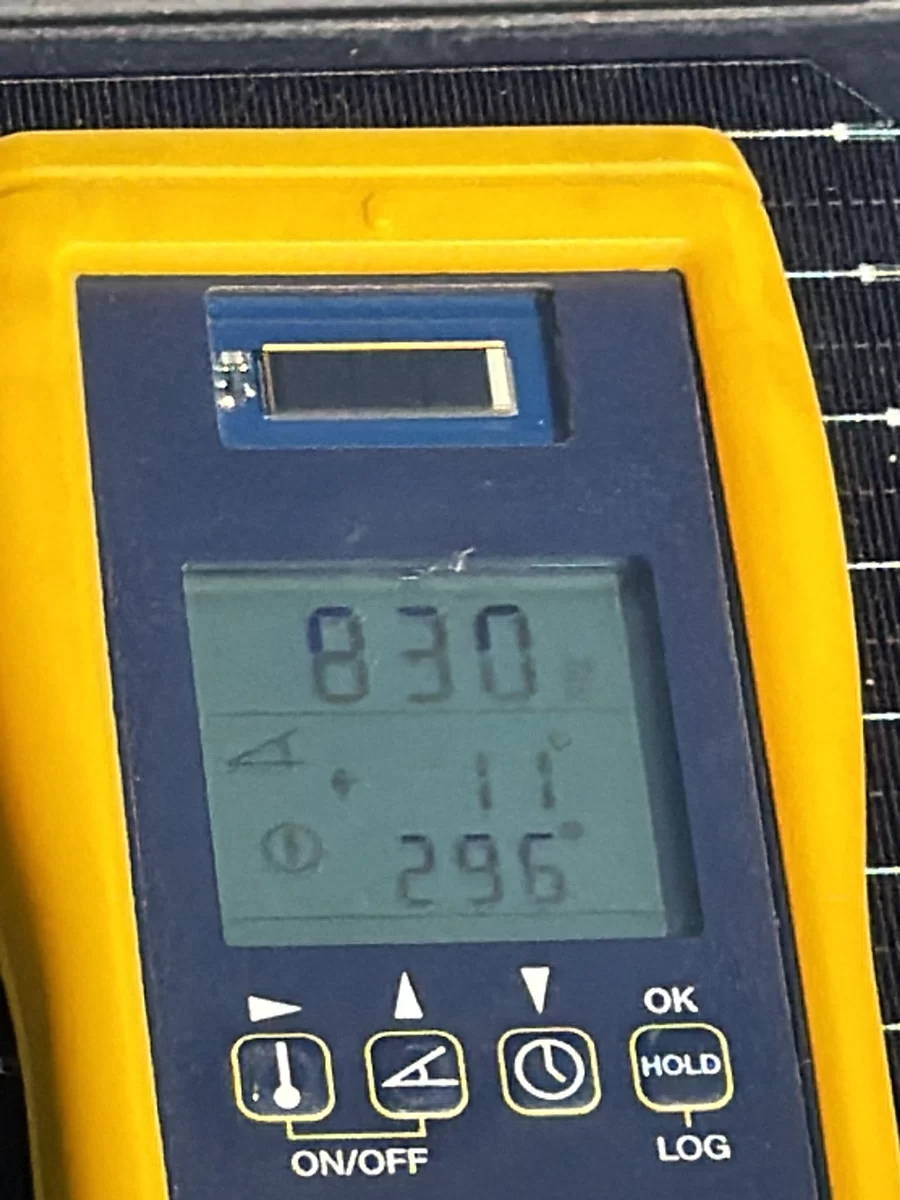
A solar thermographic survey only produces usable evidence when the array is generating properly. IEC TS 62446-3:2017 sets the minimum at 600 W/m² in the plane of the array, and sun elevation, sky stability, wind, wet panels and a curtailed array will each close the window on their own. This post explains why those conditions decide the data, and why a survey flown outside them tends to return a false all-clear rather than an honest result.
Booking a drone operator means checking paperwork, and the names have changed since most checklists were written. This piece sets out the three families of document a client should ask for, registration, authorisation and insurance, what each proves, and the pairs most often confused: an Operator ID against a Flyer ID, an Operational Authorisation against the retired PfCO, a GVC against an A2 CofC. It closes with the paperwork that belongs to your job rather than the operator.