
The Number Is Not the Evidence
Ask what temperature difference proves that a roof has water trapped in it, and you will usually be given a number in degrees, offered as though it were a pass mark. It is not one, and treating it as one is how a sound roof gets condemned and a wet one gets cleared. A thermal camera does not detect water. It measures the temperature of a surface, and it arrives at that figure through emissivity, reflection, viewing angle and whatever the sky happens to be doing overhead.
What identifies saturated material is not a magnitude at all. It is behaviour, the way one area holds the day’s heat while everything around it lets go of it, and the shape that area makes as the roof cools through the evening. A region that lags behind its surroundings and spreads outward from a detail is telling you something. A region two degrees warmer than its neighbour, on a windy night, under broken cloud, on a surface nobody has established an emissivity for, is telling you very little.
This post is about that distinction, and about the conditions the method depends on, because they are the same subject approached from opposite ends. Get the conditions right and the pattern speaks for itself. Get them wrong and no amount of care in the analysis afterwards will recover the survey.
Blog Content TL;DR...
What a thermal roof survey is actually reading, and what has to be true for it to read anything at all.
- The camera measures surface temperature, not water. Emissivity, reflected temperature and viewing angle all sit between the radiation arriving at the lens and the figure on the screen.
- Wet material lags, it does not simply run hotter. Water holds a great deal of energy and releases it slowly, so saturated areas fall behind the dry surface around them as the roof cools.
- A fixed temperature difference is not a test. The size of the contrast depends on the day, the build-up, the wind and the hour, so a threshold taken from one roof means nothing on another.
- The survey is qualitative by design, aligned with EN 13187:1999, which concerns detecting thermal irregularities in building envelopes rather than grading them against a number.
- Conditions decide the outcome before the flight. Rain, standing water, wind and cloud each remove the signal, and the day before the survey matters as much as the night of it.
The pattern is the evidence. The temperature is only the description of one evening.
What the Camera Is Actually Measuring
Surface temperature, reached through corrections that have to be set on site
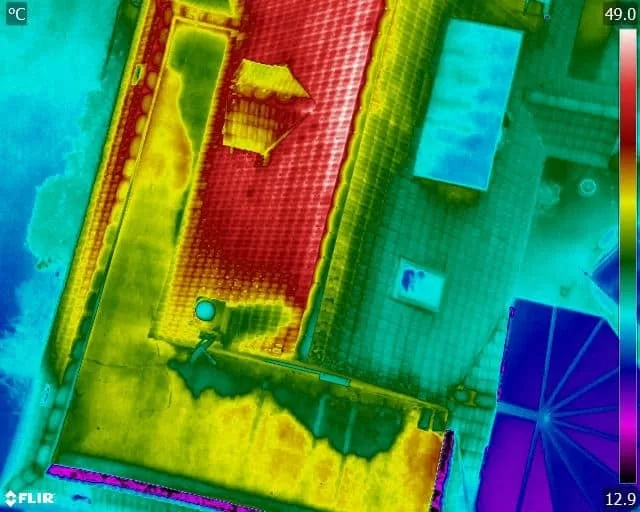
Every radiometric reading is a calculation rather than an observation. The camera collects the radiation arriving at its lens and works backwards to a temperature, and to do that it has to be told how much of that radiation the surface emitted itself, how much it reflected from somewhere else, and what the air in between did to the remainder. Get those inputs wrong and the figure on the screen is wrong with complete confidence.
Emissivity, and why roof coverings are the forgiving case
Emissivity is the ratio of what a surface radiates to what a perfect radiator at the same temperature would. Most roof coverings sit high and behave well. Roofing felt is around 0.91, asphalt and tar-based surfaces run from roughly 0.90 to 0.98, and water itself is about 0.96. In that band a modest error in the setting produces only a modest error in the result, which is why building fabric is comparatively easy to work on. Bare bright metal is the opposite case, sitting far lower and reflecting a great deal more than it emits, and it is where roof thermography becomes genuinely awkward.
Reflected apparent temperature, and the cold sky
The second correction is the one outdoor work lives or dies on. Whatever the roof reflects reaches the lens alongside what it emits, and on a clear night the dominant object in a flat roof’s field of view is the sky, which is extremely cold. That reflected component is measured on site and entered, never assumed from a table, and it is established against the actual surface being surveyed. The same clear sky that makes the survey possible, by letting the roof radiate freely, is also the single thing most likely to corrupt the measurement of it.
why wet insulation reads warm on a thermal image, what conditions a night roof thermography survey needs, why a fixed temperature difference proves nothing on a roofwhy wet insulation reads warm on a thermal image, what conditions a night roof thermography survey needs, why a fixed temperature difference proves nothing on a roof
Why Wet Material Lags Behind Dry Material
The property doing the work
Water has a high specific heat capacity. It takes a great deal of energy to raise its temperature, and it gives that energy back slowly. Insulation that has taken up water is therefore thermally heavy compared with the dry foam or mineral fibre lying beside it under the same membrane. The two do not differ greatly in the temperature they eventually reach. They differ in how long they take to get there, and how long they take to leave.
Why that only becomes visible at certain hours
Through the day the roof absorbs solar energy, and while the sun is on it the surface pattern is dominated by which parts received the most of it. A survey flown in the afternoon largely maps shading. After sunset the roof begins to radiate to a cold sky, and the dry areas, having little stored energy, cool quickly. The wet areas hold more and fall behind, so they emerge as warmer regions against a surface that is dropping away around them. The contrast opens, reaches a peak, and closes again as everything settles towards equilibrium with the night air.
Why the number will not transfer
How large that difference becomes depends on how much sun the roof took during the day, the depth and make-up of the build-up, the wind, the cloud and how long ago the sun went down. A figure measured on one roof on one evening therefore says nothing about the next. This is why the methodology aligned to this class of work, EN 13187:1999, is qualitative: it concerns the detection of thermal irregularities in building envelopes, not their certification against a temperature. The pattern, its shape and its behaviour over time are the evidence. The number is a description of one night.
What Has to Be True Before Anyone Flies
The day before matters as much as the night
The method depends on the roof having taken in energy that it can then give back, so a cold overcast day leaves very little to work with. The charge and the discharge are one process, and a survey booked purely on the forecast for the evening ignores half of it.
What removes the signal altogether
Rain wets the whole surface evenly and hides what is underneath. Standing water reads as a large cool area whatever lies below it. Wind carries away the thin surface layer the camera is reading, flattening the very differences that matter. Cloud does two things at once: it limits what the roof took in during the day, and it raises the effective temperature of the sky the roof radiates to at night, slowing the cooling the whole method rests on. Any one of these is a reason to move the date rather than press on and interpret a weak image.
Geometry, which is quietly decisive
Emissivity falls and reflection rises as the viewing angle moves away from perpendicular, so imagery is kept within roughly 30 to 45 degrees of normal to the surface. On a large roof that is not a detail. It dictates the flight pattern and the height, and it is one of the reasons this work is planned rather than flown by eye.
And what it still does not do
A thermal anomaly is a candidate, not a conclusion. Patch repairs, plant bases, differing build-ups and an afternoon spent in shade all produce one. Findings are reported as areas warranting further investigation by a suitably qualified contractor, corroborated on site where that is possible, and separated into what is confirmed and what is suspected. Drone Media Imaging provides survey, analysis and reporting. What the roof needs afterwards belongs to your own roofing contractor or surveyor.
Governing Standards and Scope
- Thermographic inspection, analysis and reporting are conducted by Steve Fisher, ITC Level III Certified Master Thermographer (Infrared Training Centre; Certification #205722059), practising in accordance with the frameworks of ISO 18436-7:2014, ASNT SNT-TC-1A and ANSI/ASNT CP-105, and BINDT CMGEN Appendix B (UK training governance).
- Survey methodology is aligned with EN 13187:1999, the qualitative detection of thermal irregularities in building envelopes.
- Thermography is an indirect technique. It measures surface temperature distribution and not the presence of water, so a reported area is a candidate for corroboration rather than a conclusion in itself.
- Emissivity and reflected apparent temperature are established on site against the actual surface and recorded with the data, together with the environmental conditions and the time elapsed since sunset.
- Object parameters are held consistent across a multi-day project so that comparisons between nights remain valid.
- Flight operations are conducted under a Civil Aviation Authority Operational Authorisation held against the PDRA-01 standard scenario, with a General VLOS Certificate (GVC) and an A2 Certificate of Competency.
- Drone Media Imaging provides survey, analysis and reporting. Repair, specification and opening up are not offered and remain with your own roofing contractor or surveyor.
Ask Whether the Conditions Suit Your Roof
If you are weighing up a thermal survey, the useful first conversation is about the roof and the weather rather than the price. Send a photograph of the covering, the approximate area and what you need the survey to settle, and you will get a straight answer on whether the method suits it. Drone Media Imaging works across Sussex, Hampshire, Kent and Surrey, travels throughout the UK, Ireland and Europe, and undertakes thermography work globally.
related posts
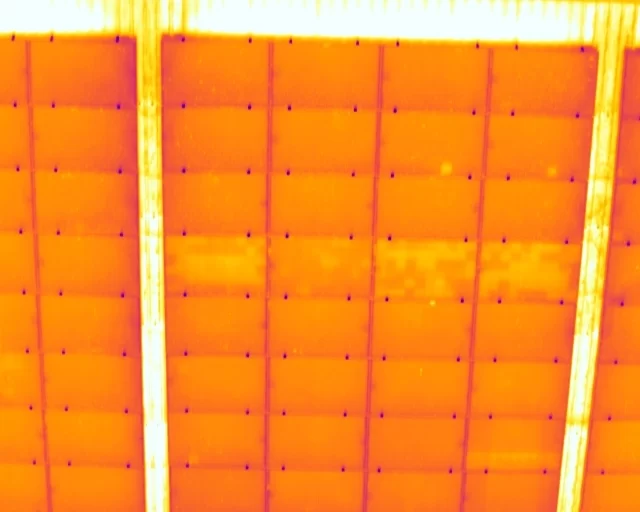
A solar installation is a four-level hierarchy: cell, sub-string, module and string within the array. A thermal camera records surface temperature across a flat plane, but the fault sits somewhere in that electrical structure, and interpretation is the work of deciding which level a warm area belongs to. This piece explains how photovoltaic installations are wired, why bypass diodes divide a module into blocks, and why the as-built string layout is as much a survey document as the imagery.
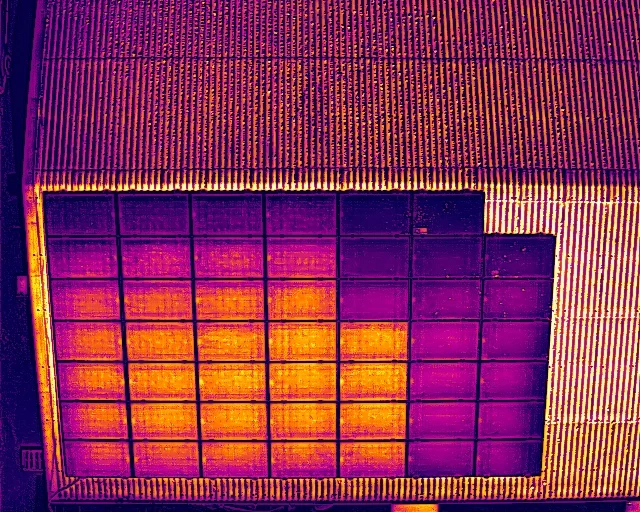
A drone or a ladder? The two are not the same solar inspection done two ways, and they produce different evidence. A visual check finds visible damage. A handheld thermal camera sees heat but, from a ladder, looks across the array at an angle where glass reflects the sky. A drone records every module from above under one set of conditions. This post sets out what each can see, why angle and timing change the reading, and where each belongs.
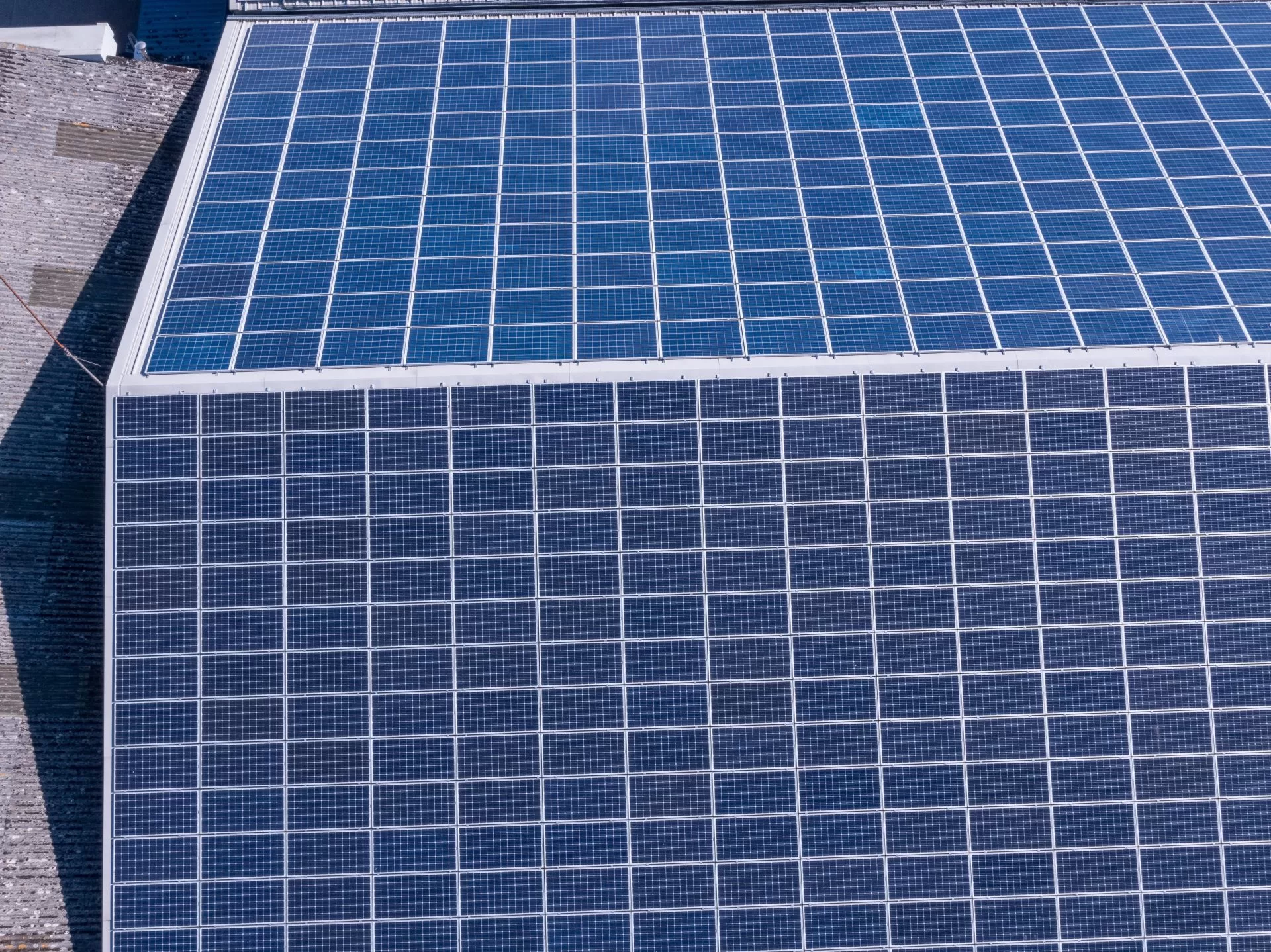
Spring and summer are peak months for solar energy production—ensure your panels are operating efficiently with a professional thermal imaging inspection. Compliance with IEC62446-3:2017 is essential for both commercial and domestic systems, helping to prevent faults, optimise performance, and maintain insurance coverage. Book your inspection today!