
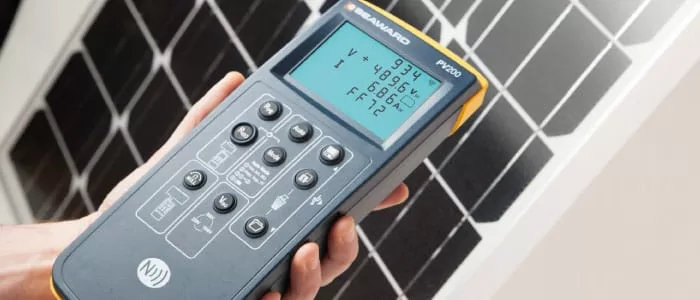
Solar String Testing Feasibility: What the Array's Design Decides
Most enquiries for electrical string testing arrive with the array’s size attached: a megawatt figure, a module count, sometimes a site plan. It is the natural thing to lead with, and it is almost never the number that decides the job.
What decides it is how the array was designed and wired. Two systems of identical capacity can differ by weeks of site time, and a third may not be conventionally testable at all, for reasons fixed at installation and invisible from the roof. Capacity tells you how much electricity the system makes. It tells you almost nothing about how many times somebody has to open a box with a screwdriver.
That is not an awkward exception. IEC 62446-1:2016 carries a clause of its own on test regimes for systems with module level electronics, which tells you the industry has been dealing with this since the standard was written.
None of it is a problem, provided it is known before a price is quoted rather than discovered on the morning of the first site day. This piece sets out the three things about an array that decide whether a string test is straightforward, expensive or impossible: where the strings terminate, what sits behind each module, and who is available to open the boxes.
Blog Content TL;DR...
What decides whether a solar array can be string tested, and what that costs in site time.
- Capacity is the wrong number. The work is counted in termination boxes opened and strings landing in each, so two arrays of identical size can differ by weeks.
- Optimisers and microinverters change what a string is. On some systems the conventional string measurements are limited or not available at all, and IEC 62446-1:2016 carries a separate clause for exactly this case.
- Half the job belongs to the client. Opening, isolating and landing cables is electrical work on your own installation, done by your competent person alongside the tester.
- Four documents settle it: the string layout, the inverter make and model, who is opening the boxes, and any previous commissioning data.
Send the wiring, not the megawatts. It is the difference between a firm price and a guess.
Where the Strings Terminate
The work is counted in boxes opened, not in megawatts installed
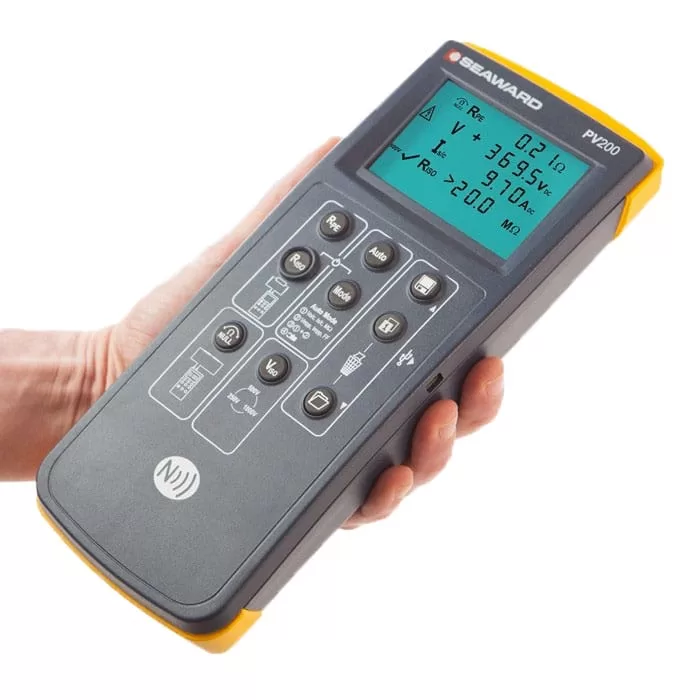
The number that matters is boxes, not megawatts
A string test is a physical operation repeated once per string, and every repetition needs safe access to both ends of that string. So the work is driven by how many termination points there are and how many strings land in each, not by the array’s rated output.
An array whose strings run back to a small number of inverters is a different proposition from one that fans out into many combiner boxes, even where the module count is identical. Fewer boxes means fewer set-ups, fewer isolations and less walking. More boxes, each holding fewer strings, means the same number of tests spread across far more openings, and the day stretches accordingly.
This is why a quotation for string testing asks about the wiring before it asks about the size. Given the termination arrangement and the strings per box, the programme can be estimated properly. Given only a capacity figure, it cannot, and anybody who prices it anyway is guessing.
Somebody has to open the boxes
The tester runs the instrument and records the results. Opening enclosures, isolating and landing cables is electrical work on the client’s own installation, and it is done by the client’s competent person working alongside. That is a resourcing question as much as a technical one, because the survey moves at the speed of whoever is doing that half of the job.
Where that person is not available for the whole visit, the visit takes longer or splits in two. It is worth settling at the enquiry rather than on the day.
can an array with optimisers be string tested, how long solar string testing takes, what a string test needs from the arraycan an array with optimisers be string tested, how long solar string testing takes, what a string test needs from the array
What Sits Behind Each Module
Optimisers and microinverters change what a string is
Conventional string testing assumes a string behaves as a string: a series of modules whose combined voltage and current can be measured at one pair of terminals. Power optimisers and microinverters break that assumption deliberately. An optimiser is a small converter fitted behind each module, which adjusts that module’s output independently so a shaded or underperforming panel stops dragging down the rest of the string.
It is a sound design and it does what it claims. It also means the terminals no longer present the raw series behaviour the test method expects, and on some systems the conventional string measurements are limited or not available at all. The standard recognises this directly: IEC 62446-1:2016 carries a separate clause on test regimes for systems with module level electronics, rather than treating them as ordinary arrays.
None of that makes such a system untestable. It changes what the test can report and how the results should be read, which is a different conversation from the one most buyers expect to have.
Why you want this settled early
An owner who has been told their system will be string tested, and who has optimisers throughout, has been sold something that may not be deliverable in the form they are picturing. Finding that out on site is expensive for everybody and awkward for whoever quoted it.
Finding it out at enquiry costs one question. The manufacturer and model of the inverters, and whether any module-level electronics are fitted, is usually enough to know what is possible before anyone commits to a date.
What to Send With the Enquiry
Four things worth sending
None of these are difficult to find, and most sit in the handover pack the installer left behind. Together they turn a rough indication into a firm price and a realistic programme, which is worth more to both sides than a fast quotation that has to be revised.
The single line diagram or string layout, which shows where the strings terminate and how many land in each box. The inverter make and model, and whether optimisers or microinverters are fitted anywhere on the system. Who will be opening and isolating, and for how many of the days. Any previous commissioning or test documentation, which says what was recorded when the system was new and gives the results something to be compared against.
What that changes
With those four, the visit can be planned to the actual shape of the array rather than to an assumption about it. The price reflects the boxes rather than the megawatts, the programme reflects the access, and the report can say whether a reading has moved since commissioning instead of simply stating what it is today.
Where the documentation has been lost, which is common on systems that have changed hands, the site survey establishes the same facts directly. It is an extra visit rather than an obstacle, and it is better than pricing blind.
Without any of it, a figure quoted is a guess wearing a number, and the correction arrives later as a variation. The service itself, what it covers and how it sits alongside a thermal survey, is set out on our combined thermal and string testing page.
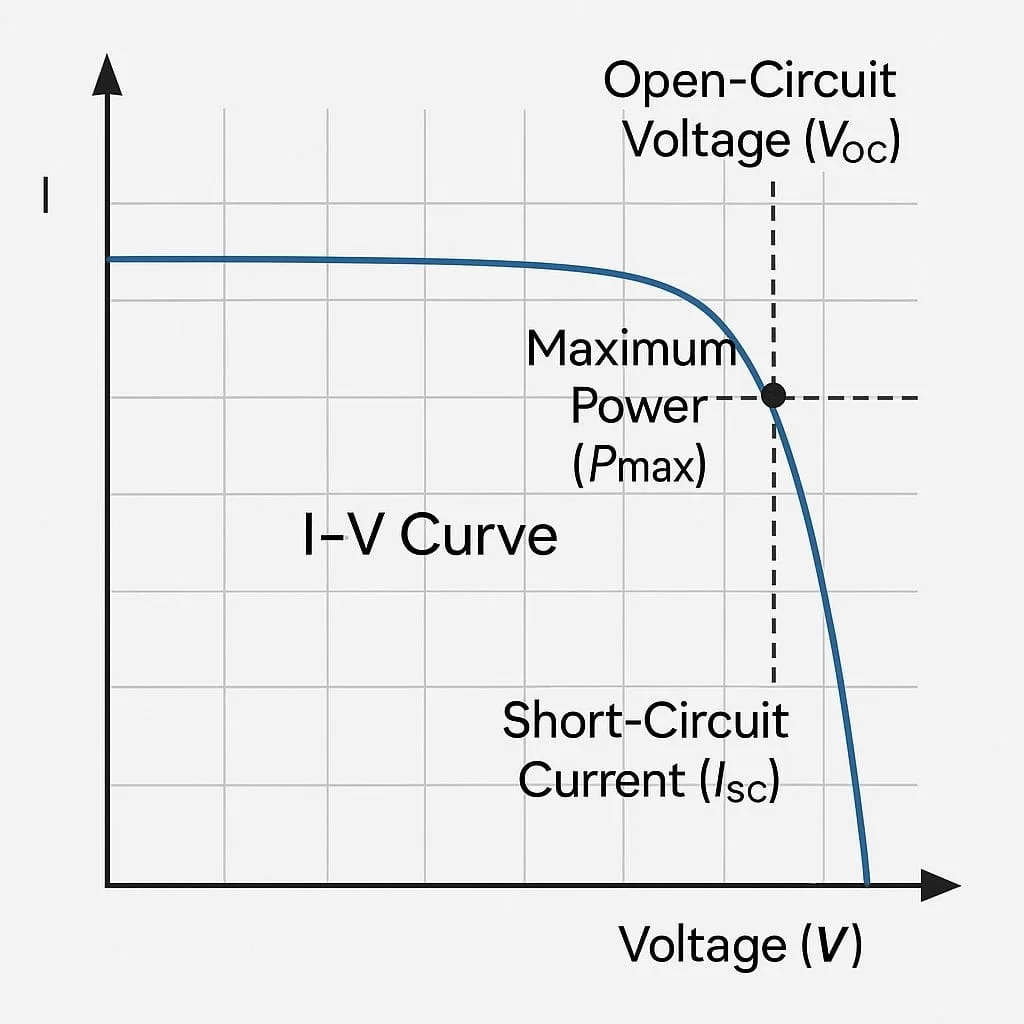
Category 1, the regime for all systems. Its test procedures cover continuity of protective earthing and equipotential bonding conductors, polarity, the PV string combiner box, open circuit voltage, string current by short circuit and operational test, functional tests, and array insulation resistance, which together establish that the array is safe, correctly connected and performing at the level its design predicts.
Category 2. A further regime whose procedures begin with string I-V curve measurement.
Module level electronics. The standard sets out test regimes for these separately, which is why the inverter and optimiser arrangement is established before a scope is agreed rather than after.
Our boundary. String-level testing only. No inverter diagnostics, no switchboard or distribution wiring, and no on-roof electrical work. Testing is carried out with IEC-compliant test instruments and an irradiance and temperature reference, and readings are recorded with the conditions they were taken under, because a voltage or current figure without its irradiance is not comparable to anything.
Governing Standards
- IEC 62446-1:2016 is the standard this electrical testing is aligned with, covering system documentation, commissioning and verification for grid-connected photovoltaic systems.
- IEC 62446-3:2017 is the methodology for the aerial thermographic half of a combined inspection, where one is carried out.
- Scope is string-level testing only. No inverter diagnostics, no switchboard or distribution wiring and no on-roof electrical work. Opening, isolating and landing of cables is carried out by the client’s own competent person.
- This is survey, analysis and reporting. Findings are recorded as areas warranting further investigation by a suitably qualified contractor, and no remedial or corrective work is undertaken.
- Survey, analysis and reporting are conducted by Steve Fisher, ITC Level III Certified Master Thermographer (Infrared Training Centre; Certification #205722059), practising in accordance with the frameworks of ISO 18436-7:2014, ASNT SNT-TC-1A and ANSI/ASNT CP-105, and BINDT CMGEN Appendix B as UK training governance, and holding the Level 3 Award in Requirements for Electrical Installations, BS 7671:2018.
Tell Us How the Array Is Wired
Send the string layout and the inverter details with your enquiry and we will tell you what is testable, what it will take and what it will cost, before anybody books a date. Where the documentation is missing, we will say what a short site survey would need to establish.
An honest answer at enquiry is cheaper than a variation at week three. If the array carries optimisers or microinverters we will say so plainly, and what can be measured instead.
We work across Sussex, Hampshire, Kent and Surrey, and travel throughout the United Kingdom, Ireland and Europe.
related posts
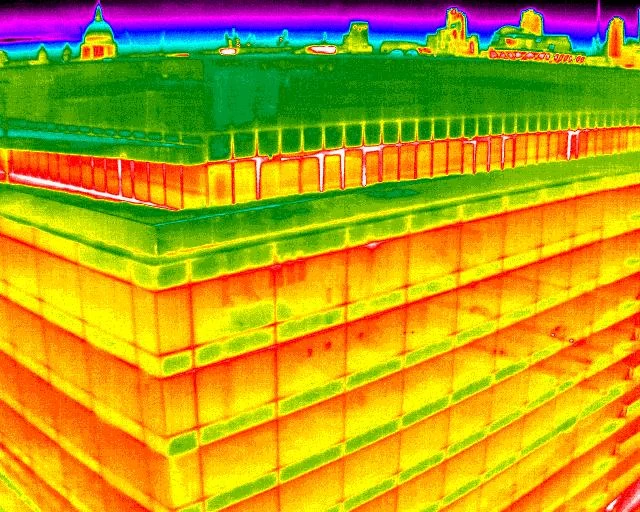
A building heat loss survey looks like a single cold night's flying, but most of what decides its value is settled beforehand. This piece sets out the information a thermographer needs from the building owner and why each answer changes how a thermal pattern is read, what has to be arranged before an after-dark survey of an occupied building, and what the finished report contains, including the difference between a certified inspection report and a professional opinion.

Revolutionizing Insurance Claims: Drones Take Rooftop Inspections to New Heights!
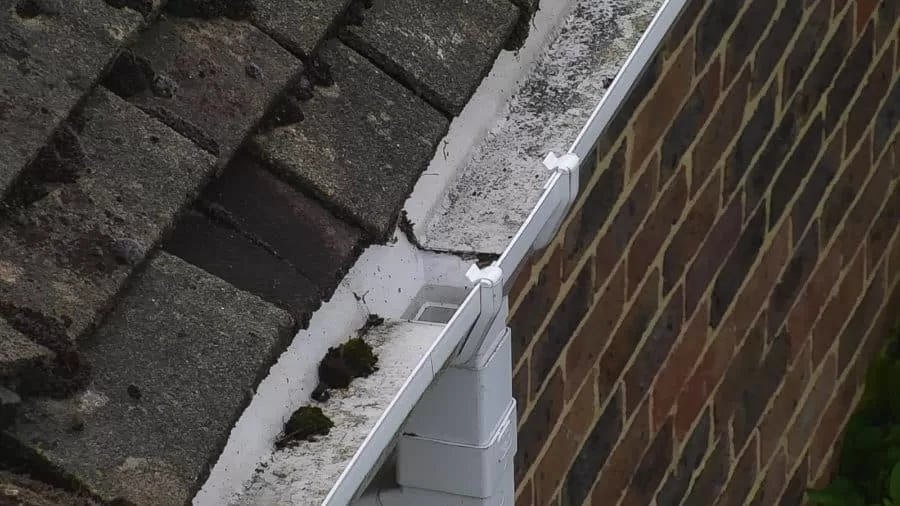
A roof moves rainwater along a designed path, from slope to valley to gutter to outlet. Autumn is when that path is loaded for the first time in months, and when anything silted, sagging or split begins to show. Almost none of it is visible from ground level. This is what an aerial inspection records about roof drainage, why standing water is such a useful signal, and how observations are marked on the imagery so a contractor can quote from them.