Rooftop Solar Inspection Without Roof Access
A commercial rooftop solar array is one of the few assets on a building that nobody visits. It sits on a roof most people have no reason to walk on, it has no moving parts, and it gives no warning when a module stops pulling its weight. The array is usually still generating something, which is exactly what makes an underperforming one so easy to live with for years.
When the question of inspection does finally come up, the interesting problem is not whether the array should be looked at. It is how anyone is supposed to get at it. A ground-mounted array in a field can be walked, module by module, by somebody with a handheld camera and a sensible pair of boots. A roof cannot, or at least not without a conversation about access, about the covering underneath, and about the business trading below it.
That difference is the whole reason rooftop arrays are surveyed from the air. It is not a preference for the technology, and it is not about the survey being quicker. It is that the roof itself sets the terms, and the aerial method is the one that satisfies them: the geometry the standard requires, the whole array in a single visit, and nobody standing on the covering to get it.
Blog Content TL;DR...
A commercial rooftop array is surveyed from the air for reasons that start with the roof rather than with the technology.
- Getting a person to roof level means scaffold, a platform or a permanent access system, and a work area inside somebody’s operating building.
- Roof coverings, rooflights and patched sections are not all capable of carrying a person, and the array shares the roof with plant, ducting and edges.
- IEC 62446-3 requires the thermal image to be taken as close to perpendicular to the module as possible, which somebody standing on a pitched roof cannot achieve.
- The resolution requirement of no more than three centimetres of module edge per pixel has to be met across the whole array, not only the reachable part.
- An aerial survey is classified as a simplified inspection, so it identifies what warrants further investigation rather than settling module quality on its own.
The roof decides how the array gets inspected, and the roof is the reason nobody should be standing on it.
The Roof Is the Obstacle, Not the Array
Everything difficult about a rooftop survey happens before anyone looks at a module
Getting a person onto the roof is the expensive part
The array itself is straightforward to inspect. Everything difficult about a rooftop survey happens before anyone looks at a single module. A person carrying a handheld thermal camera has to be lifted to roof level, and on a commercial building that usually means scaffold, a mobile elevating work platform or a permanent roof access system, arranged and paid for before the survey has begun. Where the building is occupied, it also means a work area at ground level, a permit, and somebody from the business giving up part of their day.
The first question in any work carried out at height is whether the work has to be done at height at all. An aerial survey answers that question by removing the person from the roof entirely. The camera goes up, the thermographer stays on the ground, and the access arrangements that would otherwise dominate the cost and the programme simply do not arise.
There is a second party to satisfy on a rooftop that does not exist on a solar farm, and that is whoever occupies the building. A ground-mounted array is generally on land that exists to hold the array. A rooftop array sits over a warehouse, a factory floor, a distribution shed or a school, and the roof above a working business is not a place anybody welcomes contractors without a reason. Keeping the inspection off the roof keeps the building’s own operation out of it.
The array is not the only thing up there
A commercial roof is a working surface with a history. Rooflights, older covering panels and patched sections are not always obvious from above and are not always capable of carrying a person, and the consequences of finding that out by standing on one are severe. Plant, ducting, cable runs and edge details all share the space, and the array is frequently laid out around them rather than in a clean grid.
None of that stops a survey. It does mean that a walked inspection has to be planned around where a person can safely stand, and the panels a person cannot reach are the ones that go uninspected. That is how a rooftop array becomes the asset nobody has properly looked at between the day it was commissioned and the day something went wrong with it.
can solar panels be inspected without walking on the roof, why rooftop solar arrays are surveyed from the air, inspecting a rooftop solar array on a working buildingcan solar panels be inspected without walking on the roof, why rooftop solar arrays are surveyed from the air, inspecting a rooftop solar array on a working building
What the Standard Asks of the Camera Position
The image has to be taken square to the module
IEC 62446-3:2017 governs thermographic inspection of photovoltaic systems, and it is specific about where the camera has to be. The image is to be taken as perpendicular to the module surface as possible, and where that cannot be achieved the angle between the camera and the module plane should still be greater than 30 degrees. The reason is optical. Glass reflects, and the further the camera moves away from square, the more the module returns the sky, the surrounding buildings and the person holding the camera instead of its own thermal signature. The apparent emissivity of the glass falls away with the angle as well, so a shallow view degrades the measurement twice over.
A pitched roof puts a person in the wrong place
This is where the rooftop case separates from the ground-mounted one. Somebody standing on a pitched roof is in the plane of the array, not above it. Every module within arm’s reach is being viewed along its surface rather than across it, which is the worst geometry the standard describes, and the only way to improve it is to get higher than the panels, which on a roof means the person has nowhere to go. The same standard sets a geometric resolution of no more than three centimetres of module edge per pixel, which works out at roughly five pixels by five across a six inch cell, and that has to hold for every module in the array rather than the convenient ones.
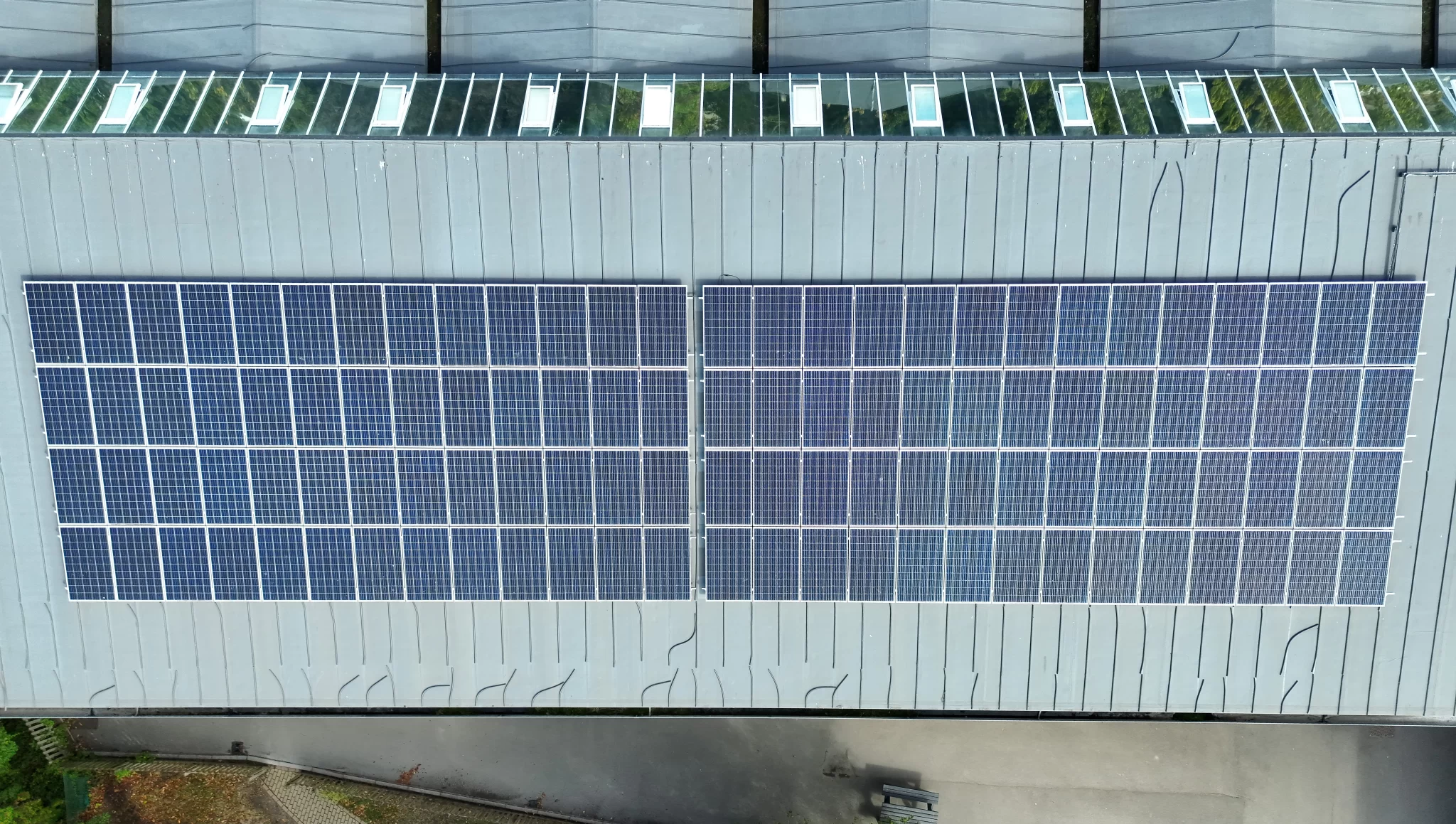
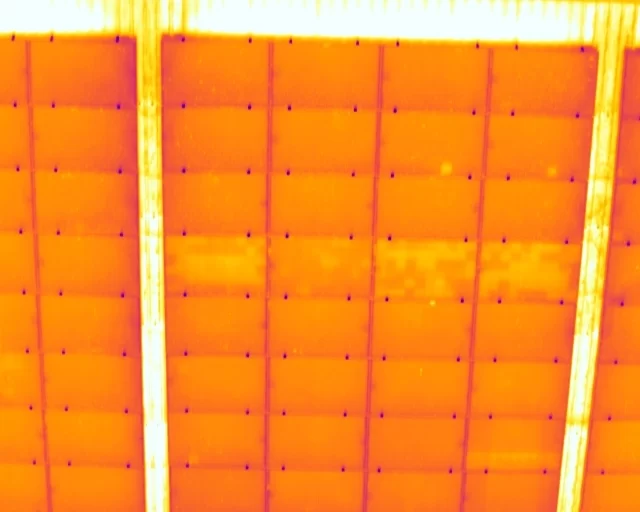
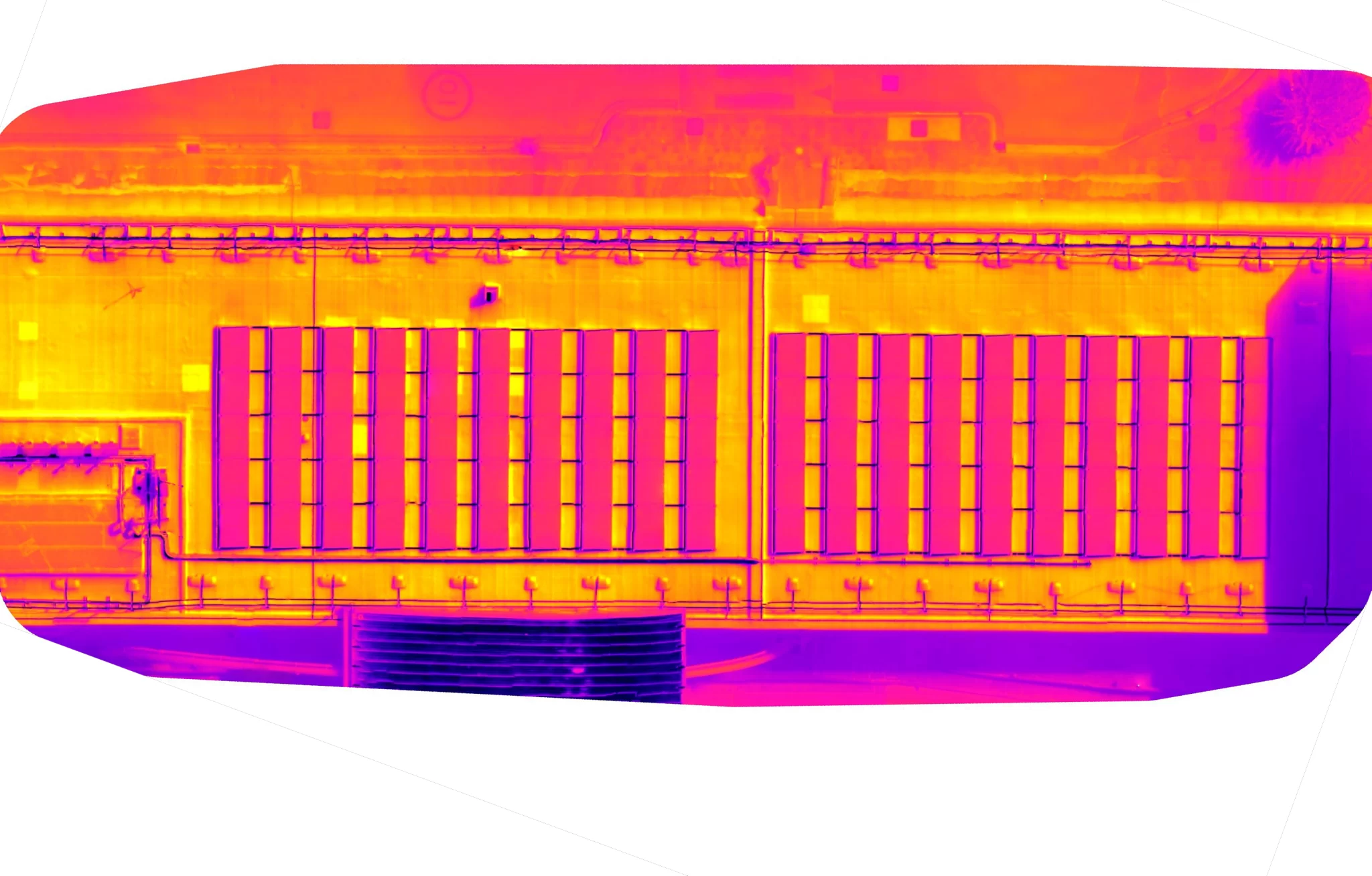
From the air both requirements are simply satisfied. The camera can be placed square to the plane of the array over any part of it, at a standoff chosen to meet the resolution rule, and the far corner of the roof gets the same geometry as the near edge. In practice this is flown as two passes, a higher overview of the whole array and a closer detail pass, so the array is seen both as a system and module by module.
What the Survey Returns, and What It Does Not
The whole array in one visit
The practical output of surveying from the air is coverage. Every module in the array is imaged in the same visit, under the same conditions, within the window in which the array is generating strongly enough for the thermal pattern to mean anything. Nothing is skipped because it sat behind a run of ducting or too close to an edge, and nothing has to be inferred from the panels that happened to be reachable. The array also stays live throughout, which is not a convenience but a requirement, because a module only declares a fault when current is flowing through it.
On buildings where the original installation paperwork has gone missing, and that is more common than owners expect, the imagery itself becomes the record. An array map with rows and columns can be built from the survey imagery where none existed before, which gives every later inspection something to refer back to and gives a contractor a way of finding the right module on the roof.
An aerial survey is a starting point, not the last word
It is worth being straight about the limits. IEC 62446-3 classifies an aerial thermographic sweep as a simplified inspection, which means it is designed to find the modules and sections behaving abnormally rather than to reach an authoritative conclusion about the quality of a module. Where a thermal pattern cannot be classified with confidence from the imagery alone, the standard expects further inspection to be applied rather than a judgement to be forced.
That is the correct shape for a rooftop asset. The survey establishes what is happening across the whole array and identifies the specific positions that warrant further investigation by a suitably qualified electrical contractor, and it does so before anybody has been put on the roof. The access arrangements, if they are needed at all, are then made once and made for a known list of modules.
Identifying that a module is faulty is only half of the requirement. IEC 62446-3 requires each thermal anomaly to be positioned using at least two independent identification methods, so that the module described in the report is the module a contractor finds on the roof. The permitted methods include the module serial number, coordinates giving a clear column and row, marking on the system documentation such as a string or roof plan, a photograph showing the position within the array on smaller installations, and permanent marking of the module on site.
On a rooftop array this is more straightforward than on a large ground-mounted site, because the roof geometry supplies a natural grid. Rows can be lettered from the ridge and columns numbered across the pitch, which gives an unambiguous reference that survives the survey and can be checked against string records. The standard also requires the thermographic image of an anomaly to show at least one whole module, with the junction box and the lower edge visible, so the orientation of the finding is never in doubt.
Governing Standards and Competence
- IEC TS 62446-3:2017, Photovoltaic (PV) systems, requirements for testing, documentation and maintenance, Part 3: Outdoor infrared thermography of PV modules and plants.
- Surveys conducted by Steve Fisher, ITC Level III Certified Master Thermographer (Infrared Training Centre; Certification #205722059).
- Practising in accordance with the frameworks of ISO 18436-7:2014, ASNT SNT-TC-1A and ANSI/ASNT CP-105, and BINDT CMGEN Appendix B as UK training governance.
- Methodology aligned with IEC 62446-3:2017 for solar photovoltaic thermographic inspection, and with IEC 62446-1 where string-level electrical testing is contracted alongside it.
- Flight operations conducted under a CAA authorisation appropriate to the site and the airframe.
- Findings are reported as areas warranting further investigation by a suitably qualified contractor. Nothing in a survey constitutes a building survey, a structural assessment or a condition grading of the roof.
Talk to Us About Your Rooftop Array
If you look after a building with solar on the roof and nobody can tell you when it was last inspected, that is the usual starting point. We survey commercial rooftop arrays from the air, without roof access, and report what is happening across the whole installation. Coverage across Sussex, Hampshire, Kent and Surrey, travelling throughout the UK, Ireland and Europe.
related posts

Aerial imagery enters an insurance file by three routes: a loss adjuster who cannot safely reach a roof, a broker placing or renewing cover on a large building, and a policyholder who wants an independent dated record before a repair covers the evidence. This piece sets out what each uses the images for, and the five things that make a set of photographs acceptable to a sceptical reader: dated, placed, systematic, unaltered, and accompanied by a plain account of what was observed.

Conducting an IEC inspection at Trethosa, Cornwall's solar farm for Natural Generation Ltd.Drone Media Imaging examined the solar panels in line with IEC 62446-3:2017 to ensure compliance with safety standards, ensuring optimal performance and longevity of the solar farm.
Pinpointing energy loss in buildings involves identifying hidden insulation defects, thermal bridges, and air leaks. A Level 3 Thermographer employs advanced thermal imaging to ensure precise diagnostics and compliance with energy standards, providing property owners with detailed reports for informed energy efficiency improvements and cost savings.