The Drainage Path Nobody Can See
A roof does not simply keep rain out. It moves it, from the highest point to the ground, along a path that was designed before the building was finished and has been quietly working ever since. Every ridge, every slope, every valley and every gutter is part of that path. When the path works, nobody thinks about it. When part of it stops working, the water does not stop arriving, it just goes somewhere it was never meant to go.
Autumn is when that path is tested properly for the first time in months. Leaves come down, the first sustained rain arrives, and anything that has silted up, sagged, split or come loose over the summer starts to show. The trouble is that almost none of it is visible from where you are standing. A gutter looks fine from the pavement whether it is empty or full to the brim. A valley between two slopes is simply not in view from ground level at all.
This is the part of a roof that an aerial inspection is genuinely good at. Not because the camera is in the air, but because being above the roof is the only position from which the whole drainage path can be seen and photographed in one visit. It is a survey of where the water goes, recorded as photographs you can keep.
Blog Content TL;DR...
If you only read one part of this:
- A roof sheds water along a designed path: slopes, valleys, gutters, outlets and downpipes.
- Autumn loads that path with leaf fall and sustained rain for the first time in months.
- Most of the path cannot be seen from ground level, and a ladder only ever reaches the edge of it.
- Photographed from above, the whole run is recorded in one visit, joint by joint and outlet by outlet.
- Observations are marked on the images as areas warranting further investigation by a suitably qualified contractor.
Water always finds the gap. The point is to find it first.
Where the Water Is Supposed to Go
The drainage path, and why it is invisible from the ground
A designed path, not an accident
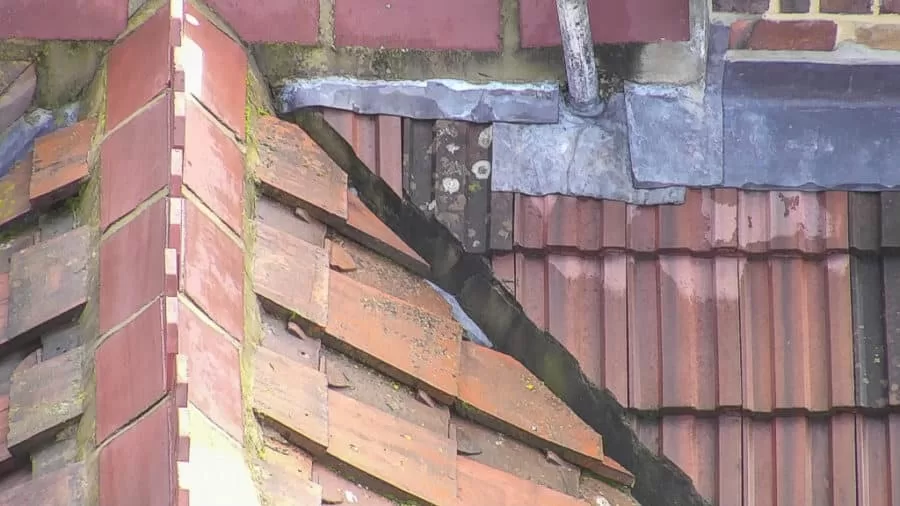
Rain landing on a pitched roof runs down the slope to the eaves, into the gutter, along to an outlet and down a pipe. Where two slopes meet, it is concentrated into a valley, which carries several times the volume of any single slope and is therefore the hardest-working part of the whole arrangement. On a flat roof the principle is the same but the margins are finer, because the falls are shallow and the water is relying on a gentle gradient to reach an outlet rather than on gravity down a pitch. Both arrangements work perfectly well until something interrupts the fall, and neither gives any warning from the ground that it has been interrupted.
Every one of those transitions is a joint, a lap, a fixing or an opening, and every one of them is a place the path can be interrupted.
The parts you cannot stand and look at
From the ground you can see the underside of a gutter and the face of a fascia, and very little else. A ladder puts you at the eaves, which is a single point on a run that continues the length of the building, and it tells you nothing about the valley several metres up the slope or the outlet in the middle of a flat roof. The parts of the drainage path that fail most often are precisely the parts that are hardest to stand in front of, which is why they tend to be checked last or not at all.
Autumn Gutter and Valley Condition | Where Rainwater Actually Goes | Roof Drainage Recorded From AboveAutumn Gutter and Valley Condition | Where Rainwater Actually Goes | Roof Drainage Recorded From Above
What Autumn Rain Brings to the Surface
Leaf fall, silt and the first sustained rain
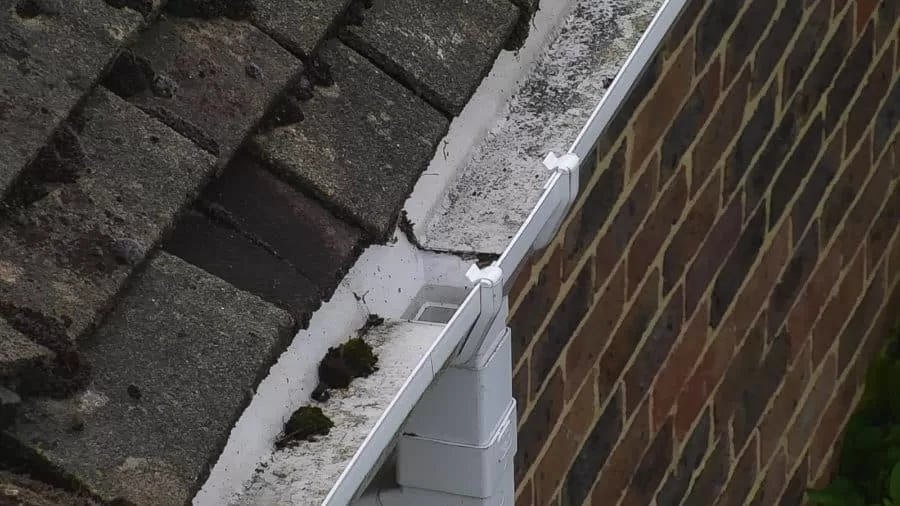
Summer leaves a roof with a slow accumulation nobody notices: dust, grit washed off the covering, moss growing where the slope stays damp, and the first of the leaf fall collecting in the corners that do not drain. The first heavy autumn rain moves all of it at once, and it moves it to the narrowest points in the system. That is why blockages appear at outlets, at the head of a downpipe and at the bottom of a valley rather than spread evenly along a gutter.
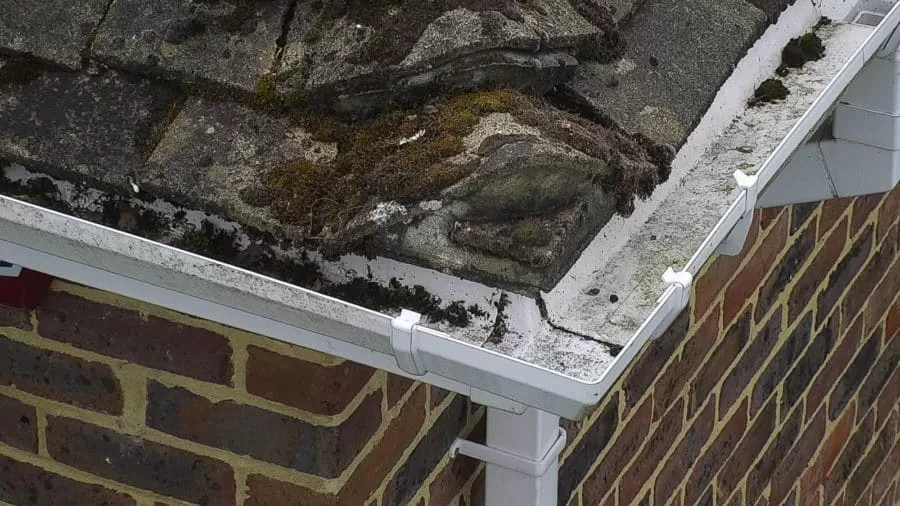
What shows in photographs taken from above is not the blockage itself so much as the evidence around it. Standing water sitting in a gutter long after the rain has stopped, or a tide line of silt along one side of a valley where the flow has been pushed off its proper line. Moss banked against a ridge of leaves, staining running down a wall below a joint that is letting go, or a sagging run where a bracket has pulled out of a fascia that has itself begun to rot. None of those is dramatic on its own, and all of them are legible in a photograph taken close enough.
On a flat roof the same story reads as ponding: water standing where it should have drained, usually near an outlet that is partly blocked or a little too high, and often close to an upstand, a rooflight or a plant base where the fall was interrupted when something was installed.
From Photograph to Something a Contractor Can Quote From
Close, not just high
An aerial photograph of a building is not, by itself, useful. A wide shot taken from high above shows a roof and tells you almost nothing about it. What makes the imagery worth having is how close the camera gets to the detail and whether the light is working with it: a split at a lap, a lifted edge of flashing, the silt line in a valley, photographed tightly enough that the thing itself is unarguable rather than inferred. Height is only the means of getting the camera into a position where that detail can be taken at all.
Observations marked, and located
Where something is worth attention, it is annotated on the photograph and placed on the building, so that whoever receives it knows both what they are looking at and where on the roof it sits. That matters because the image usually has a second journey to make. It goes to a roofing contractor for a quotation, to a managing agent so a decision can be made, or into a file as a dated record of how the roof looked at a point in time. An image that needs a covering note explaining it has not done its job.
What it is, and what it is not
This is a visual inspection. Drone Media Imaging photographs what is visible and describes what the photographs show. The scope is agreed with you beforehand, as stills, video or both, according to what you actually need to see. It records the surface, and it does not see under a covering, into a cavity or through a ceiling. Observations are recorded as areas warranting further investigation by a suitably qualified contractor, and no building survey, structural assessment or condition grading is offered or implied.
Pitched roofs shed water by gravity down a slope, and the covering only has to resist water moving downhill across it. Flat roofs are not flat: they are laid to a designed fall so that water migrates to an outlet. Where that fall is shallow, interrupted by later work, or the deck has deflected between supports, water stops migrating and stands.
Standing water is the useful signal, and it is one of the few roof conditions that reads more clearly from directly overhead than from any other position, because the reflective surface of the pool shows its true extent and shape. Its outline also indicates where the low point actually is, which is not always where the outlet was put. Valleys concentrate the flow from two slopes into one channel, so a partial obstruction there has a disproportionate effect. Gutters are sized for a catchment, and a run that is sagging, silted or discharging at a joint is no longer delivering the capacity the roof was designed around.
Book an Autumn Roof and Gutter Inspection
Drone Media Imaging carries out visual roof and building inspections across Sussex, Hampshire, Kent and Surrey, travelling throughout the UK, Ireland and Europe. Tell us what you need to see and we will agree the scope before we fly.
related posts

Insurance companies can greatly benefit from embracing drone technology, particularly in the areas of claims assessment, risk prevention, and post-disaster response. Drones can quickly and accurately assess damage, provide risk mitigation recommendations, and aid in resource allocation during disasters.

Thermal inspections can help domestic solar panel owners detect issues early, preventing costly repairs. These inspections identify hotspots, indicating potential problems like loose connections or damaged cells. By addressing these issues promptly, owners can ensure optimal performance and longevity of their solar panels, maximizing their return on investment.
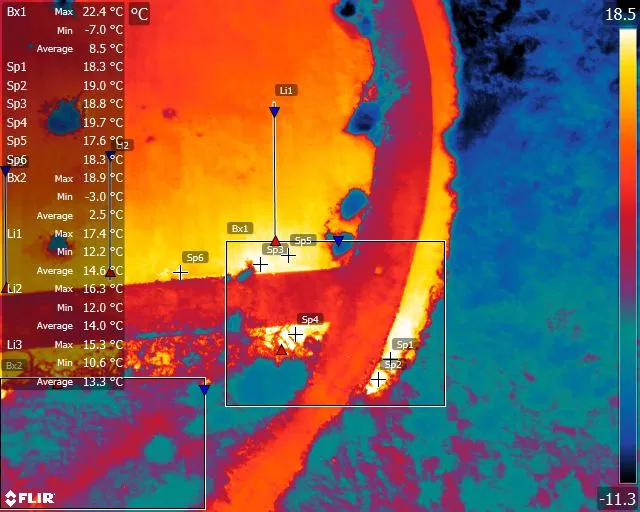
Explore the crucial role of drone thermal imaging in boosting fire safety measures at solid waste landfill sites.