Coverage And Consistency, Not Novelty
Anyone responsible for a commercial solar roof is sooner or later offered two ways of having it checked. Somebody can go up a ladder, or onto the roof, and look at the panels, perhaps with a handheld thermal camera. Or a drone can fly over the whole array and record it from above. The question that follows is usually put as which one is better, and it is the wrong question, because the two are not the same inspection done two ways. They produce different evidence.
A person reaches what a person can reach, and sees it from wherever they happen to be standing. That gives a spot check, which is useful and has its place. An aerial thermographic survey records every module in the array, from the same height and the same angle, inside one window of suitable weather. That is what makes the results comparable, module against module on the day, and survey against survey from one inspection to the next.
So the difference that matters is not novelty, and nobody should buy a survey because it involves a drone. The differences are coverage and consistency, and they decide what an inspection can actually tell you. This post sets out what each method can see, why the viewing angle and the timing change a thermal reading, and where each one belongs.
Blog Content TL;DR...
A drone and a ladder are not two ways of doing the same inspection. They produce different evidence.
- A visual check from a ladder finds visible damage, but not the faults that look normal in daylight, such as failing cells or hot connections.
- A handheld thermal camera sees those faults, but from a ladder it looks across the array at a shallow angle, where module glass reflects the sky and the inspector.
- A drone records every module from above, at the same distance and angle, with thermal and visual imagery captured together.
- A thermal inspection is only valid in strong, steady sunlight, roughly four hours on a suitable UK day, so what can be covered inside that window decides how comparable the results are.
- The ladder still has a place: IEC TS 62446-3 describes surveying the whole array first, then looking closely at what the survey finds.
Coverage and consistency decide what an inspection can prove, and who reads the result decides what it means.
What Each Method Can Actually See
A ladder, a handheld camera and an aircraft, looking at the same roof

From the ladder
A visual check from a ladder, or from the roof itself, finds what can be seen: cracked glass, a lifted fixing, damaged or chafed cabling, heavy soiling, bird droppings, scorch marks on a connector within reach. These are worth finding, and regular visual checks by the owner are part of the advisory maintenance schedule in MIS 3002, the UK installation standard for solar PV. What a visual check cannot find is the fault that looks exactly like its neighbours in daylight. A failing cell, a bypass diode that has switched part of a module out of circuit, a connection running hot in the junction box on the back of a module: none of these is visible to the eye, and they are among the faults that matter most.
With a handheld thermal camera
A thermal camera sees those faults, because they show up as heat. Held from a ladder, though, it looks across the array rather than down onto it. On a pitched roof, a camera at the top of a ladder at the eaves is looking up the slope, almost along the surface of the modules rather than at them. The first row is imaged well. Every row behind it is further away and seen at a shallower angle, which, as the next section explains, changes what the camera is actually measuring.
From the air
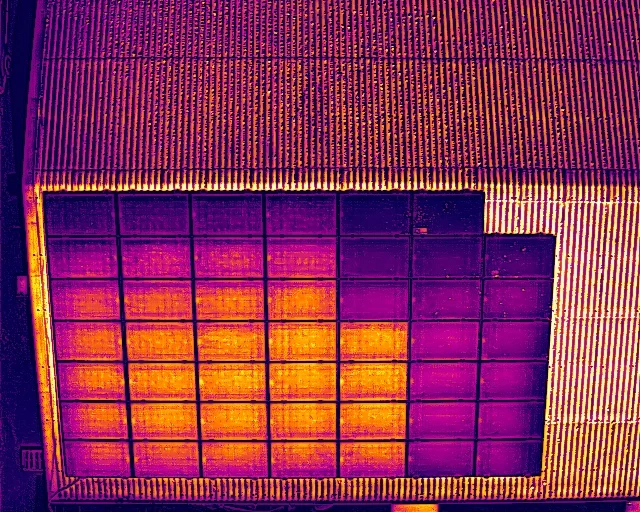
A drone looks down on the whole array, close to square on to the modules, with every module at the same distance and the same angle. Thermal and high-resolution visual imagery are captured together, so a warm module can be checked against what it physically looks like. That is the starting point of every solar PV survey Drone Media Imaging flies.
Is a drone solar inspection better | When is a handheld thermal camera enough | Manual solar panel inspectionIs a drone solar inspection better | When is a handheld thermal camera enough | Manual solar panel inspection
Why The Angle And The Timing Change The Reading
Glass becomes a mirror at a shallow angle
Part of what a thermal camera receives from a solar module is not the module at all but a reflection of whatever is in front of the glass. Face on, the glass gives off mostly its own radiation. At a shallow angle it behaves more like a mirror, returning the sky, nearby buildings and the person holding the camera, which is why IEC TS 62446-3, the international technical specification for thermographic inspection of solar plants, asks for images as close to perpendicular to the modules as possible and at no less than 30 degrees. On a roof that geometry is rarely available to anyone standing on it, as set out in why a rooftop solar array is surveyed from the air.
The weather will not wait
A thermal inspection is only valid while the array is generating strongly and steadily: at least 600 watts of sunlight on every square metre of module, wind no stronger than 28 km/h, and no more than a quarter of the sky covered by cumulus cloud. On a suitable UK day that gives a usable window of roughly four hours, and a great many days give no window at all. A visual check from a ladder can be made on any dry day. A thermal inspection cannot, whatever carries the camera.
One set of conditions
So the useful question is not only whether a method can see a fault, but how much of the array it can record inside one window, under one set of conditions. An inspection that works its way across an array over a long stretch of the day ends up comparing modules imaged in different sunlight and wind. That is also why Drone Media Imaging proposes survey dates against the forecast, rather than accepting whichever date is offered.
What It Means For The Evidence You Hold
Evidence that can be compared
On a commercial rooftop, the survey itself takes an hour or two on site, well inside the window, so every module is recorded under the same conditions. Each warm module can be compared with a healthy one in the same image, and at the next inspection the array can be flown again to the same height and path, so a fault that is advancing can be told apart from one that has been stable for years. That comparability is what turns a set of images into a record an insurer, a warranty provider or a board can rely on.
Where the ladder still belongs
None of this makes the ladder redundant. A visual check between surveys is still worth doing, and a located finding still needs somebody to go to it. IEC TS 62446-3 describes that pairing as a typical approach: survey the whole array to find the modules and strings with noticeable problems, then look closely at those. The survey tells the contractor exactly where to put the ladder, rather than leaving them to hope the fault is within reach.
Who reads what comes back
The method is only half the question. Anyone can fly a thermal camera; reading what it records is a certified discipline, and the specification states plainly that training on the camera provided by its manufacturer is not sufficient. Drone Media Imaging flies the survey and carries out the analysis at ITC Level III, reporting findings as areas warranting further investigation by a suitably qualified contractor. Our IEC 62446-3 thermographic inspection page sets out the method in full, and do I need a Level 3 thermographer for a solar inspection? answers the qualification question honestly.

A thermal camera can give an absolute temperature for any point on a module, and on its own that number says less than it seems. IEC TS 62446-3 warns that absolute temperatures across a solar array vary with wind and convection, with time, and with position in the array. Two healthy modules at opposite ends of a roof, or the same module an hour apart, can read differently for reasons that have nothing to do with a fault.
A detailed evaluation therefore leans on relative temperature: the difference between the warm area and healthy module surface nearby, in the same image, captured at the same moment. Sunlight, wind and sky act on both in much the same way, so the difference isolates what is happening inside the module. The specification lists what else has to be weighed, including irradiance and load, wind, cloud movement, soiling and previous inspection results.
That is the technical reason coverage inside one window matters. A difference taken within one image is sound. A comparison between modules imaged under different conditions is not.
Governing Standards
- IEC TS 62446-3:2017, the technical specification for outdoor infrared thermography of photovoltaic modules and plants, including the conditions an inspection must be carried out under.
- IEC TS 62446-3:2017 clause 5.4, the section on how thermal images are taken, which asks for images as close to perpendicular to the modules as possible and at no less than 30 degrees.
- IEC TS 62446-3:2017 clause 7, the section on evaluating thermal images, which notes that absolute temperatures vary with wind, convection, time and position across an array.
- IEC TS 62446-3:2017 Annex B, the section dealing with who carries out the inspection, which states that training on the camera provided by its manufacturer is not sufficient.
- MIS 3002, the Microgeneration Certification Scheme standard for solar PV, whose advisory maintenance schedule includes regular visual checks by the owner.
- Analysis by Steve Fisher, ITC Level III Certified Master Thermographer (Infrared Training Centre; Certification #205722059), practising in accordance with the frameworks of ISO 18436-7:2014, ASNT SNT-TC-1A and ANSI/ASNT CP-105, and BINDT CMGEN Appendix B as UK training governance.
Put The Whole Array On Record
Drone Media Imaging carries out solar PV thermographic survey, analysis and reporting across Sussex, Hampshire, Kent and Surrey, travelling throughout the UK, Ireland and Europe. Tell us where the array is, roughly how large it is and whether it has been surveyed before, and we will propose survey dates against the forecast conditions rather than ask you to pick one.
related posts
Discover how drones and thermal imaging are revolutionizing fire surveys and transforming landfill management.
Pinpointing energy loss in buildings involves identifying hidden insulation defects, thermal bridges, and air leaks. A Level 3 Thermographer employs advanced thermal imaging to ensure precise diagnostics and compliance with energy standards, providing property owners with detailed reports for informed energy efficiency improvements and cost savings.

Quantitative and qualitative thermography are two essential methods in thermal imaging analysis. Quantitative thermography measures exact temperature values, while qualitative thermography focuses on pattern recognition. Both play a crucial role in building inspections, electrical fault detection, and industrial diagnostics. Understanding their differences helps professionals choose the right approach for accurate thermal assessments. Drone Media Imaging provides expert thermographic services, ensuring precise, reliable results. Contact us today for professional thermal imaging analysis.