What the Tiles Can Tell You About the Loft Below
Most of the heat a house loses through its roof never reaches the tiles directly. On a typical pitched roof the insulation is laid across the ceiling of the top floor, and above it sits the loft: an open, ventilated space holding cold air, timber and whatever has been stored up there. The tiles are on the far side of that space, fixed to battens, with air moving behind them. So when a thermal camera looks down on a pitched roof from the air, it is not looking at the insulation. It is looking at the outside of a cold box that sits on top of it.
That does not make an aerial roof survey pointless. It makes it a matter of reading an indirect signal properly. Where the insulation below is thin, disturbed or missing, the loft over that part of the house tends to run warmer, and the tiles above it can show it, softly and with blurred edges. Where rooms have been built into the roof, the insulation follows the slope of the rafters, the covering sits much closer to the heated space, and the picture sharpens considerably.
There is a second complication that every roof shares, pitched or flat. A roof faces the sky, and on a clear night the sky is extremely cold. Both effects have to be understood before a warm patch on a roof can be called a finding.
Blog Content TL;DR...
Why a pitched roof seen from above is an indirect view of the insulation, and what makes the reading defensible.
- The camera sees the tiles, not the insulation. On most pitched roofs a ventilated loft sits between the two.
- Weak insulation can still show, as softer, broader warm areas where the loft above a poorly insulated ceiling runs warmer.
- Rooms in the roof read differently, because the insulation follows the rafters and sits close behind the covering.
- The sky is in every roof image. A cold night sky is reflected by, and draws heat from, every surface facing it, so it is measured and corrected.
- Each pitch is flown square on, so that viewing angle neither creates nor hides a pattern.
A warm patch on a roof is a question about the building, and the survey is designed to answer it honestly.
What Sits Between the Camera and the Insulation
Cold roofs, warm roofs and the loft in between

Two kinds of pitched roof
From the street, one tiled roof looks much like another. Thermally they fall into two broad arrangements, and which one you are looking at changes what an aerial image can say. In the first, usually called a cold roof, the insulation lies across the ceiling joists and the loft above it is deliberately kept cold and ventilated, so that moisture rising from the house does not condense on the timbers. In the second, a warm roof, the insulation follows the line of the rafters, most often because the roof space has been turned into rooms, and the heated space runs right up under the covering.
Why the arrangement matters from the air
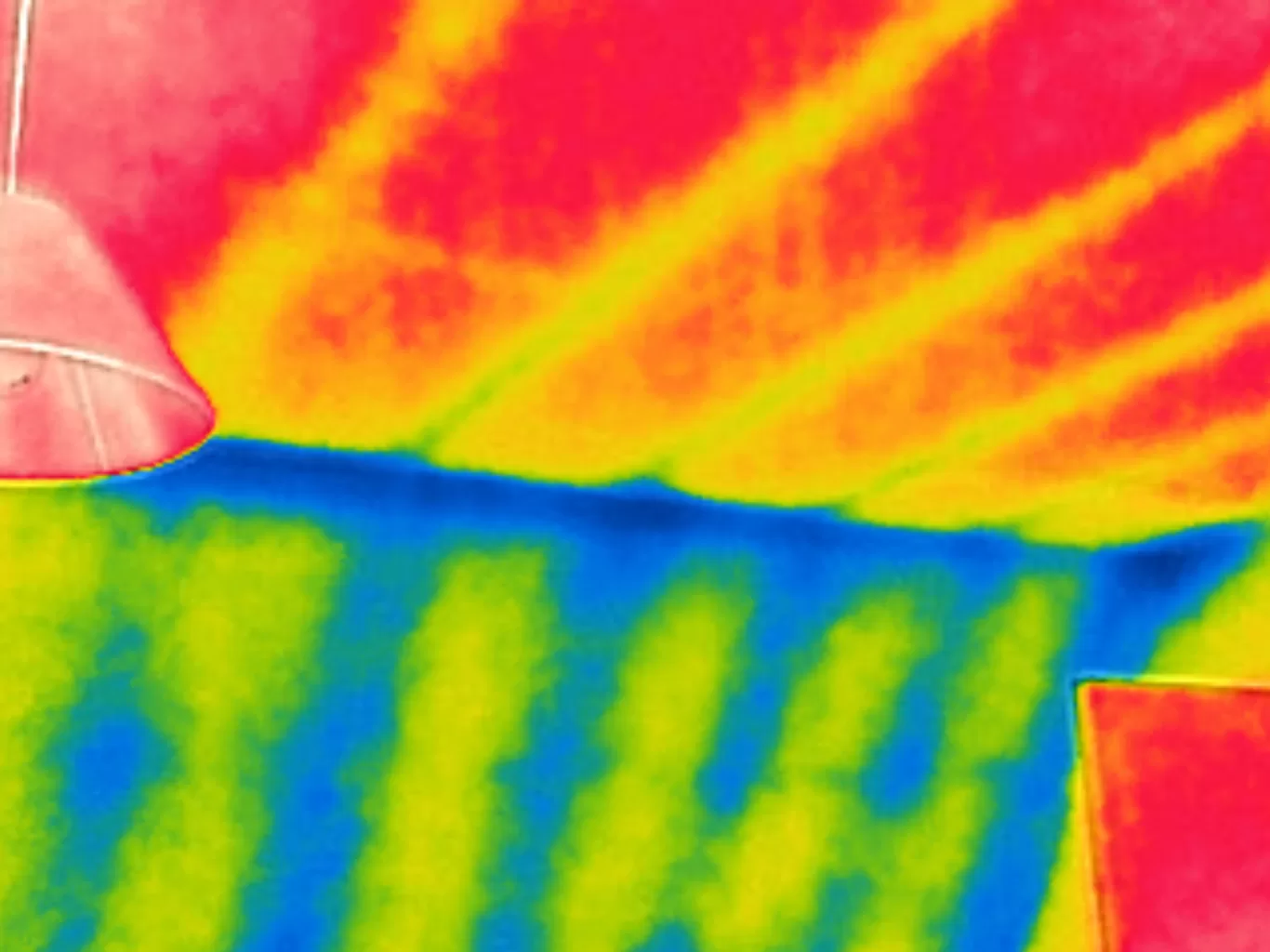
Over a cold roof, heat escaping through the ceiling first warms the loft air, and some of that warmth is carried away by ventilation before the underside of the tiles feels it. The signal reaching the outer surface is weak and spread out. A missing section of insulation above a bedroom will not appear as a crisp rectangle with the outline of the gap. It is more likely to show as a broad, gentle rise in tile temperature across that part of the roof, and a well ventilated eaves or a breezy night can flatten it further.
Over a warm roof the path is shorter. The insulation sits directly behind the covering, so a gap between boards, a slumped section or a poorly sealed junction at a dormer can register far more distinctly. The two cases are read differently, and the analysis takes account of which arrangement is present, from the construction information supplied and the matching visual images. A pattern that matters over a room in the roof may be unremarkable over a cold loft, and the reverse is also true: a faint signal over a cold loft can be the only sign of a substantial gap.
pitched roof heat loss from the air, loft insulation seen through the tiles, correcting a roof thermal image for the night skypitched roof heat loss from the air, loft insulation seen through the tiles, correcting a roof thermal image for the night sky
The Sky Is in Every Roof Image
Walls look sideways, at the street, the neighbouring buildings and the ground, all of which sit close to air temperature. A roof looks up. On a clear night, what it looks up at behaves, to a thermal camera, like a surface far colder than anything on the ground. Pointed straight up under a clear sky, a thermal camera typically reads somewhere between minus 20 and minus 40 °C, depending on how much cloud there is. That cold sky affects a roof in two separate ways.
The surface loses heat to it
A roof covering radiates heat upwards all night, and under a clear sky it can fall below the temperature of the surrounding air. How far it falls depends on the cloud, the wind and the material, so the whole roof carries a baseline that has nothing to do with the insulation beneath it. Cloud drifting across part of the roof during a flight can shift that baseline locally, which is why rapidly changing cloud is recorded as a caution on the day rather than ignored.
The surface reflects it
Clay tiles, weathered concrete tiles and roofing felt are good emitters, but none is perfect, so a small proportion of what the camera receives from the roof is reflected sky rather than emitted roof. Slate varies more widely, and lead, metal flashings and some roof lights reflect a great deal. Without a correction the camera reports reflective surfaces as colder than they really are, and a lead valley or a run of flashing can appear as a dramatic cold feature that is really a picture of the sky.
Managed, not avoided
None of this rules out an aerial roof survey. It means the sky is measured on the night, the cloud is recorded flight by flight, and reflective materials are identified from the matching visual images, so that what remains is the pattern the building is actually producing.
What Makes a Warm Patch on a Roof Worth Reporting
Put the loft and the sky together and the consequence is plain. A warm area on a roof is not, on its own, evidence of missing insulation. It becomes a finding when it survives the checks that could otherwise explain it.
The checks that come first
Each pitch is flown square on to its own slope, as a wall would be, rather than viewed obliquely from one position, because emissivity falls and reflection rises as the viewing angle steepens. The sky reading and cloud cover are recorded for every flight. Chimneys, flues, vents and roof lights are located on the visual images, since each produces warmth or reflection of its own. A pitch that carried afternoon sun is treated with caution, because tiles and the loft beneath them store heat and give it back for hours.
What is left
What survives is compared across the roof, and across neighbouring roofs of the same construction where a terrace or an estate is flown. A section of one house running consistently warmer than the matching section next door, on the same night and under the same sky, is a pattern worth reporting. It is described as an area warranting further investigation by a suitably qualified contractor, usually starting with a look inside the loft, which is where the cause is confirmed or ruled out.

A thermal camera turns the radiation it receives into a temperature using several object parameters, one of which is the reflected apparent temperature: a single value standing for everything the surface reflects into the lens. For a wall it is usually close to air temperature. For a roof under a clear sky it is not, and entering air temperature there would understate the temperature of every reflective part of the roof.
So the sky is measured on the night. Before flying, the camera is set to an emissivity of 1.0 and a distance of zero, then either pointed straight up or held over a sheet of foil that has been crumpled and flattened again so that it reflects its surroundings evenly. The reading is kept with the data. That value, with an emissivity chosen for the actual covering, the air temperature, humidity and height, is what the analysis corrects against. Where the cloud changes, a fresh sky reference is captured, and conditions for every flight are logged so the correction can be checked later.
Standards and Governance
- Thermographic inspection, analysis and reporting are conducted by Steve Fisher, ITC Level III Certified Master Thermographer (Infrared Training Centre; Certification #205722059), practising in accordance with the frameworks of ISO 18436-7:2014, ASNT SNT-TC-1A and ANSI/ASNT CP-105, and BINDT CMGEN Appendix B (UK training governance).
- Building envelope methodology is aligned with BS EN ISO 6781-1:2023, the general procedure for detecting heat, air and moisture irregularities in buildings by infrared methods.
- The survey is qualitative. No U-value or heat loss rate is derived from the thermal images, and none is implied.
- Emissivity and reflected apparent temperature are established on the night against the actual surfaces and sky conditions, and recorded with the data.
- Drone Media Imaging provides survey, analysis and reporting only. No remedial work or specification is offered or implied.
Planning a Roof or Whole-Building Thermal Survey?
Tell us the address, the type of roof if you know it, and what you need the survey to settle. Drone Media Imaging covers Sussex, Hampshire, Kent and Surrey, travels throughout the UK, Ireland and Europe, and books envelope surveys to the right winter night rather than a fixed date.
related posts
Ask three companies for a solar panel inspection and you can receive three different pieces of work, all correctly described by that word. A visual inspection, string-level electrical testing and a thermographic survey answer three separate questions, and IEC 62446-1:2016 keeps inspection and testing in different clauses for exactly that reason. This article sets out what each technique comprises, what each one cannot reach, how the three relate, and how to word an enquiry so it returns the answer you actually needed.
A spring solar survey is booked around the weather, but much of what decides its value is settled by the client before anyone checks a forecast. This piece sets out what Drone Media Imaging asks for ahead of a solar PV thermal survey, from the string layout and plant records to access, operating status and a contact on the day, why each item changes how firmly the findings can be written, and how a weather-held booking works across the season.
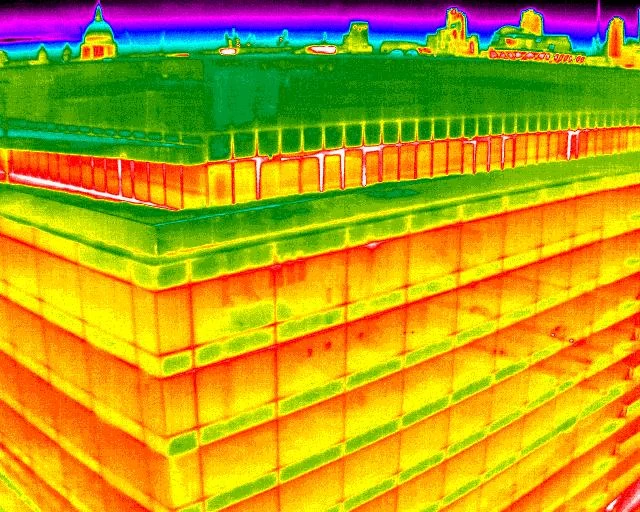
On a steel framed, clad commercial building, thermal bridging rarely appears as a single fault. It shows as a regular pattern that follows the fixings, panel joints, rooflights and the base of the wall. This article explains why that repeat is the baseline rather than the finding, what a departure from it tends to look like, why heating across large buildings has to be understood first, and why bare metal needs careful handling on an aerial thermal survey.