Reading a Drone Quotation With Confidence
Every trade has its shorthand, and drone work has more than its share. A quotation for an aerial survey can arrive carrying an operating category, an authorisation reference, a competence certificate and a class mark, none of which mean anything obvious to the person being asked to sign it. The temptation is to skip past them to the price.
That is a mistake, because those terms are the part of the document that tells you what can actually be flown. They describe the framework the work is planned under, the permissions the operator holds, and the aircraft chosen to do it, and those three things together decide whether your site can be surveyed the way you have imagined it.
A further complication is that much of the vocabulary in circulation is out of date. The United Kingdom replaced its drone framework at the end of 2020 and revised it again at the start of 2026, and a good deal of what is still written online, including on operators’ own websites, belongs to the system before that. Terms that once meant something now mean nothing at all.
What follows is not a dictionary. It is the set of terms you are likely to meet in a real quotation or a real conversation about permissions, with the practical consequence of each attached. Read it once and the paperwork stops being opaque.
Blog Content TL;DR...
The drone industry’s shorthand is not decoration. It tells you what can be flown.
- UAV, UAS, RPAS and SUA all describe the same thing and signal nothing about capability.
- Open and Specific are the two categories that matter, and the one chosen governs every other term on the page.
- An Operator ID belongs to the business and a Flyer ID to the pilot, and the two are routinely confused.
- The A2 CofC works inside the Open category; the General VLOS Certificate is what Specific category work requires.
- An Operational Authorisation is the written permission itself, and PDRA-01 is the regulator’s standard template behind most of them.
Read the terms as a set. When they agree with one another, the job has been planned before it was priced.
What the Words Actually Describe
Aircraft, systems and operating categories
Four names for one aircraft
The aircraft itself attracts more names than anything else in the industry. Unmanned Aerial Vehicle and its abbreviation UAV describe the airframe alone. Unmanned Aircraft System, or UAS, describes the whole assembly, meaning the aircraft, the controller and the link between them, which is why it is the term the regulations use. Remotely Piloted Aircraft System, or RPAS, says the same thing while making the point that a qualified person is flying it. Small Unmanned Aircraft, sometimes SUA, is the older British legal phrase. None of these signals anything about quality or capability, and an operator using one rather than another is telling you nothing. Where the words start to matter is when they are attached to a category.
The word that governs everything else
Operations are sorted by risk into the Open category and the Specific category, and the label chosen decides every other term on the page. Open category work needs no authorisation but accepts tight limits on how close the aircraft may come to people and to built-up areas. Specific category work exceeds those limits and is flown under a written authorisation from the Civil Aviation Authority. Most genuinely useful commercial inspection sits in the Specific category, because useful inspection happens near buildings and near the people who use them. If the quotation names a category, that single word has already told you which set of constraints the rest of the document is working within.
what the terms in a drone quotation mean | the difference between an Operator ID and a Flyer ID | what an Operational Authorisation coverswhat the terms in a drone quotation mean | the difference between an Operator ID and a Flyer ID | what an Operational Authorisation covers
Registrations, Certificates and Authorisations
Two registrations that sound alike
Registration comes in two parts and they are constantly confused. The Operator ID belongs to the organisation responsible for the aircraft and is displayed on the airframe itself. The Flyer ID belongs to the individual flying and evidences a competence test. Their reference numbers even announce which is which, one beginning GBR-OP and the other GBR-RP. A competence card always carries the pilot’s Flyer ID, never the operator’s registration, so the two are easy to tell apart.
Two certificates, two different reaches
Pilot competence comes at two levels. The A2 Certificate of Competency, usually the A2 CofC, permits flight closer to people within the Open category, on a suitably class-marked aircraft. The General VLOS Certificate, the GVC, is the qualification required to fly in the Specific category under an operational authorisation, and VLOS simply means visual line of sight, the pilot keeping the aircraft in unaided view. The distinction matters commercially. An operator holding only the A2 CofC is working inside Open category limits, whatever the aircraft.
The permission, and the template behind it
An Operational Authorisation is the written permission the Civil Aviation Authority issues for Specific category work, and most are granted against PDRA-01, a pre-defined risk assessment the regulator publishes so that a common type of operation need not be assessed from first principles every time. Seeing PDRA-01 quoted alongside an authorisation number is a good sign rather than a puzzling one, because the work is being planned against a standard the regulator wrote itself.
Reading the Quotation as a Whole
The mark on the aircraft
One more term has arrived recently and appears increasingly on specification sheets. Since the beginning of 2026 drones placed on the United Kingdom market carry a class mark, written UK0 through to UK6, which grades an airframe by weight and capability and determines which of the Open category subcategories it may be flown in. Aircraft marked to the European scheme, whose labels run C0 to C4, are currently read across to the equivalent UK class, and that read-across is due to end on 31 December 2027. Older aircraft predating the scheme carry no mark and are handled under separate transitional arrangements. None of this restricts work flown under an operational authorisation, where the authorisation rather than the mark sets the limits.
Reading the whole page at once
The value of the vocabulary is not in any single definition. It is that the terms should agree with one another. A quotation naming the Specific category should also name an authorisation, and a pilot qualification to match it. One naming the Open category should be describing work that genuinely sits within those limits, on an aircraft whose class mark allows it. Where the words line up, the operator has thought about the job before pricing it, which is the real thing you are looking for. If one term looks out of place, the question to ask is simply what it means for this site, and any operator worth commissioning will answer it in a sentence.
The documents behind the terms have recognisable shapes, which makes them quick to check. An Operator ID is issued to the legal entity, begins GBR-OP, is displayed on every aircraft flown, and renews annually. A Flyer ID is issued to the individual, begins GBR-RP, follows a short online test, and runs for five years. The General VLOS Certificate is issued against that same Flyer ID by a Recognised Assessment Entity and runs for five years of its own; the A2 Certificate of Competency is issued the same way and carries its own expiry date. An Operational Authorisation is issued to the operator rather than the pilot, carries its own reference number and expiry date, and is renewed on its own annual cycle against a declaration that a current operations manual is held. The cycles are independent of one another, which is why a well-run operation tracks them separately. Class marks, running UK0 to UK6, belong to the aircraft and do not expire.
Governing Regulations and Guidance
- Assimilated Regulation (EU) 2019/947, the United Kingdom rules for unmanned aircraft operations, which establish the Open, Specific and Certified categories
- Assimilated Regulation (EU) 2019/945, which sets the product requirements behind the UK class marks carried by new aircraft
- The Air Navigation Order 2016 as amended, which carries the registration requirements for operators and remote pilots
- CAP 722, the Civil Aviation Authority’s guidance on operating unmanned aircraft in UK airspace
- CAP 2320, The Drone and Model Aircraft Code, the Civil Aviation Authority’s plain English guidance for pilots
- Assimilated Regulation (EU) 785/2004, the aviation insurance standard that authorised operations must meet
Planning Aerial Survey Work?
Drone Media Imaging provides aerial survey, thermal inspection and mapping across Sussex, Hampshire, Kent and Surrey, travelling throughout the UK, Ireland and Europe. Tell us what you need to see and we will set out plainly how the work would be planned, which permissions it sits under and what the deliverables would be.
related posts
Booking a drone operator means checking paperwork, and the names have changed since most checklists were written. This piece sets out the three families of document a client should ask for, registration, authorisation and insurance, what each proves, and the pairs most often confused: an Operator ID against a Flyer ID, an Operational Authorisation against the retired PfCO, a GVC against an A2 CofC. It closes with the paperwork that belongs to your job rather than the operator.
A drone roof inspection puts high-resolution, annotated imagery of every gutter, valley, ridge and fixing in your hands without scaffolding, access equipment or anyone leaving the ground. Autumn is the last sensible window to commission one before winter weather tests the roof for you. This post explains what the inspection delivers, how the imagery is captured and annotated, and why a dated photographic baseline of your roof earns its keep all winter, across Sussex, Surrey, Kent and beyond.
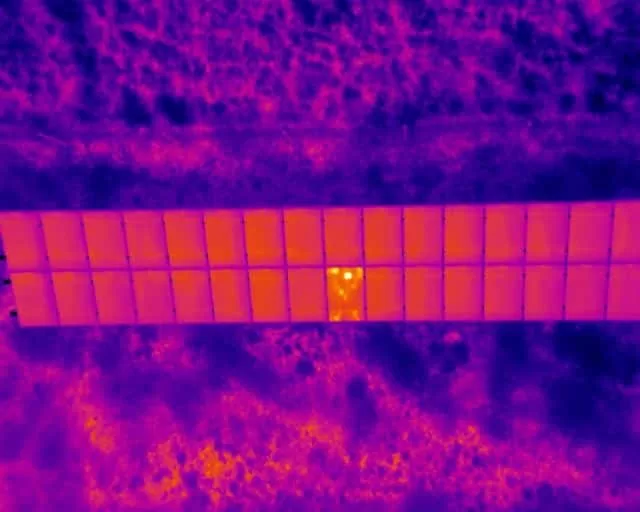
A thermal image of a photovoltaic array records surface temperature, and surface temperature is a symptom rather than a diagnosis. This post sets out how the signatures are actually read on an operating array: what a single hot cell suggests, why a uniformly warm third of a module points somewhere entirely different, how potential-induced degradation gives itself away by geometry, and why severity under IEC 62446-3:2017 is framed with caution rather than asserted from one temperature figure.