The Physics of a Wet Roof Build-Up
A flat roof is not a single surface. It is a build-up, a waterproof membrane over a layer of insulation over a structural deck, and each of those layers behaves differently when it is heated through the day and left to cool after dark. When the membrane fails somewhere and water finds its way into the insulation beneath, the water does not simply sit there waiting to be found. It changes how that part of the roof stores and releases heat.
That change is what a thermal survey is actually looking for. It is not looking at water, because a thermal camera cannot see through a membrane, and it is not measuring dampness, because a thermal camera is not a moisture meter. What it records is a difference in how quickly one part of the roof gives up the heat it gained during the day. That difference is a consequence of the water rather than a picture of it.
Understanding that distinction is the whole of this subject. It explains why the survey is timed to the evening rather than the middle of the day, why cloud and wind can put a job off, why a warm patch is a question rather than an answer, and why the report that follows is written in the careful language it is written in.
Blog Content TL;DR...
The short version of how trapped moisture in a flat roof gives itself away, and what that signal is actually worth.
- Water in the insulation displaces the trapped air and brings a far greater capacity to store heat.
- Through a sunny day the whole roof warms and the differences stay hidden. The contrast appears on the way down.
- Wet areas release their stored heat more slowly, so they read warmer at the surface once the sun has gone.
- Cloud, wind and recent rain all flatten the pattern, so the survey is timed to the weather rather than the diary.
- A warm patch is a thermal anomaly consistent with moisture, not proof of it, and it is reported as exactly that.
The lag is the evidence, and the honest limit of that evidence is part of the finding.
What Water Does to a Roof Build-Up
Thermal mass, and the layer that stops working
Dry insulation works by trapping still air. Air conducts heat poorly and has very little capacity to store it, which is exactly why a thick layer slows the passage of heat between the inside of a building and the sky above. The material itself contributes some of the performance, but a great deal of the work is done by the air held within its structure.
Water entering that structure undoes both properties at once. It displaces the air, so the layer conducts heat far more readily than it was ever designed to. It also brings with it a far greater capacity to store heat than the material it has replaced, because water has a far higher heat capacity by volume than the dry materials around it. The wet zone therefore becomes both a better conductor and a much larger heat store than the dry insulation surrounding it, and it is the second of those two changes that the survey depends on.
Why that matters more at night than at noon
Through a sunny day the whole roof absorbs heat from above. Wet and dry areas alike warm up, and surface temperatures across the roof tend to even out under strong solar loading, which is precisely why a midday thermal image of a flat roof is usually uninformative. Energy is arriving faster than the differences between the layers beneath can express themselves at the surface.
The lag appears on the way down
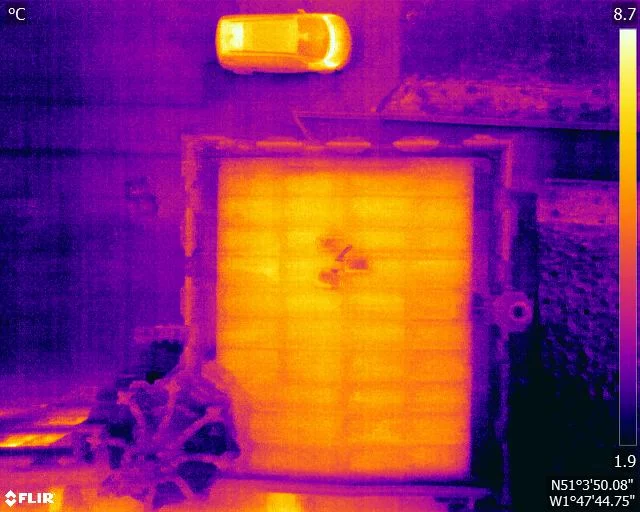
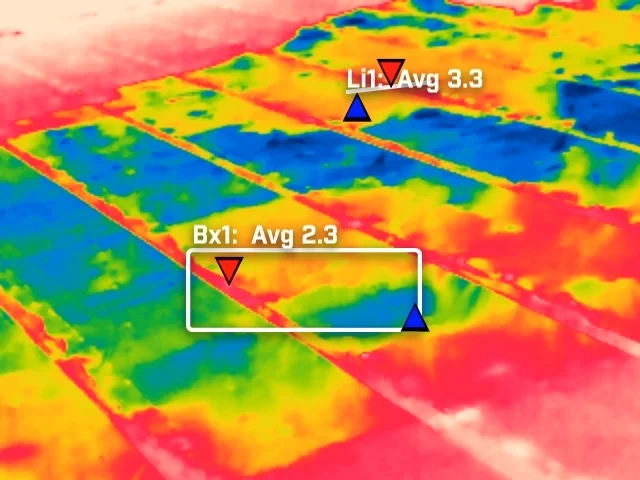
After sunset the driver reverses. The roof begins to radiate its heat away to the sky, and the dry areas, holding little, cool quickly. The wet areas hold a great deal more, so they give it up more slowly and stay warmer at the surface for some hours afterwards. The pattern a thermal survey records is that lag, made visible.
why wet insulation stays warm after sunset, timing a roof survey to the evening cooling cycle, what a thermal pattern on a flat roof does not provewhy wet insulation stays warm after sunset, timing a roof survey to the evening cooling cycle, what a thermal pattern on a flat roof does not prove
Timing the Survey to the Cooling Cycle
Because the signal exists only while the roof is losing heat unevenly, the survey has to be carried out inside that window, and the window is created by the weather rather than chosen for convenience. A day of genuine solar gain charges the roof. A clear, calm evening lets it discharge. Those two conditions together are the difference between a survey that produces usable data and one that produces a flat, featureless image, so the forecast is part of the method, checked in advance and again shortly before the visit.
What flattens the pattern
Cloud during the day means the roof never takes on enough heat to show a contrast on the way down. Cloud after sunset slows radiative cooling and holds the whole roof at a more even temperature. Wind strips heat from the surface faster than the layers beneath can influence it. Rain in the days before a survey wets the top of the membrane, which produces evaporative cooling patterns that have nothing to do with what lies underneath. Each of these is a reason to postpone rather than to press on, and where a survey does go ahead in marginal conditions, those conditions are recorded alongside the imagery so that the analysis carries the caveat with it.
Reading the Pattern, and the Limits of It
What a warm patch actually is
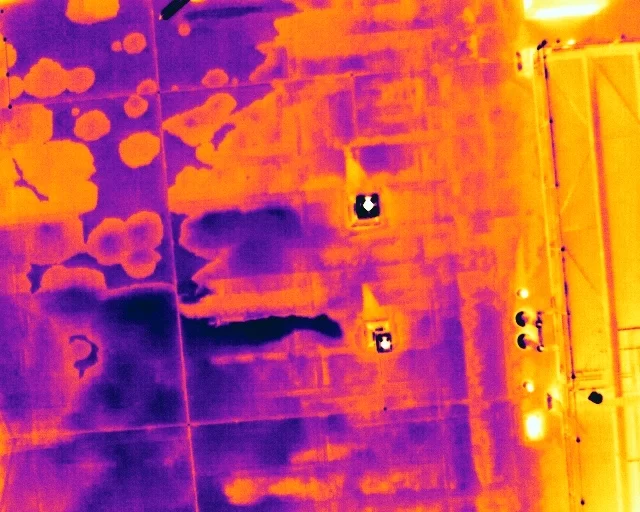
A warm area on an evening thermal image of a flat roof is an area that is cooling more slowly than the roof around it. That is all it is. Trapped moisture is one explanation for it, and on many roofs it is the most likely one, but it is not the only one, and the distance between those two statements is the distance between a defensible survey and a guess.
The other things that hold heat
Rooftop plant and flues put heat into the roof directly. A warm room below the deck, a kitchen, a plant room or a server room, shows through as a warm zone with no water involved at all. Ballast and gravel carry their own thermal mass and cool on their own schedule. Standing water lying on top of the membrane behaves differently again. Recent repairs, patches of a different material and changes in insulation thickness all produce contrast that is perfectly legitimate and entirely dry. This is why the daylight photographs and the walk-round matter as much as the thermal frames, and why every warm feature is photographed and registered before anything at all is concluded about it.
How the finding is written
The honest form of the result is a thermal anomaly consistent with trapped moisture, located, photographed and described, with the conditions under which it was recorded set down alongside it. Thermography does not confirm the presence of water. Confirmation comes from corroborating methods such as core sampling or capacitance testing, which sit outside this work. Findings are therefore reported as areas warranting further investigation by a suitably qualified contractor, and the survey, the analysis and the report are where the service ends. Saying that plainly is not a weakness in the method. It is what makes the rest of the report worth relying on.
None of it implies an opinion on the structure itself. A thermographic survey records surface temperature behaviour and what can reasonably be inferred from it; it is not a building survey, a structural assessment or a condition grading, and it does not stand in place of one.
The behaviour described here is a dynamic one rather than a steady-state one. A U-value describes how a build-up performs once temperatures have settled and heat is flowing steadily through it. It says nothing about what happens while conditions are changing, which on a roof under a daily solar cycle is most of the time.
The dynamic case is the subject of ISO 13786, which covers the dynamic thermal characteristics of building components and the calculation of how a layered element responds to a periodic driving temperature. Two of its concepts map directly onto what a roof survey exploits. The time shift is the delay between a temperature swing at one face of an element and its effect at the other. The decrement factor is how far that swing is damped on the way through. Adding water to the insulation layer alters both, and it is that alteration, expressed at the surface during the cooling half of the cycle, that a thermal image records.
Governing Standards and Basis
- EN 13187:1999, Thermal performance of buildings, Qualitative detection of thermal irregularities in building envelopes, Infrared method. Methodology aligned to this standard as applicable.
- ASTM C1153, Standard Practice for Location of Wet Insulation in Roofing Systems Using Infrared Imaging, as the reference practice for the method described here.
- ISO 13786, Thermal performance of building components, Dynamic thermal characteristics, as the framework for the thermal mass behaviour described above.
- Work conducted by Steve Fisher, ITC Level III Certified Master Thermographer (Infrared Training Centre; Certification #205722059), practising in accordance with the frameworks of ISO 18436-7:2014, ASNT SNT-TC-1A and ANSI/ASNT CP-105, and BINDT CMGEN Appendix B as UK training governance.
- Scope is Survey, Analysis and Reporting. Findings are reported as areas warranting further investigation by a suitably qualified contractor, and no building survey, structural assessment or condition grading is offered or implied.
Discuss a Flat Roof Thermal Survey
Drone Media Imaging carries out building envelope thermography across Sussex, Hampshire, Kent and Surrey, travelling throughout the UK, Ireland and Europe. If you would like to talk through whether a thermal survey suits your roof, what conditions it needs and what the report would actually contain, get in touch and we will tell you straight.
related posts
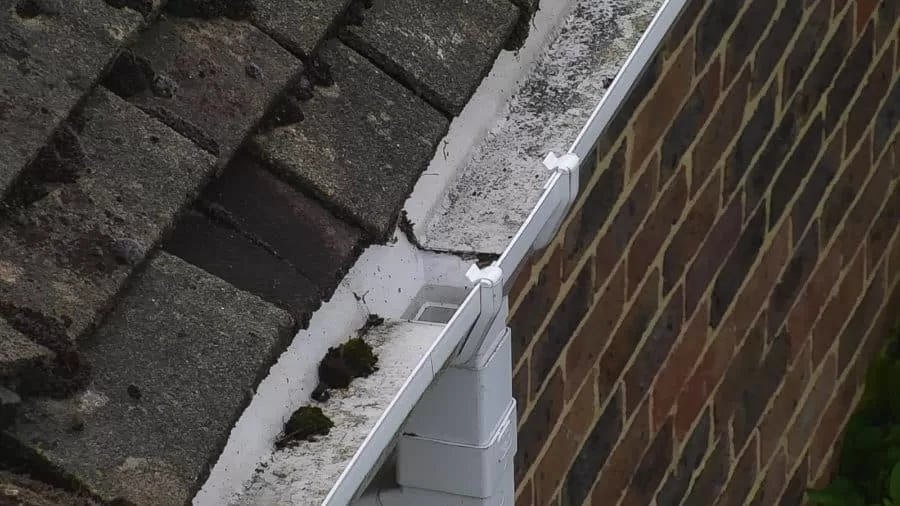
A roof moves rainwater along a designed path, from slope to valley to gutter to outlet. Autumn is when that path is loaded for the first time in months, and when anything silted, sagging or split begins to show. Almost none of it is visible from ground level. This is what an aerial inspection records about roof drainage, why standing water is such a useful signal, and how observations are marked on the imagery so a contractor can quote from them.
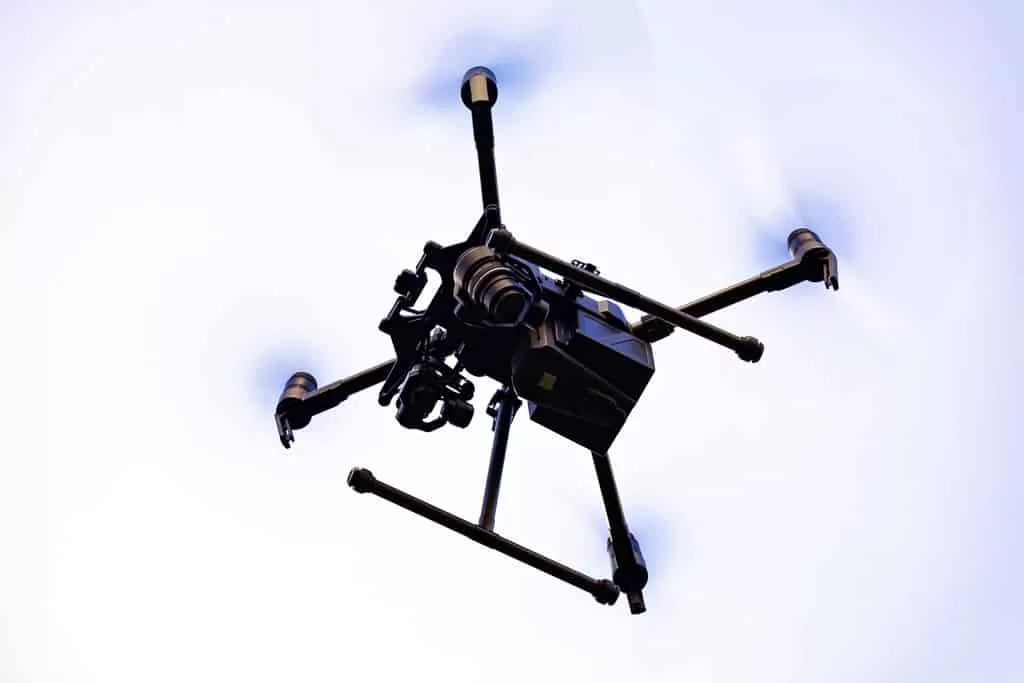
A quotation for aerial survey work arrives carrying an operating category, an authorisation reference, a competence certificate and a class mark, and it is tempting to skip past all of it to the price. Those terms are the part of the document that tells you what can actually be flown. This is the vocabulary you are likely to meet in a real quotation or a real conversation about permissions, in plain English, with the practical consequence of each attached.