
A Site Near an Airport Is Not an Unflyable Site
Plenty of commercial property sits close to an airport. Business parks, distribution centres, data centres and industrial estates cluster around them, because that is where the road links and the workforce are. So when the owner of one of those sites asks for aerial photography, video or a thermal survey, a reasonable question comes up early: can a drone legally fly here at all?
The short answer is usually yes, and the useful answer is that it depends on a permission most people do not know exists. A protected aerodrome sits at the centre of a Flight Restriction Zone, and that zone reaches well beyond the perimeter fence. Inside it, a drone flight needs the agreement of the aerodrome’s own air traffic unit before it happens, quite separately from anything the site owner has agreed to.
That is not a formality to be discovered on the morning of the shoot. It has a lead time, it can be refused, and it is assessed for the specific flight rather than granted once and reused. Understanding how it works is the difference between a booking that holds and a day that gets stood down, so it is worth ten minutes of a property manager’s time before the diary gets fixed. None of it makes the site unflyable. It makes the site something that has to be planned properly, by an operator who has done it before and knows what the aerodrome will want to see.
Blog Content TL;DR...
What a Flight Restriction Zone means if your site sits near an airport.
- A protected aerodrome sits inside a zone of roughly 2 to 2.5 nautical miles radius, plus runway protection zones, reaching up to 2,000 feet above the aerodrome.
- Sites well outside the airport boundary are frequently inside the zone, and line of sight to a runway is not the test.
- Three permissions are in play, the aerodrome’s, the landowner’s and the operator’s own authorisation, and only one of them is the client’s to give.
- The airspace permission is assessed for the individual flight and cannot be granted once and then reused.
- Tell your operator the address before the date is agreed, because the airspace answer can change what the date should be.
Near an airport the work is routine, provided the airspace question is asked at the enquiry rather than on the morning.
What a Flight Restriction Zone Actually Covers
The zone is bigger than the airport, and the permission is not the site owner's to give
The shape of the zone
A Flight Restriction Zone is built around a protected aerodrome in two parts. There is a cylinder of roughly 2 to 2.5 nautical miles in radius centred on the aerodrome, and there are runway protection zones extending from the ends of each runway. Together they reach up to 2,000 feet, or 600 metres, above the aerodrome. In practice that means a site well outside the airport boundary, a couple of miles down the road with no view of a runway, can still sit squarely inside the zone. Distance from the terminal building is not the test, and neither is line of sight to the airfield.
The zones exist around protected aerodromes, which covers the large international airports and many smaller licensed airfields, and they are not the only restricted airspace on the map. Prisons, nuclear sites and military ranges carry their own permanent restrictions, published in the aeronautical information publication. Events, emergencies and security operations generate temporary ones at short notice, issued as notices to airmen. A site can therefore be perfectly flyable in general and unflyable on a particular Tuesday.
Three permissions people tend to treat as one
Most site owners assume that because they control the land, they control the flight, and it is an understandable assumption. In fact three separate permissions are in play and only one of them is theirs to give. The airspace permission comes from the aerodrome’s air traffic unit, which is assessing the flight against its own traffic and its own safeguarding, not against the merits of your project. The landowner permission covers the take-off and landing site and the ground operation, and that one is yours. The third is the operator’s own authorisation to do commercial work at all, held before any job is discussed and renewed on a fixed cycle.
Keeping them separate matters because they fail in different ways. A landowner can be entirely willing while the aerodrome declines the slot. An aerodrome can be content while the only viable take-off point turns out to belong to somebody else. Sorting all three at the enquiry stage, rather than in sequence as each one surfaces, is most of what makes a date near an airport reliable.
can a drone fly near an airport, drone flight restriction zone permission, aerial photography near Gatwick Airportcan a drone fly near an airport, drone flight restriction zone permission, aerial photography near Gatwick Airport
Getting the Permission, Flight by Flight
Why it cannot be granted once and reused
The rule underneath all of this is short. A commercial operator’s authorisation permits work across the UK, and it does so expressly subject to whatever airspace restriction applies on the day. The authorisation does not override a Flight Restriction Zone, it defers to it. So the assessment is made for each job: this site, this date, this height, this duration, this aircraft, this pilot. An approval for a shoot last March says nothing about a shoot this September at the same address. That is why an operator who works in these zones treats the airspace question as part of quoting the job, not as an administrative step afterwards.
What the aerodrome is being asked to agree to
The request that goes to the air traffic unit is specific rather than general. It describes where the aircraft will be, how high it will go, when it will start and stop, and how the operator will be contacted while it is airborne. The unit weighs that against its own movements and its own procedures, and it may approve it, approve it with conditions such as a ceiling or a time window, or decline it. Conditions are the common outcome and they are usually workable, provided they arrive before the crew is on site rather than after.
Alongside that sits the ordinary pre-flight work that applies anywhere: current aeronautical information, active notices, the ground risk, the people who will be near the operation, and the landowner’s agreement to use the take-off point. Near an airport none of that gets easier, it simply gains an extra approval on top. The practical consequence for a client is lead time. A date offered without a word about airspace, on a site inside a zone, has not been checked.
What This Means When You Book the Work
Four things worth saying at the enquiry
You do not need to know whether your site is inside a zone. That is the operator’s job, and it takes minutes to establish from the address. What helps is telling them the address early, before the date is agreed, because the answer can change what the date should be.
It also helps to say what the flight has to achieve. A survey that needs consistent height across a whole site is a different conversation with an air traffic unit from a handful of oblique photographs taken from one position, and the second is easier to approve near a runway. Say who controls the ground you would launch from, since that is frequently a neighbour, a managing agent or a highway rather than the client. And flag anything time critical, because a restriction that appears at short notice for an event or an incident can move a day that was otherwise agreed.
Sites near airports get flown regularly and successfully. Coverage across Sussex, Hampshire, Kent and Surrey sits under or beside the zones of several protected aerodromes, Gatwick, Heathrow, Farnborough, Shoreham and Lydd among them. The work is routine, provided it is planned as the thing it is rather than treated as an afterthought.
The Rules This Sits Under
- Operations are conducted by VisualChaos Studios Ltd, trading as Drone Media Imaging, under a CAA Operational Authorisation held in the Specific category and renewed on a fixed cycle.
- Flight within any applicable airspace restriction requires the appropriate permission, assessed for each job rather than granted once, in accordance with the conditions of that authorisation.
- Flight Restriction Zones around protected aerodromes are established under the Air Navigation Order 2016 as amended, with entry subject to the agreement of the aerodrome’s air traffic unit.
- Airspace assessment uses current aeronautical information publication data and active notices to airmen, as part of the pre-flight feasibility assessment recorded in the operations manual.
- Landowner permission for the take-off and landing site is obtained separately from any airspace permission and is never a substitute for it.
- Third party liability insurance meeting UK Regulation (EU) 785/2004 is held as a condition of the authorisation.
Tell Us the Address Before You Fix the Date
Send us the site address and what the aerial work has to achieve, and we will tell you whether it sits inside a Flight Restriction Zone and what that means for the timescale. If it does, we will say what the aerodrome is likely to want and roughly how long it usually takes. Coverage across Sussex, Hampshire, Kent and Surrey, travelling throughout the UK, Ireland and Europe.
related posts
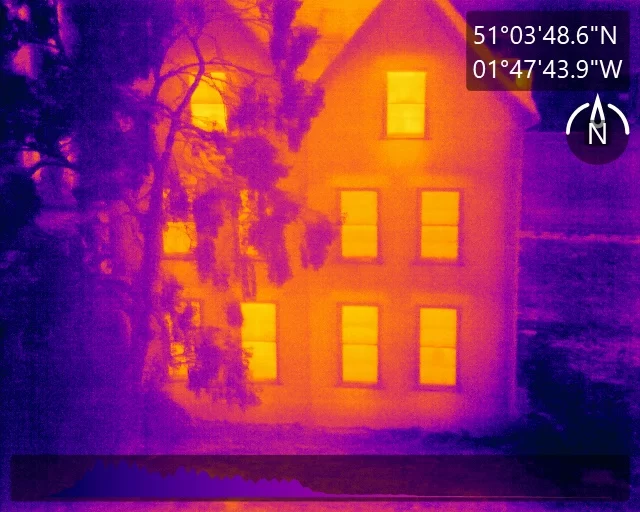
A thermal camera does not see insulation, it sees temperature difference, and that single fact decides when a building survey can usefully be done. This explains the differential EN 13187 recommends, why the working season in the United Kingdom is shorter than most people expect, why imagery is captured well after sunset rather than at dusk, and how wind, rain and cloud affect what the results are worth. Practical guidance for anyone planning a heat loss survey this coming season.
Commissioning aerial photography, a roof inspection or a solar survey means buying the legal basis of the flight as well as the imagery. UK drone regulation changed completely in 2020, and the old shorthand no longer describes anything real. This is a plain guide to the four documents a professional operator should be able to produce on request, what each one actually permits, and the site-specific paperwork a properly run job generates before anybody takes off.