
Why the Operator Asks Who Will Be on Site
Ask a commercial drone operator to fly at your premises and the first questions come straight back at you. Who will be on site that day? How close are the neighbouring houses? Is there a public footpath along the boundary? It can feel like interrogation before a quote has even been mentioned, and the reason is not curiosity. The rules that decide where a drone may be flown in the UK are written around one thing above all: how close the aircraft comes to people who have nothing to do with the flight, and to the places where those people live, work and gather.
Those rules have changed a great deal since drone work first became common, and much of what is still repeated about them is out of date. The old blanket distance from every person, vehicle and building not under the pilot’s control has gone. In their place is a system that sorts every flight by risk, sets separation according to the aircraft and the operator’s qualifications, and gives a professional operator a route to fly closer than a hobbyist can. This piece sets out the ground rules in plain terms, so that the questions make sense and the answers you give shape a safer, quicker booking.
Blog Content TL;DR...
How close a drone may fly to people and buildings in the UK, and what that means for a booking at your site.
- Flights are sorted by risk, not by whether they are paid for. The Open category covers low-risk flying with no authorisation; the Specific category covers everything closer or busier, under an Operational Authorisation.
- The Open category splits into A1, A2 and A3. A1 is the smallest aircraft, which may pass over people but never over a crowd; A2 is close to people with a qualification and a class-marked aircraft; A3 is far from people and at least 150 m from residential, commercial, industrial and recreational areas.
- Every category shares a ceiling of 120 m above the surface, measured from the nearest point of the ground beneath the aircraft.
- An “uninvolved person” is anyone not briefed into the flight and free to decline. Your staff and visitors count as uninvolved unless that is done properly.
- A Specific category authorisation is what lets a commercial operator work closer on a busy site, which is why it is the normal footing for survey and inspection work.
The distance a drone keeps from your people is not a preference. It is set by the category the flight sits in.
One Ceiling, Three Ways of Flying Near People
The Open category, and where each of its subcategories can go
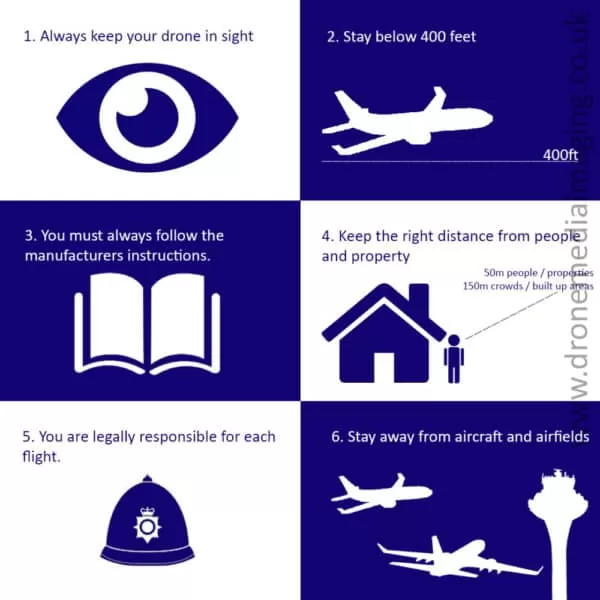
UK drone regulation sorts every flight into a category by the risk it carries, and for work near people and buildings that sorting happens before anything else about the job is decided. The lowest-risk flights sit in the Open category, which needs no authorisation from the Civil Aviation Authority.
The limits everyone shares
Whatever else applies, an Open category flight stays within the pilot’s visual line of sight, uses an aircraft under 25 kg, drops nothing and never climbs above 120 m from the nearest point of the surface beneath it. That ceiling is measured from the ground below the aircraft, not from the take-off point, so on a sloping site it follows the terrain.
A1, A2 and A3 in plain terms
Within the Open category, three subcategories describe how close to people a flight may go. A1 is for the smallest aircraft and permits flight over uninvolved people but never over a crowd. A2 is flying close to people, and it needs both a class-marked aircraft and a pilot holding an A2 Certificate of Competency; with that combination the aircraft may work as near as 30 m to uninvolved people, and closer still in a low-speed mode. A3 is flying far from people, well clear of anyone uninvolved and at least 150 m from residential, commercial, industrial and recreational areas.
Read those against a typical commercial site and the difficulty is obvious. An occupied office, a working yard or a housing estate cannot be flown 150 m from itself, so A3 is out, and A1 relies on an aircraft so light that it limits the camera it can carry. That leaves A2, with its conditions, or a different category altogether.
how close can a drone fly to people in the UK, what is an uninvolved person in drone rules, the 120 metre drone height limit explainedhow close can a drone fly to people in the UK, what is an uninvolved person in drone rules, the 120 metre drone height limit explained
What "Uninvolved" Means for Your Staff and Visitors
Every separation distance in the rules is measured to an uninvolved person, so the word carries the whole weight of the system. It does not mean a stranger. It means anyone who is not part of the flight, and by default that includes your own staff, contractors, customers and anyone walking past the boundary.
How a person becomes involved
A person is treated as involved only where several things are true at once. They have agreed to take part, they have been given and have understood clear instructions on what the aircraft will do and what to do if it behaves unexpectedly, they broadly understand the risk, they are free to decline, and declining costs them nothing. A remote pilot checks that understanding with simple questions before the flight, not by assuming it. A notice on a gate, an announcement over a tannoy or a line in a ticket condition does none of this, which is why spectators, shoppers, a sports crowd or people on a street are always uninvolved.
What that means on a working site
For a client the practical consequence is that briefing is a real activity with a cost in time, and it only works for a manageable number of named people. A site manager and two operatives can be briefed into a flight. A shift of forty, a car park of customers or the residents of the next street cannot, so the flight is planned to keep the required distance from them, or to take place when they are not there. That is why the operator asks who will be on site, when, and where.
It also answers a common request. A drone is never flown over a crowd in any category, and it keeps its horizontal distance from an assembly of people at no less than its own height, so the framing you are offered is the framing the rules allow.
Why Commercial Work Usually Sits in the Specific Category
Put the Open category rules beside a real commercial job and the gap is clear. A roof inspection on an occupied building, a solar array on a working factory, a mapping flight over a housing development: each sits inside the 150 m that A3 forbids, with people about who cannot all be briefed.
Closer, under authorisation
The route a professional operator uses is the Specific category, in which the Civil Aviation Authority grants an Operational Authorisation to the business rather than the pilot. The standard authorisation for this kind of work permits flight within 150 m of residential, commercial, industrial and recreational areas, with the aircraft kept 50 m from uninvolved people in flight and 30 m at take-off and landing, under the same 120 m ceiling and never over a crowd. Access to this category does not depend on the aircraft’s class mark, which matters now that the class mark rules changed at the start of 2026 and pushed older aircraft towards A3 in the Open category.
What the authorisation buys is not permission to ignore the distances but a defined set of them that fits a working site, held by a business with an operations manual, insurance and a qualified pilot behind it. Who carries the responsibility under it, and the paperwork that proves it, have their own pieces on this site, as do take-off permission, the airspace above a site and the zones around airfields. This one is only about how close, and the short answer is closer than the Open category allows, by a fixed and published margin, and no closer.
Governing Rules and Scope
- The operating categories and subcategories described here are those set out in assimilated Regulation (EU) 2019/947 and the Civil Aviation Authority’s guidance in CAP 722 and the Drone and Model Aircraft Code.
- The Specific category distances quoted are those of the standard pre-defined risk assessment authorisation (PDRA-01) under which Drone Media Imaging operates. Other authorisations carry their own conditions.
- Flight operations are conducted under a Civil Aviation Authority Operational Authorisation, with a General VLOS Certificate (GVC) and an A2 Certificate of Competency, and are insured for commercial operation in accordance with the aviation insurance regulation.
- Class mark and transition rules changed on 1 January 2026 and continue to change. This article describes the position at the time of writing, for a client’s general understanding, and is not legal or regulatory advice.
- Airspace, flight restriction zones, land permission for take-off and the operator’s documents are covered in their own articles and are outside the scope of this one.
Tell Us About the Site and Who Will Be There
The quickest way to find out whether a flight can be done as you picture it is to describe the site: what is on it, who will be there on the day, what stands next to it and where the nearest houses or public areas are. We will tell you plainly which category the work sits in, what distance the aircraft will keep and whether anything about the day needs to change.
Sussex, Hampshire, Kent and Surrey are home ground, with travel throughout the UK, Ireland and Europe where a job warrants it.
related posts
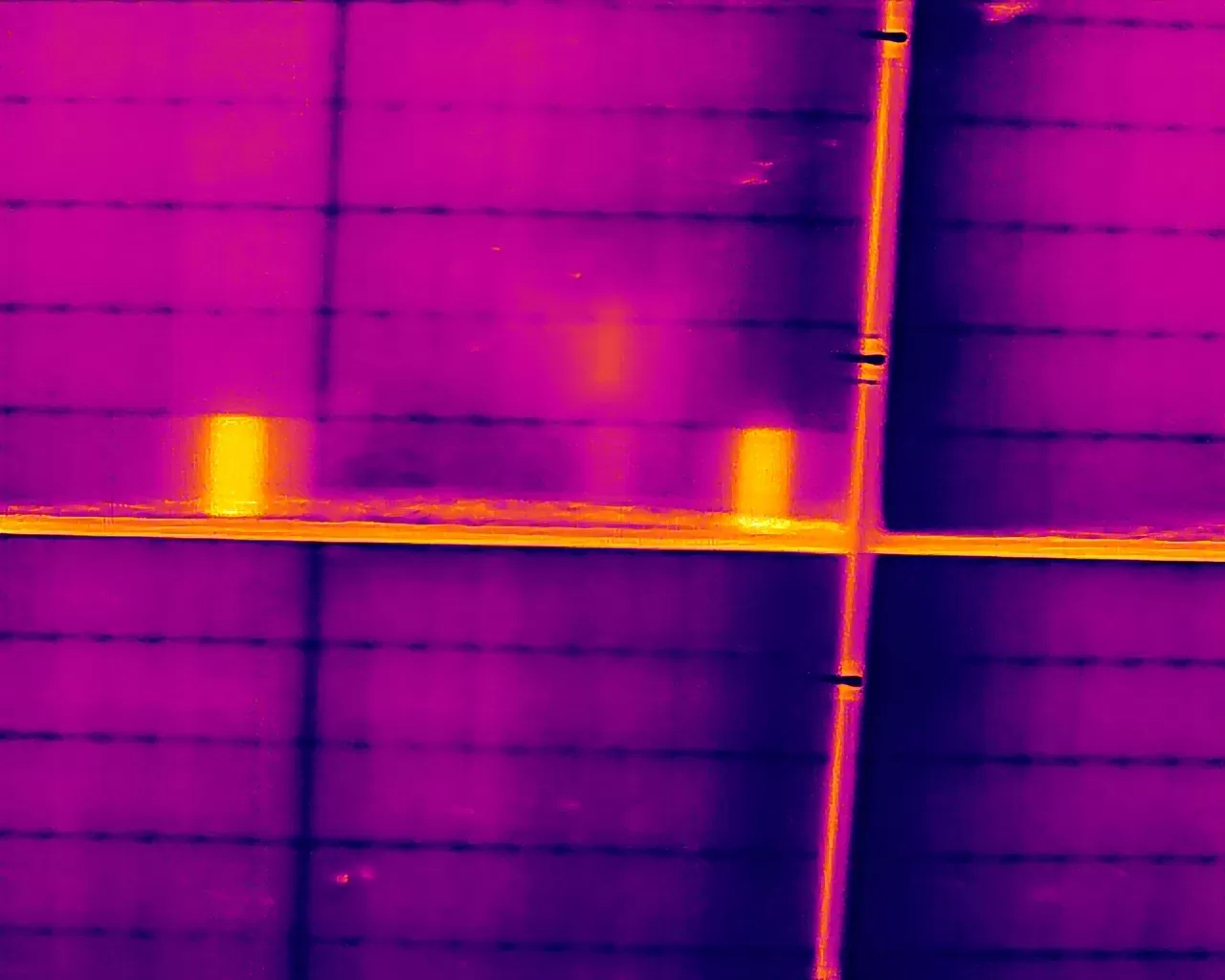
Almost every solar thermographic report leads with hot spots, but a hot spot is a symptom rather than a diagnosis. The same temperature rise can come from a bypass diode, a microcrack, potential induced degradation or a disconnected string, and one common reading is not a fault at all. This piece explains what the temperature figure does and does not tell you, and the symmetry rule that separates electrical faults from cell damage on a commercial rooftop or ground-mount array.
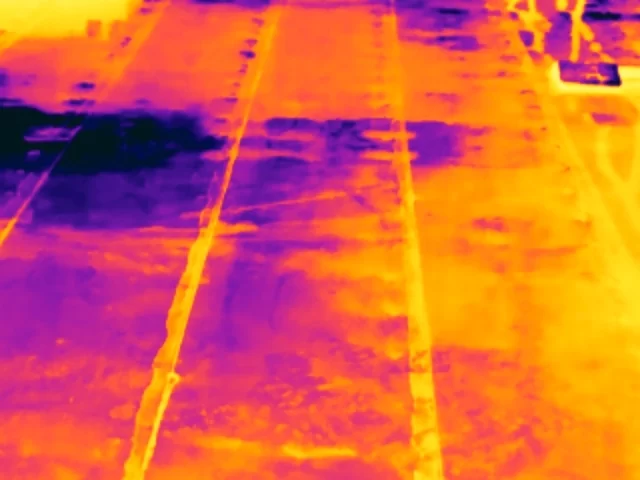
A thermal camera renders apparent temperature. Turning that into a defensible figure needs the surface emissivity, the reflected apparent temperature of the surroundings and the atmospheric path between camera and target, all set correctly at capture and none of them recoverable afterwards. This piece explains why a false-colour palette is a presentation choice rather than data, how automatic scaling can make a trivial difference look alarming, and why a comparison inside one image is sturdier than either reading alone.
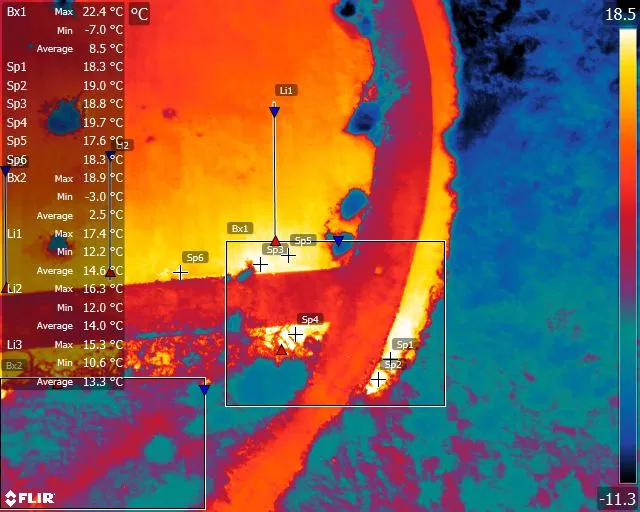
Explore the crucial role of drone thermal imaging in boosting fire safety measures at solid waste landfill sites.