Flat Roof Water Ingress
Replace the Wet Part, Not the Whole Roof
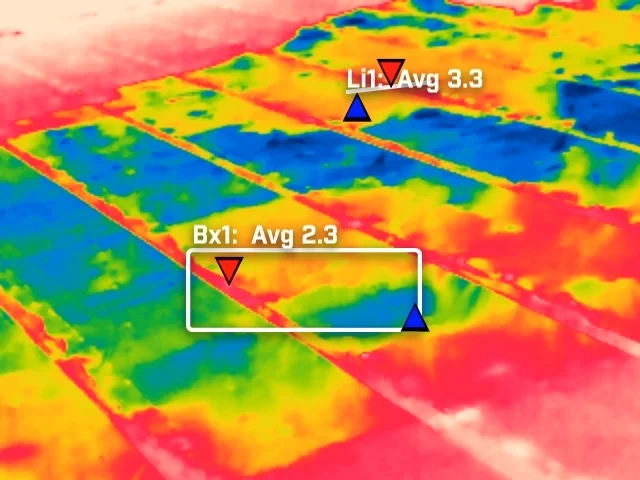
Thermal survey of a flat roof to locate trapped moisture and saturated insulation, flown in the window after sunset when wet material still holds the day's heat. Produces a mapped, bounded picture of where the water actually is, verified on site with a moisture meter, so repair can be scoped to the wet area instead of the whole roof. Analysed and reported by an ITC Level III Certified Master Thermographer.
Replace the Wet Part, Not the Whole Roof
Water appearing on a ceiling tells you almost nothing about where it entered the roof. It has travelled along a deck, across a vapour barrier and down whatever it found first, and the stain is frequently a long way from the defect. That is why flat roof leaks get chased for months, patched in the wrong place twice, and eventually solved by replacing the entire roof because nobody could prove which part of it had failed.
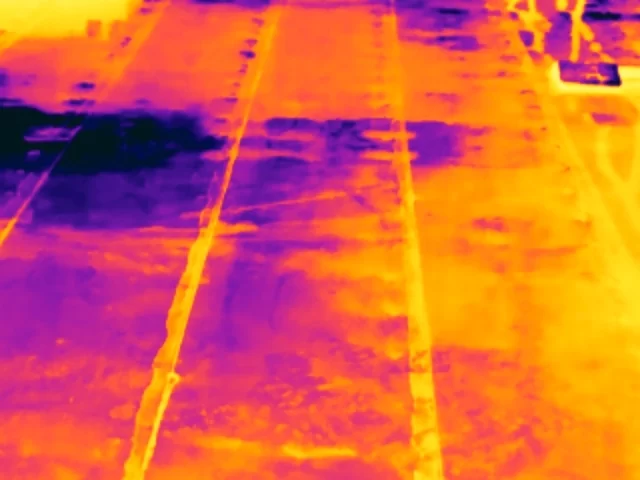
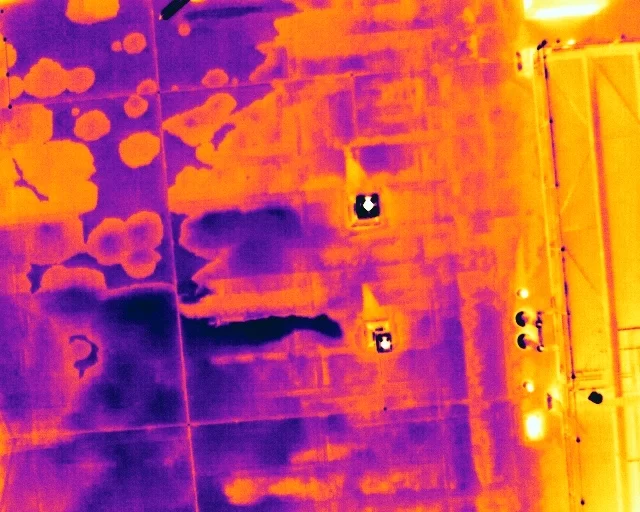
A thermal survey answers the question directly. Wet insulation holds heat differently from dry insulation, so in the hours after sunset the saturated areas are still warm while everything around them has cooled. What that produces is a map: the wet areas located, bounded and measured, on a roof that otherwise looks uniform from every angle. Then the argument stops being about opinion and starts being about area.
What You Get Back
A bounded moisture map, verified rather than asserted
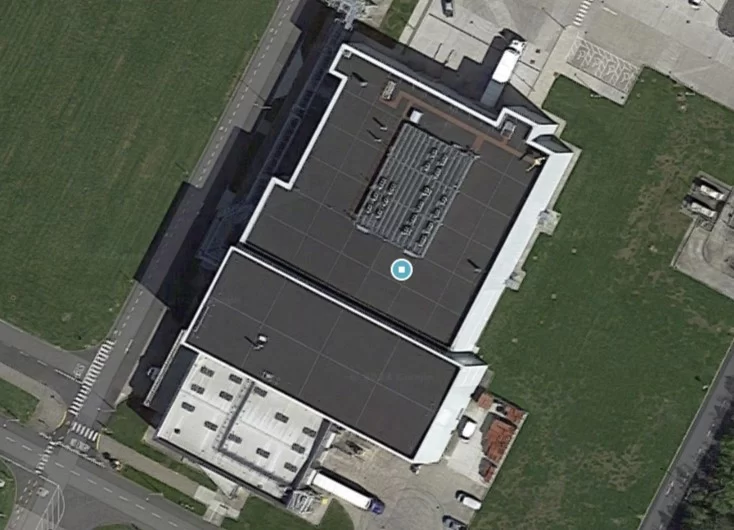
The deliverable is a plan of the roof with the suspected wet areas drawn on it, each one bounded, located against a fixed feature you can find on site, and given an approximate area. Alongside it sit the thermal images the areas were identified from, the visual images of the same locations, and the conditions the survey was flown in.
Every reported area is checked on site before it is reported. A thermal anomaly is a difference in surface temperature, and there are several things besides water that produce one: a patch repair with a different build-up, a plant base, standing water on the surface, or a section that simply sat in shade all afternoon. So the candidate areas are tested directly with a moisture meter, and the reading is recorded with the finding. Areas that read wet are reported as wet. Areas that read dry are reported as thermal anomalies with a probable cause, which is a different and more honest statement.
The report separates what is confirmed from what is suspected, and says which is which. That distinction is the whole value of the exercise, because a roofing contractor pricing from it needs to know where the evidence is firm and where it is indicative.
Where absolute proof is needed before a large spend, the accepted next step is a core sample cut through the build-up at a point the survey identifies. That is destructive work carried out by your roofing contractor, and the survey exists precisely so that it is done in two or three places that matter rather than a dozen chosen by guesswork.
At a glance
How a thermal roof survey finds trapped water, and what has to be true for it to work.
- Locates trapped moisture and saturated insulation across the whole roof, mapped and bounded, rather than inferred from where the ceiling stain appeared.
- Flown after sunset. Wet material holds the day’s heat longer than dry material, so the contrast appears as the roof cools and is strongest a few hours after dark.
- Thermal findings are verified on site with a moisture meter before they are reported. A thermal anomaly on its own is a candidate, not a conclusion.
- Scopes the repair. Knowing the wet area is 40 square metres rather than the whole 900 changes the specification, the price and the decision to repair or replace.
- Conditions rule it. Rain, standing water, high wind or a day with no sun on the roof will postpone a survey rather than degrade one.
- Ballasted, gravel-covered and some insulated membrane roofs read poorly or not at all, and we will tell you that at the enquiry rather than after the invoice.
The survey does not prove water. It proves where to look, accurately enough to stop looking anywhere else.
Often Flown on the Same Visit
Repair or Replace, Decided on Evidence
The survey usually costs less than the argument it settles
Most flat roof spending decisions are made without knowing how much of the roof is actually wet, and the absence of that one number is what pushes them towards full replacement. A survey changes the shape of the decision.
If the wet area is small and contained, a targeted repair is defensible, and the survey shows exactly where it goes and how far it extends. Patching a roof at the point where the ceiling is stained frequently misses, which is how a roof acquires a history of failed repairs and a reputation for needing replacement.
If the wet area is extensive, that is worth knowing too, and it is a far stronger basis for a capital request than a photograph of a damp ceiling. Saturated insulation is not just a leak, it is insulation that has stopped working and a deck that is being kept permanently wet, and both of those get worse rather than better.
Where the argument is with somebody else, a dated survey with mapped areas and recorded moisture readings is evidence. That matters in a dilapidations negotiation, in an insurance claim, in a dispute with a contractor over recent work, and in a service charge discussion where somebody has to justify the number.
It also tells you when there is nothing to find. A roof that surveys dry across the whole area, on a night with good conditions, moves the investigation somewhere else, which is a useful and frequently unwelcome answer. We report that outcome exactly as readily as the other one.
Investigating Building Fabric Without Opening It Up
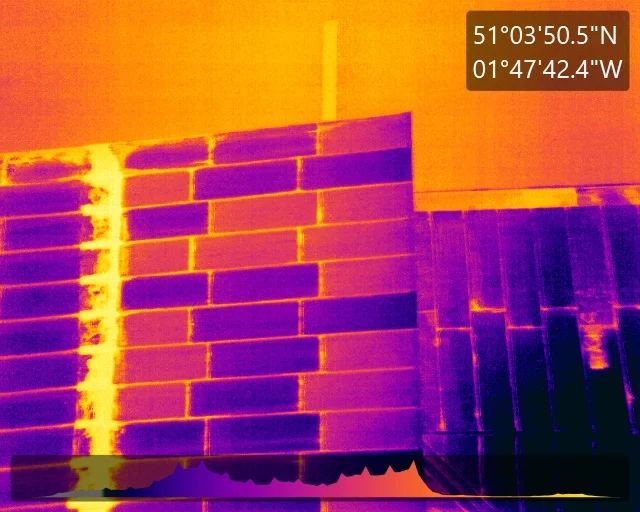
Thermal imaging applied to Grade I and Grade II listed buildings, where the fabric cannot be opened up to find out what is happening inside it. The survey identified heat loss patterns and areas of fabric condition without any intervention at all, which on a protected structure is frequently the only investigation permitted, and is the same non-invasive principle a roof moisture survey works on.
The Roofs This Does Not Work On
This is the section most surveyors would leave out. It is here because a survey sold onto the wrong roof wastes your money and our evening, and because knowing the exclusions in advance is what makes the rest of the method trustworthy.
Ballast and gravel defeat it. A layer of stone over the membrane has its own thermal behaviour, holds heat unevenly, and sits between the camera and the thing being looked at. Loose-laid ballasted roofs generally cannot be surveyed this way, and pavers are worse. If the roof is ballasted, we will say so from the photographs before anybody books a night.
Some build-ups mask the signal. Where insulation sits above the membrane, or where a thick, well-drained modern build-up separates any trapped water from the surface, the contrast at the top may be too small to read reliably. Inverted roofs are the common case, and they are a genuine limitation rather than a matter of trying harder.
The weather has to have cooperated for two days, not two hours. The method depends on the roof having absorbed heat during the day and giving it back after dark. A cold overcast day gives the roof nothing to release. Rain during or shortly before the survey wets the surface uniformly and hides everything underneath it, and standing water reads as a large cold area regardless of what is beneath. Wind strips the surface signal in the same way it does on a building elevation.
It finds wet material, not the hole. The point of entry is often at the edge of the wet area, at a detail, an upstand, a penetration or a lap, and the survey narrows it to a few metres rather than pointing at a single defect. On a roof where water has tracked a long way under the membrane, the wet area and the breach can be some distance apart, and the report says so rather than implying a precision the method does not have.
What it does exceptionally well is cover an entire roof in one pass, at night, without anybody walking on a surface that may already be compromised, and turn a vague and contested problem into a bounded area on a drawing.
The method rests on one property of water: it takes a great deal of energy to warm up, and it gives that energy back slowly. Compared with the dry foam or mineral insulation around it, wet material is thermally heavy.
Through the day the roof absorbs solar energy. Dry and wet areas both warm, and while the sun is on the roof the surface is dominated by how much sun each part received, which is why a survey in daylight tells you about shading rather than about water.
After sunset the roof begins to cool, radiating heat to a cold sky. The dry areas have little stored energy and cool quickly. The wet areas hold considerably more and cool slowly, so as the evening goes on they fall behind the surrounding surface and begin to stand out as warm regions. The pattern that emerges follows the water rather than the shading, and it is the shape of that pattern, spreading from a detail or pooling in a bay, that identifies it as moisture rather than as something structural.
That contrast opens, peaks and closes. Too early and the residual solar pattern is still dominant. Too late and everything has reached equilibrium with the night air and the difference has gone. The usable window is a matter of hours on the same evening, which is why these surveys are flown at night to a plan rather than fitted into a working day.
It also explains the exclusions. Anything that interrupts the cooling curve breaks the method: cloud that stops the roof charging, rain that wets everything equally, wind that carries the surface layer away, or ballast that has its own thermal mass sitting on top of the roof you are trying to read.
- Thermographic inspection, analysis and reporting are conducted by Steve Fisher, ITC Level III Certified Master Thermographer (Infrared Training Centre; Certification #205722059), practising in accordance with the frameworks of ISO 18436-7:2014, ASNT SNT-TC-1A and ANSI/ASNT CP-105, and BINDT CMGEN Appendix B (UK training governance).
- Survey methodology is aligned with EN 13187:1999, the qualitative detection of thermal irregularities in building envelopes.
- Thermography is an indirect technique. It measures surface temperature distribution, not the presence of water. Reported areas are corroborated on site by moisture meter reading, and confirmed and suspected findings are reported separately and labelled as such.
- Emissivity and reflected apparent temperature are established on site against the actual roof surface and recorded with the data, together with the environmental conditions and the time elapsed since sunset.
- Flight operations are conducted under a Civil Aviation Authority Operational Authorisation held against the PDRA-01 standard scenario, with a General VLOS Certificate (GVC) and an A2 Certificate of Competency.
- Drone Media Imaging provides survey, analysis and reporting. Core sampling, opening up, repair and roof specification are not offered and remain with your own roofing contractor or surveyor.
Send Us a Photograph of the Roof Before Anything Else
A photograph of the roof surface answers most of the question in about a minute, because the covering decides whether this method will work at all. Send that, the approximate area, where the water is showing inside, and what you need the survey to settle, whether that is a repair specification, a capital case or an argument with somebody else. You will get a fixed price back and a straight answer on suitability. If the roof is ballasted or inverted we will tell you before you spend anything, rather than after.