Solar PV Thermographic Inspection of a Food Manufacturing Rooftop Array
Why a Food Manufacturing Site Commissioned an IEC 62446-3 Solar Inspection
A solar PV thermographic inspection was carried out on a rooftop array at a commercial food manufacturing site in the East of England, covering 808 modules across 37 strings and 11 inverters with a rated capacity of 165 kW AC. The survey was flown by drone under IEC 62446-3:2017 as a simplified qualitative inspection, with every anomaly assessed against a healthy reference module of comparable orientation within its own thermogram. Thirty one findings were classified across two roof zones. Six carried a Safety consequence, five of those at Critical severity, with six locations recording apparent temperatures above 95 °C. The east-facing zone also showed potential induced degradation on nine separate module columns, identified by a repeating gradient running from the module frame toward the centre and still early in its development. A certified Level 3 report was issued with 34 annotated thermogram pages and an array control map for each zone, giving the asset owner a prioritised picture of what warrants investigation first and a baseline thermal record for comparison at the next inspection.
Project Overview
Subject
solar PV thermographic inspection, rooftop solar array survey, East of England, food manufacturing asset owners, IEC 62446-3:2017
Skills Used
IEC 62446-3 Solar Thermographic Inspection, Qualitative Thermal Analysis, Level 3 Report Writing
Portfolio Tags
Solar PV Inspection, Rooftop Solar Array, Thermal Imaging, East Of England, IEC 62446-3:2017, Food Manufacturing, Drone Media Imaging, What Is Potential Induced Degradation
What Does A Solar PV Thermographic Inspection Find, IEC 62446-3 Rooftop Solar Inspection East Of England, Drone Thermal Survey For Commercial Solar ArraysWhat Does A Solar PV Thermographic Inspection Find, IEC 62446-3 Rooftop Solar Inspection East Of England, Drone Thermal Survey For Commercial Solar Arrays
Solar PV Thermographic Inspection of a Food Manufacturing Rooftop Array
~ Two roof zones, 808 modules, one clear afternoon of usable sky. ~
Ageing arrays rarely fail all at once, and our Level 3 Master Thermographer's job is to find where they have started.
Why a Food Manufacturing Site Commissioned an IEC 62446-3 Solar Inspection
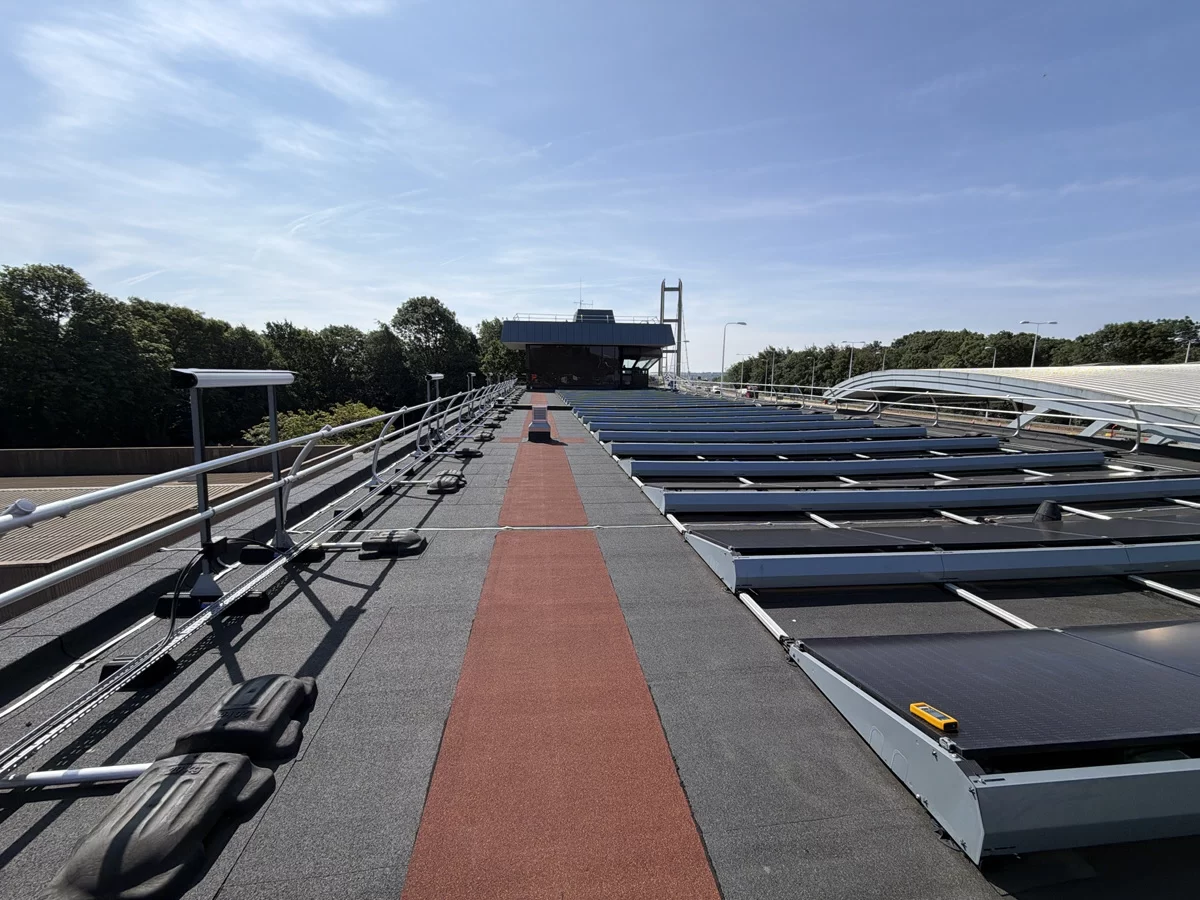
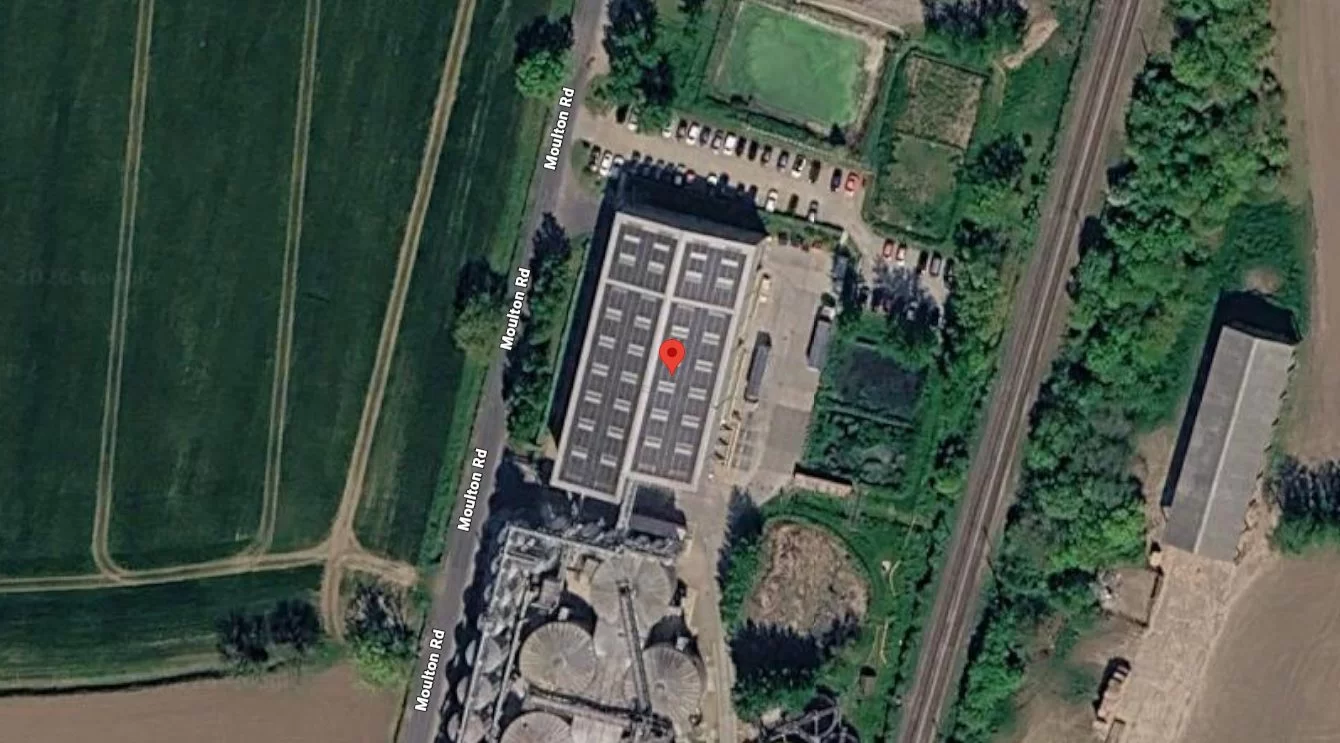
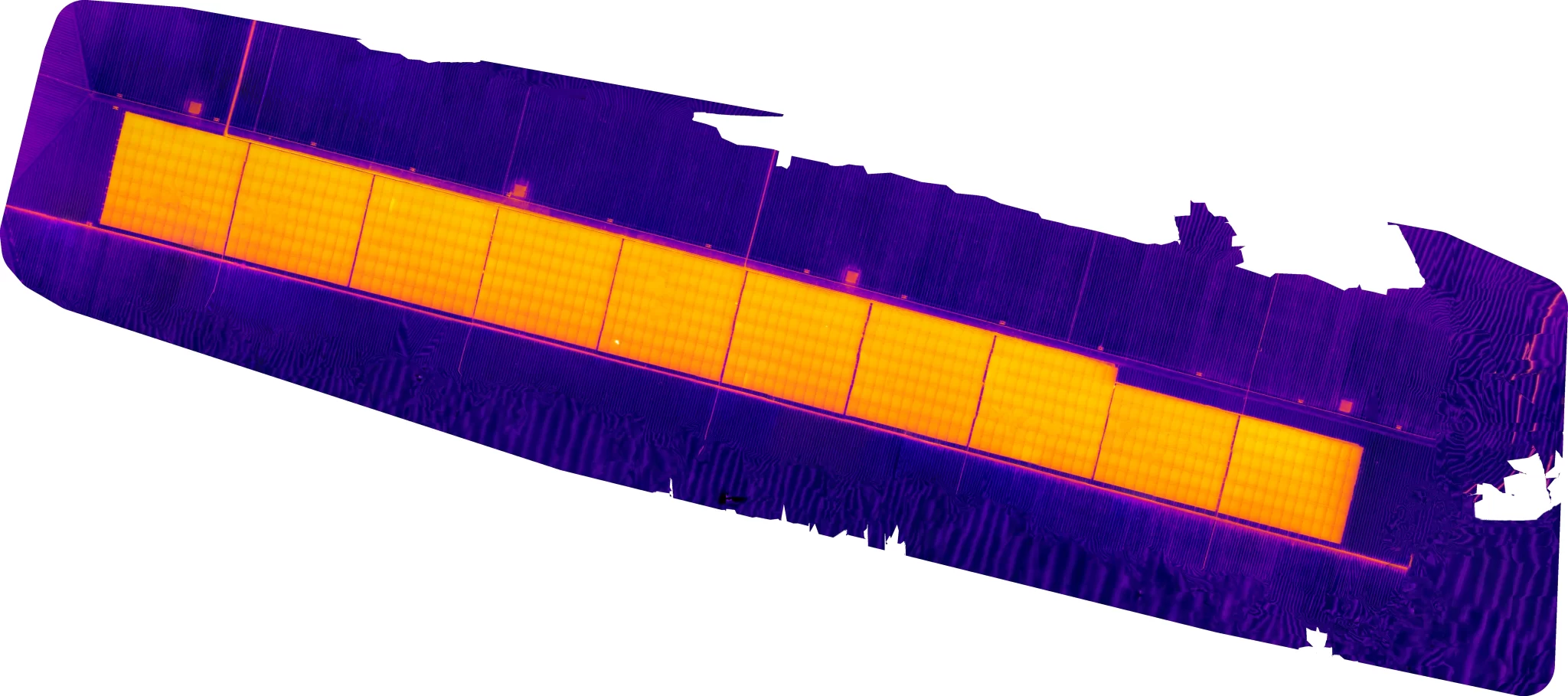
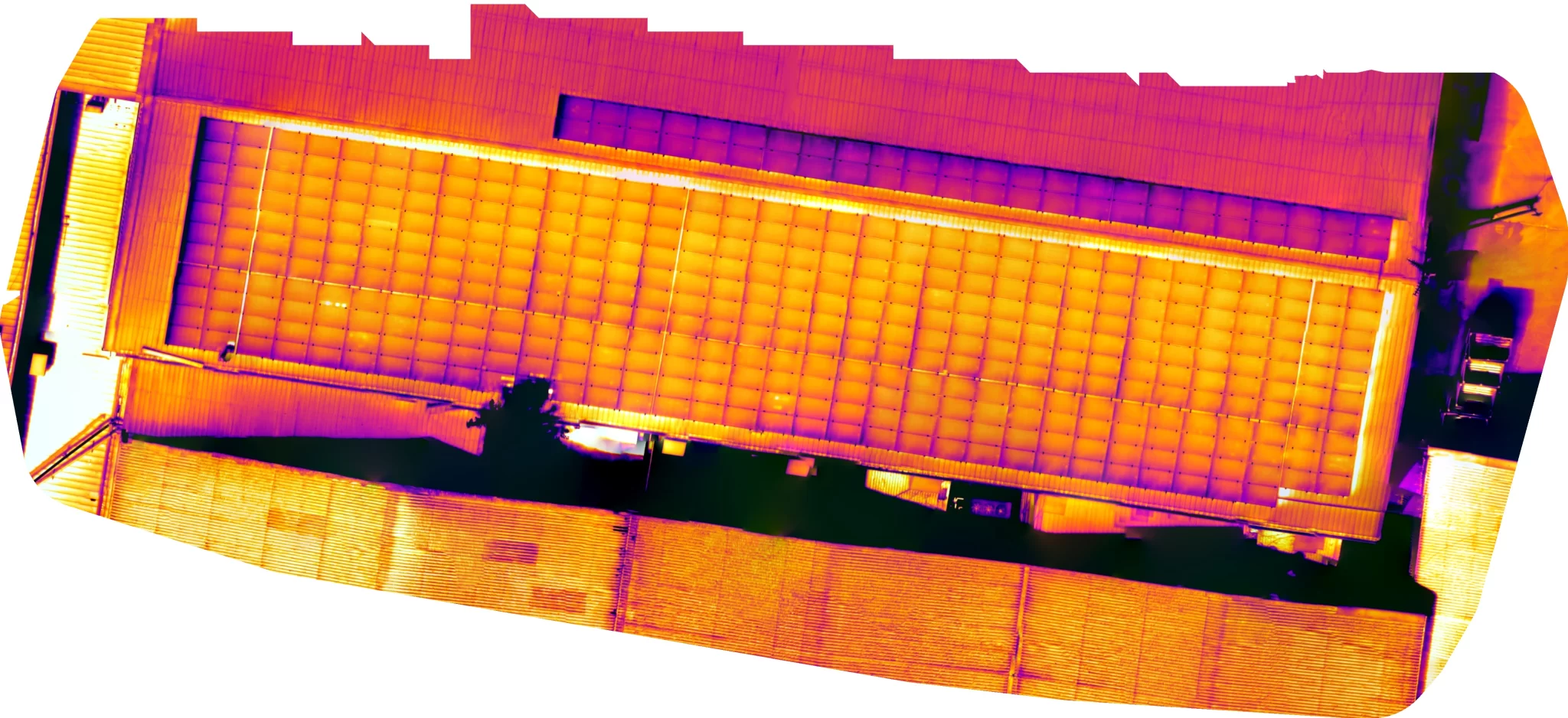
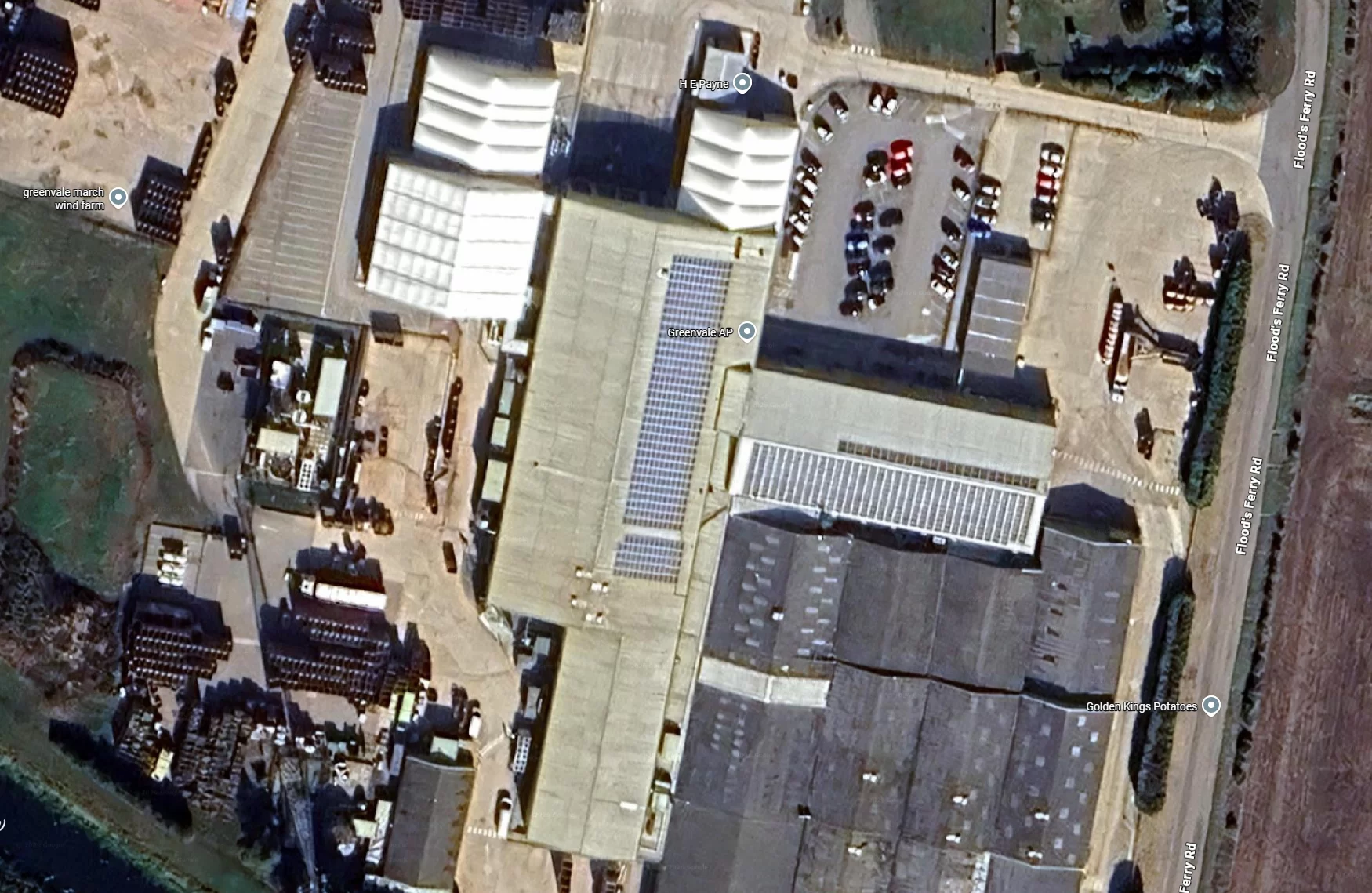
A commercial food manufacturing site in the East of England commissioned a solar PV thermographic inspection of the rooftop array serving its operation. The installation dates from the early 2010s and spans two roofs, one a large slope facing predominantly south with its first two rows set over the ridge and facing north, the other essentially east facing. Between them the roofs carry 808 modules across 37 strings and 11 inverters, rated at 165 kW AC. No array layout diagram, commissioning documentation or previous thermal report was available, so the survey had to establish the array’s own map before it could say anything about its condition.
Photovoltaic modules give away their electrical condition thermally. A cell that is shunting, an interconnect that has degraded, a bypass diode that is not doing its job, all of them turn electrical energy into heat instead of current, and all of them show as a temperature difference against modules working normally alongside them. That is why the comparison matters more than the absolute number. Each anomaly is measured against a healthy reference module of comparable orientation within the same thermogram, so the reading reflects the fault rather than the weather.
The inspection was delivered by Drone Media Imaging, a trading name of VisualChaos Studios Ltd, as a thermographic survey only. No electrical testing was carried out, no inverter or switchgear was accessed, and nothing intrusive was undertaken. The findings describe how the array behaved thermally on the survey date and identify what warrants further investigation by a suitably qualified electrical contractor.
Governing Standards
- IEC 62446-3:2017 sets out the requirements for thermographic inspection of photovoltaic systems, including the environmental conditions under which a survey is valid and the way anomalies are identified against healthy reference modules.
- ISO 18436-7 is the condition monitoring and diagnostics framework for thermography personnel, and is one of the frameworks on which our Level 3 Master Thermographer’s Infrared Training Centre certification is built.
How was the solar PV thermographic inspection carried out?
How the Rooftop Solar PV Thermographic Survey Was Carried Out
IEC 62446-3:2017 is specific about when a thermographic survey can be considered valid, because a module that is not working hard does not reveal much. The standard sets a minimum of 600 W/m² of in-plane irradiance, limits on wind, and a requirement for stable cloud conditions. On this site irradiance was measured in the plane of the array at the start of the first zone and again at the close of the second, reading 941 and 827 W/m². Wind averaged 2.6 m/s against a working limit of 7, cloud held at one to two oktas with no cumulus development, and the array remained under normal operational load throughout.
Data was captured by drone at 20 m above the module surface, giving a 2 cm ground sample distance, which is close enough to resolve behaviour at individual cell level across an array of this size. Environmental and radiometric parameters were logged on site with industry-grade instruments, and reflected apparent temperature was measured directly from a sky thermogram rather than calculated, which removes one of the commoner sources of error in outdoor radiometry.
Because no layout documentation existed, an array control map was built for each zone from the survey imagery, giving every module a column and row reference so findings could be located precisely and revisited at a future inspection.
- Included: qualitative thermographic survey of all accessible module-facing surfaces across both zones, anomaly classification against IEC 62446-3:2017, an array control map per zone, and a certified Level 3 report.
- Not included: electrical testing of any kind, inverter or switchgear access, intrusive investigation, and remedial or corrective work.
What did the solar PV thermographic inspection find?
Thirty one findings were classified across the two zones. Six carried a Safety consequence and five of those were Critical, the highest severity in the IEC 62446-3:2017 taxonomy. All six were cell-level conditions, discrete and contained within individual cell boundaries, with a morphology consistent with localised shunting or interconnect failure producing sustained resistive heating at the point of the fault. Six separate locations recorded apparent temperatures above 95 °C and five more sat between 80 °C and 95 °C. Above roughly 85 °C the encapsulant that seals a module is past its thermal degradation threshold, so softening, discolouration or delamination would be expected, which compromises the moisture seal and feeds back into the thermal condition.
The east-facing zone carried a second and quite different picture. Potential induced degradation was identified on nine separate module columns spanning almost the full width of the array. The diagnostic signature is a gradient warming from the module frame toward the centre, repeating consistently across adjacent modules in a common column, which follows the distribution of sustained voltage stress along a string rather than the random scatter of a manufacturing or installation defect. Every differential recorded was modest, placing the condition early in its development. Alongside it the array carried bypass diode findings, current-limiting modules, and a group of modules showing the uniform whole-module elevation associated with modules not delivering current to the inverter.
What did the asset owner get, and what happens next?
The deliverable was a certified report signed off by our Level 3 Master Thermographer, carrying 34 annotated thermogram pages, an array control map for each zone, and the full environmental and radiometric record for the survey. Every finding carries two classifications, an IEC 62446-3:2017 severity for the thermal magnitude and a Drone Media Imaging Consequence Classification, which translates that magnitude into what it means for the asset owner: Safety, Yield, or Degradation Trajectory. Severity alone does not tell an owner what to do first. The second axis does.
That distinction shaped the recommendations here. The six Safety findings warrant immediate investigation, because a credible risk to the building fabric exists while they remain live. The degradation identified across the east-facing zone is a different kind of priority: individually modest, but present across nine columns, and early-stage presentations of this condition are recognised as responding to treatment in a way that advanced degradation does not. That window is worth knowing about while it is open.
- Escalate the Safety findings to a suitably qualified electrical contractor for immediate investigation.
- Treat the degradation findings as a distinct programme, assessed on their own timescale rather than folded into the safety work.
- Use the array control map and thermogram set as the baseline record for comparison at the next inspection.
- Establish a reassessment interval, since the value of an early-stage identification depends on tracking whether it moves.
Why the array map mattered as much as the thermograms
An array with no layout documentation is difficult to act on, because a finding that cannot be located is a finding that cannot be fixed. Building the control map from the survey imagery gave every module a column and row reference, so a contractor arriving on the roof knows which module to open, and the next survey has something to compare against rather than starting over.
Know what your rooftop array is actually doing
Drone Media Imaging carries out IEC 62446-3:2017 solar PV thermographic inspections on commercial rooftop and ground-mounted arrays, reported and certified at Level 3. Every finding is classified for thermal severity and for what it means commercially, so you know what to investigate first rather than being handed a list. We work across Sussex, Hampshire, Kent and Surrey, and travel throughout the UK, Ireland and Europe.