
Solar Farm Inspections: Ground-Mount and Utility Scale
Thousands of Modules. Which Ones Are the Problem?
A ground-mount array is not a rooftop array with more panels on it. The scale changes what a survey has to prove, how the flight is planned and how the findings have to be organised to be usable. Drone Media Imaging has flown more than five hundred solar missions over the past five years, a large share of them on ground-mount and utility-scale sites, and inspects to IEC 62446-3:2017 with the analysis carried out by an ITC Level III Certified Master Thermographer.
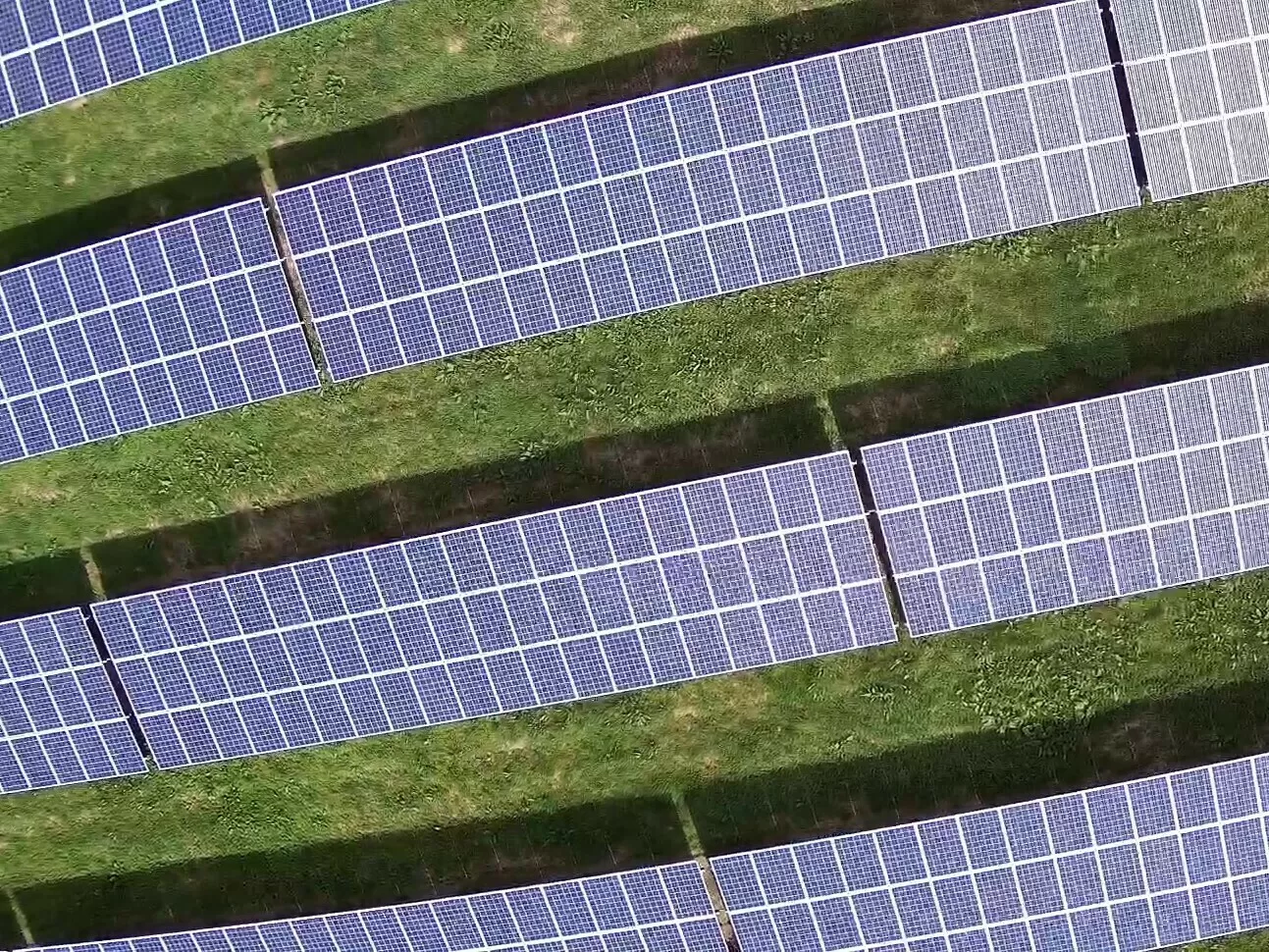
Thousands of Modules. Which Ones Are the Problem?
On a solar farm the problem is rarely that nobody knows something is wrong. Generation data usually says as much. The problem is that the data tells you a string is underperforming and says nothing about which of the several hundred modules on it is responsible, or why, or whether it matters this month or next year.
Walking the rows to find out is slow, and it is also unreliable, because most of what you are looking for is invisible at eye level. A module with a failing cell, a bypass diode that has gone, a junction box quietly cooking behind the laminate: none of it announces itself to somebody standing in front of it on a bright afternoon.
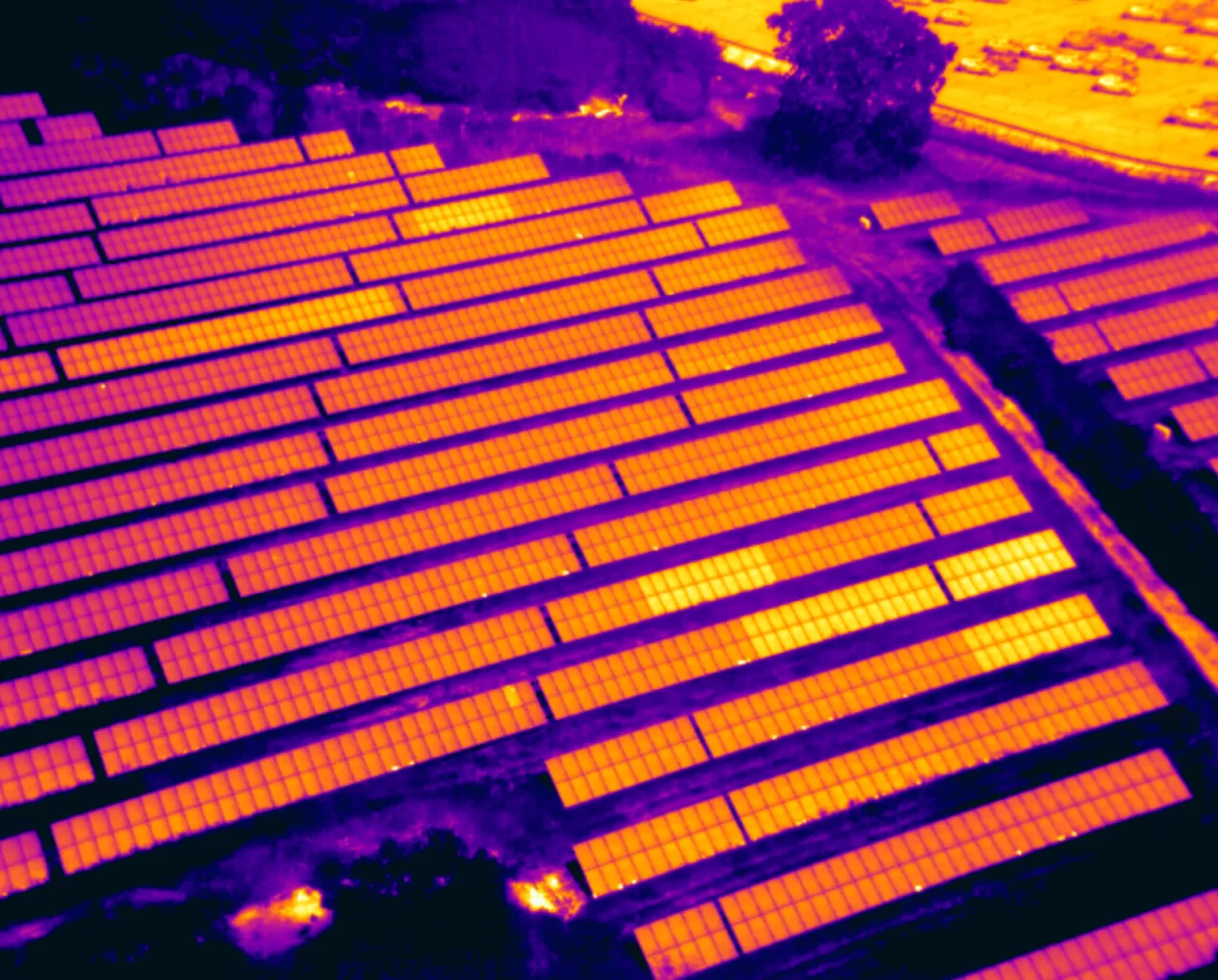
A thermographic survey resolves the whole site in a few hours of flying, module by module, and returns a list of what is wrong with each item located precisely enough for a technician to walk straight to it. Drone Media Imaging has flown more than five hundred solar missions over the past five years, a large share of them on ground-mount and utility-scale sites, so this is routine work rather than an occasional undertaking. It is carried out in line with IEC 62446-3:2017, and the analysis is done by an ITC Level III Certified Master Thermographer rather than handed back to you as imagery.

Why Scale Changes the Job
Finding the fault is easy. Finding it again is the hard part.
A rooftop array and a solar farm need the same physics and a completely different plan. On a roof, a finding can be described in a sentence and somebody will locate it. On a site of many thousands of modules laid out in near-identical rows, a finding that cannot be pinpointed is close to useless, because the cost of hunting for it exceeds the cost of the fault.
So the discipline that matters at scale is not detection, it is bookkeeping. Every module has to be imaged, every image has to carry its position, and every anomaly has to come out of the analysis tied to a row, a table and a place in it. Get that right and the report is a work list. Get it wrong and it is an interesting document that nobody can act on.
The flight is planned around that requirement rather than around covering ground quickly. Altitude and path are set so that each module is resolved properly rather than merely appearing in frame, and the path is flown square to the tables so nothing is captured at an angle that distorts what it is telling you. Larger sites are flown in blocks, with the environmental conditions logged through the survey rather than recorded once at the start and assumed to hold.
That last point is where large sites most often come unstuck. A survey that begins in valid conditions and runs into cloud is not a valid survey for the part flown afterwards, and a report that does not say so is hiding something. We assess the window against a calibrated forecast before mobilising, which is a very different thing from arriving and hoping.
At a glance
What a ground-mount or utility-scale solar farm inspection involves, and what you get back.
- More than five hundred solar missions flown over the past five years, a large share of them on ground-mount and utility-scale sites. This is routine work.
- Every module imaged, not a sample. A partial survey tells you the site has faults. It does not tell you where they are, which is the only part you can act on.
- Findings located precisely enough to walk to. Row, table and position, so a technician is sent to the module rather than looking for it.
- Severity classified against the standard’s own categories, so remediation can be prioritised rather than treated as one undifferentiated list.
- Flown to IEC TS 62446-3:2017, with conditions assessed against a calibrated irradiance model before we mobilise rather than hoped for on the day.
- Analysis by an ITC Level III Certified Master Thermographer, not by the pilot who flew the capture.
- Optional IEC 62446-1 string testing for the faults that produce no heat at all and will never appear in a thermal survey.
- We do not carry out the remedial work, so there is nothing being sold to you on the back of what the survey finds.
Generation data tells you something is wrong. This tells you which module, and whether it can wait.
Related Solar Survey Services


What the Survey Finds, and What It Is Worth
Sorted by what deserves attention, not by what is easiest to see
A thermal survey of a solar farm finds a spread of things that behave very differently from one another, and the value of the report is largely in telling them apart. Some findings are cosmetic and will be the same in five years. Some are costing you generation now. A small number are a safety matter and want attending to regardless of what they are costing.
Single cells running hot, whole substrings dropped out because a bypass diode has failed, modules disconnected entirely, junction boxes overheating, and progressive patterns across a table that point at something structural rather than at individual units: each has a different signature and a different consequence. Classifying them properly is the difference between a report that guides a maintenance budget and a spreadsheet of anomalies.
The report is therefore organised by severity first and location second, and it says plainly what warrants further investigation by a suitably qualified contractor rather than pretending to have diagnosed a root cause from a thermal image alone. Where the imagery cannot support a conclusion, it says so. Findings are cross-referenced to the visual imagery captured alongside, so an anomaly can be checked against what the module physically looks like rather than inferred from heat by itself.
Drone Media Imaging does not carry out remedial work, and that is deliberate rather than a limitation. An inspector who also sells the repair has an interest in what the inspection finds, which is precisely the conflict the standard’s own independence clause exists to avoid. The findings go to whoever maintains the site, and we have nothing at stake in how many there are.
IEC 62446-3 Thermographic Inspection of an 8 MW Ground-Mounted Solar Farm
A full-array thermographic survey of an 8 MW ground-mounted solar farm, flown to IEC 62446-3:2017 with the conditions logged on the day and the path set perpendicular to the strings. Findings ranged from isolated hotspots and sub-string heating to bypass diode signatures, soiling and vegetation shading, each classified for severity and located against matching high-resolution imagery, with a prioritised action list for the site’s maintenance team.
Planning a Survey on a Working Site
The practical constraint on this work is the weather rather than the flying. Thermal imaging of a photovoltaic array is only valid while the modules are generating strongly and their temperatures are stable, which in UK conditions produces a usable window of roughly four hours on a suitable day, and a great many days that are not suitable at all.
That is why we assess the window against a calibrated forecast model before mobilising rather than booking a date and finding out on arrival. It is also why a site three hours away is a different proposition from one nearby: the further the travel, the more the decision has to be made in advance and the more it matters that the decision is made on something better than a general forecast.
On site, the survey is unobtrusive. There is no need to shut anything down, no interference with generation, and no requirement for anyone to walk between the rows during the flight. Larger sites are flown in blocks with a clear record of which block was flown under which conditions, so nobody has to take on trust that the last hour was as valid as the first.
Where a fuller picture is wanted, string-level electrical testing to IEC 62446-1 can be carried out alongside. That matters on a solar farm more than anywhere else, because some genuinely expensive faults produce no heat at all and a thermal survey on its own will never see them. Reported together, against a single set of conditions on a single day, the two are directly comparable in a way that two separate visits never are.
Our reach is national. We work across Sussex, Hampshire, Kent and Surrey as home ground and travel throughout the UK and Ireland for site work of this kind, which is normally planned rather than urgent and can therefore be scheduled against the weather rather than against the diary.
The cells in a solar module are wired in series, one after another, which means the current passing through all of them is limited by the worst of them. Shade one cell with a leaf and the whole module drops to what that shaded cell can pass. Worse, the healthy cells go on pushing against the obstruction, and the blocked cell absorbs that energy as heat instead of producing power.
A bypass diode is the component that stops this becoming serious. Modules are built with two or three of them, each looking after a group of cells. A diode is a one-way valve for electricity: it normally does nothing at all, but when the group behind it starts obstructing rather than generating, it opens a path around that group. The module loses the output of one section and carries on producing from the rest, and the obstructed cells stop cooking.
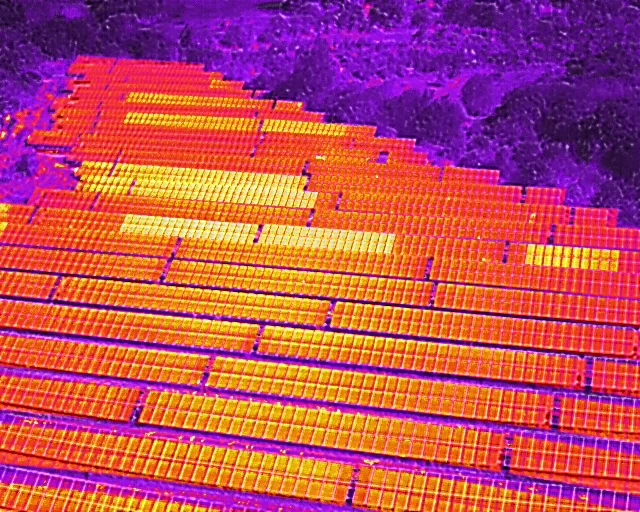
Which is why a failed diode is worth finding. When one fails open, the protection is simply gone, and a shading or cell problem that would have cost you a third of one module can instead pull down the whole string it sits in. It is also why a thermal survey reads a solar farm so well: an active diode leaves an unmistakable pattern, a clean block of the module running at a different temperature from its neighbours, and that pattern says which section and often why.
Diodes are a consumable in practice rather than a permanent fitting, and they fail quietly. Nothing alarms, generation drops by an amount easily lost in the noise of weather and seasons, and on a site of many thousands of modules the loss accumulates unnoticed until somebody looks.
- IEC TS 62446-3:2017 is the technical specification for outdoor infrared thermography of photovoltaic modules and plants, and it governs the conditions, method, competence and reporting of every survey on this page.
- IEC 62446-1:2016+A1:2018 covers electrical testing, documentation and commissioning verification for grid-connected PV systems, and governs our optional string-level testing.
- ISO 18436-7:2014 sets the international framework for thermographic condition monitoring personnel, and our analysis practice is aligned to it, alongside ASNT SNT-TC-1A and ANSI/ASNT CP-105.
- Survey conducted by Steve Fisher, ITC Level III Certified Master Thermographer (Infrared Training Centre; Certification #205722059), holding iRed Academy Thermal Imaging Category 2 and Drone Thermography Category 1.
- Flown under CAA Operational Authorisation, with GVC and A2 CofC, and fully insured for commercial operations across the UK, Ireland and Europe.
Scope a Solar Farm Survey
Tell us where the site is, roughly its capacity or module count, and what the survey has to settle, whether that is an unexplained shortfall against expected generation, a commissioning obligation, an insurer’s question or a scheduled maintenance cycle. We will scope it and come back with a fixed price. Site size and location determine cost on this work, which is why we quote rather than publish a rate card. Quotations and consultations are free. Say too whether you want string testing alongside, because that is decided at the scoping stage rather than added later.